
Lund’s Tower: The Yorkshire landmark with mystery surrounding its history
Lund’s Tower and Wainman’s Pinnacle are landmark stone-built follies on the ridge overlooking the main road between Cross Hills in the Aire Valley and Colne in Lancashire.
Locals have long referred to them as the Salt and Pepper Pots.
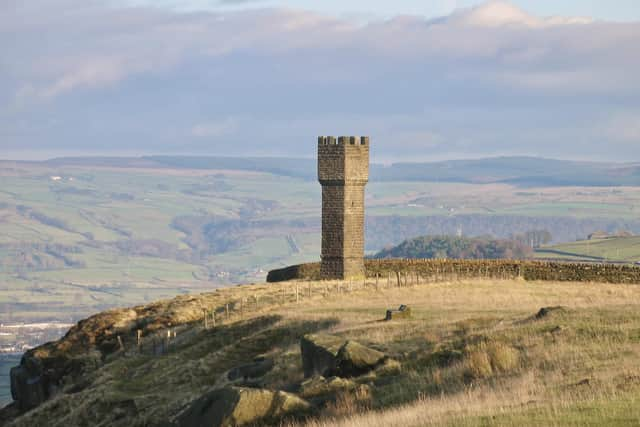
A square structure located at one end of a long gritstone outcrop called Earl Crag, Lund’s Tower is the more visually striking of the two.
Set on a low plinth, it is almost 40ft tall and adorned with crenellated battlements which are corbelled - projected out - from the main part of the tower.

Inside, a spiral staircase of 39 steps leads to the top from where there are fine long-distance views.
Built from squared, dressed gritstone the tower looks like a slender castle.
It dates from 1887 and was commissioned by a wealthy textile manufacturer James Lund (1829-1903), who lived down in the valley at Malsis Hall, an Italianate-style mansion which later became a public school.
He employed the Keighley architectural firm of R. B. Broster to design a monument that could be seen from his gardens, but the precise reason for its construction has been the subject of discussion over the years.
Unhelpfully, words on a plaque fixed to one of the walls have been weather-eroded, and there is even a suggestion that it might never have been engraved.
One clue might be in the name by which the folly is known by some people living in the nearby villages of Sutton-in-Craven and Cowling.
Perhaps with the words Eiffel Tower in mind, they refer to it as the “Ethel Tower”. The eponymous Ethel was one of Lund’s daughters and it is suggested the tower was built in her honour.
However, another local name is the “Jubilee Tower”, and since Queen Victoria’s Golden Jubilee celebrations in 1887 occurred when it was constructed that seems the more probable explanation.