
Marton-cum-Grafton: The sought-after Yorkshire village which is rich in history
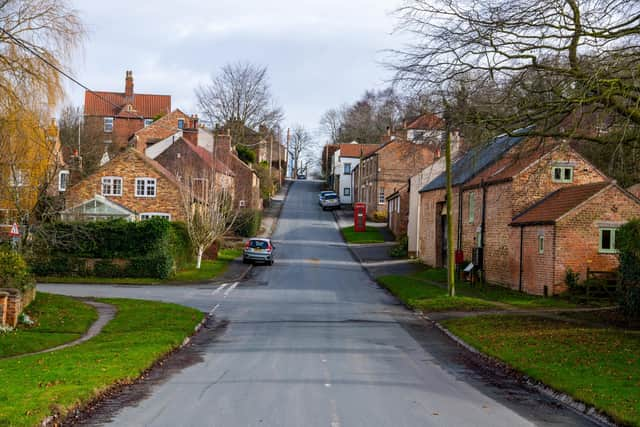
While opinion differs over whether Marton cum Grafton is one or two villages, its reputation as one of Yorkshire’s most sought-after places to live has long been cemented.

“So exclusive most people can’t even pronounce it properly", according to one Yorkshire-based website. “If you know someone who lives here, they definitely went to private school."
Although that assessment might be bit tongue-in-cheek, numerous estate agents have often placed it in Yorkshire’s pricey Golden Triangle, despite it being several miles to the north of the traditional York-Harrogate-Leeds property hotspot.
Good schools, an attractive historic pub, an award-winning village store stocked with a fine range of treats and fresh goods, properties protected by a conservtion area since 1979, quiet roads and large gardens are said to contribute to the village being desirable for property-hunters.

Secondary school pupils from the villages travel to nearby Boroughbridge or Knaresborough, but Marton-cum-Grafton has a Church of England primary school.
Last year it received a top ranking from Ofsted for the quality of education, behaviour and attitudes, personal development, leadership and management as well as early years provision. Inspectors found pupils had a strong understanding of the local community. Significantly, the 15 staff and 97 pupils celebrated the rating with the community.
Nearby, on Church Lane, stands Christ’s Church, which was recorded as All Saints in Pope Nicholas’s Taxation of the 11th century. Elements of the ancient property remain, but it was badly damaged by Scots invaders in the 14th century and became a ruin before somewhat controversially bein rebuilt by a Victorian vicar, using the original stone.
Other historic properties in the village include the former vicarge, Grafton Manor and Beck Farmhouse which is thought to have been built in the 17th century.
Marton-cum-Grafton has even more ancient origins. It has developed around a hummocky landform created by glacial deposits, with Grafton to the north still separated from Marton by fields and a bend in the road.
Until 2008, underground boreholes at Marton provided the water for 15 villages in the area, with the system including landmark water tower on Grafton Hills between Marton and Grafton, at 75m above sea level.
In 2007 an isolated cist burial, consisting of a lead-lined oak coffin and the skeleton of a 30 to 45 year old male, was discovered by a metal detectorist on a field near Hundayfield Farm beside the York to Boroughbridge road, once known as Dere Street, the Roman route from York to Catterick.
The cist was sited on a low spur of land projecting eastwards into the Vale of York at 35m above sea level and just 3.5km south of Aldborough, the Roman civitas capital Isurium Brigantum.
Isotope analysis has indicated the man had migrated to Roman Britain, probably from southern Italy or Spain. Such burial finds are vanishingly rare, with a late third century example from Trentholme Drive in York being the closest comparable example nationally.
In 1890, near the site of the original church and Marton Old Hall, in the field called Hall Garth, off Legram Lane, a Neolithic hand axe, which was used as both hoe and hammer, was unearthed.
After it was taken to York to be displayed in a museum archaeologists said they believed it to be 6,000 years old, making it contemporary with the Devil’s Arrows monoliths at nearby Boroughbridge.
A further dig in 1950 unearthed an Iron Age hill fort revealed Grafton Hills. To the west, quarrying of the hilltop immediately to the south of Grafton and to the east of Marton in the 1950s exposed the footings of curvilinear structures and an enclosing wall, apparently of Iron Age date.
Marton-cum-Grafton, which still had thriving self-contained communities at the end of 19th century, also boasts community tennis courts by a pretty sports ground in woods off Thorneyhill Lane, which also serves as home to the village ccket club and features a playground.
Efforts have been made to make the area of use to the whole community. For example, a walking football group there has seen players in their 80s regularly taking part.
Other distinctive green areas in Marton-cum-Grafton include small lawned areas at the junctions of roads and surrounding the Millennium Sundial, near the junction of Grafton Lane and Town Street. People are invited to stand on the sundial so their shadow tells the time.
The villages have three gardens in the National Gardens Scheme which are open by arrangement visits from May to June for groups, while visits can be booked for smaller parties on specific dates.
High on the hill, Paddock House in Marton offers a combination of cottage garden and Mediterranean styles and fine views.
Like many village pubs, the Punch Bowl serves as a community focal point, but has seen its fortunes ebb and flow. In the 1950s, the inn was converted into a “roadhouse” for motoring enthusiasts, which proved popular as the Great North Road at the time had no speed restrictions.
Just 18 months ater buying the property in 2008, carrying out a major refurbishment, filming a TV series and launching a microwbrewery there, former Men Behaving Badly star Neil Morrisey and TV chef Richard Fox called time on the venture.
in 2021 the pub was awarded an AA Rosette for top quality ingredients, culinary expertise and attention to detail and the following year it was named best venue in Yorkshire and the Humber, at the annual National Pub and Bar Awards.
However, in January, the 16th century grade II listed Punch Bowl inn was put on the market for £695,000.
Agents described the premises as “rich in atmosphere, with exposed beams, open fires and a series of intimate rooms that lend themselves naturally to relaxed but refined dining”.