
Marton Mills cloth: Woven in Yorkshire and worn on the catwalk - and by Claudia Winkleman
As worn by Claudia Winkleman, school girls and the military, Marton Mills' beautiful tweeds, tartans and other cloths are Yorkshire born and bred. Yorkshire Post Fashion Editor Stephanie Smith visits the mill.

On the banks of the River Wharfe, Marton Mills weaves exquisite tartans and tweeds and sends them out across the world. Even those not familiar with its name will almost certainly have seen its beautiful fabrics without realising that they were made right here in Yorkshire.
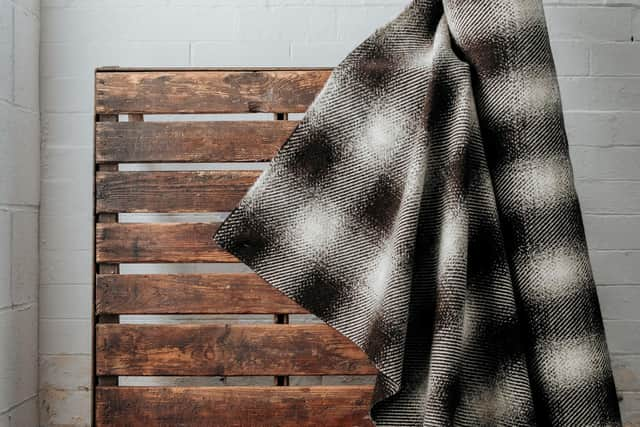
Sought for their durability as well as their depth and richness, Marton Mills cloths are used for ceremonial military wear, for school uniforms, soft furnishings, and increasingly for fashion.
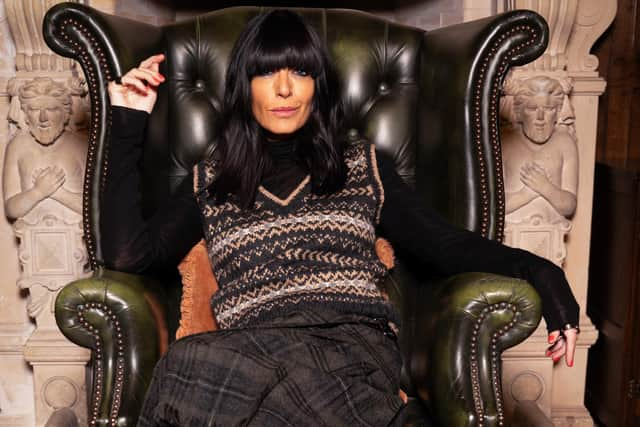
Super-cool Scottish brand Le Kilt chose Marton Mills Heath Charcoal Bog Tweed to craft into a beautiful kilt worn by Claudia Winkleman on The Traitors series four. In fact, Marton Mills makes for many fashion brands, large and small, in the UK and abroad, for luxury, high-end fashion houses as well as for well-known high street and online names – although it cannot say too much about it.

“Most of our high street customers are protective of where they get their fabrics from,” says managing director Laura Watts. Chairman Duncan Watts, who is Laura’s father, adds: “Because that's their intellectual property right, that they deal with us, and they don’t want others to come here and copy their designs.”
Marton Mills is launching its British Wool Collection, focusing on sustainability, woven from pure British wool, some of which is undyed, from local sheep, such as Masham sheep, creating cloth from fleece to fabric within a 50-mile radius, suitable for fashion and for furnishings.
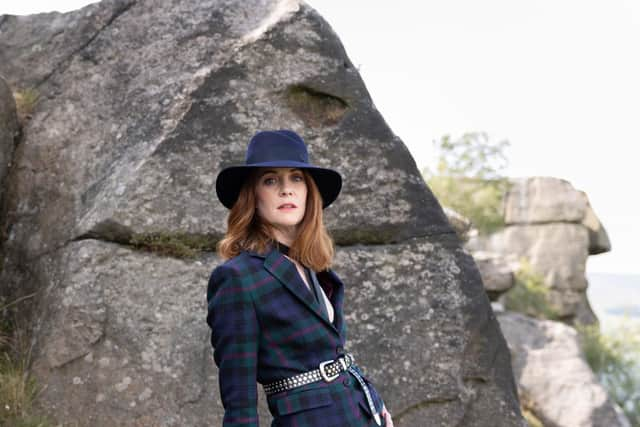
There are three ranges: Leathley, with its iconic heritage patterns; Brimham, inspired by the sculptural rocks of its namesake; and Ingleton, a bold fabric echoing dramatic northern landscapes.
British Wool has been working closely with Marton Mills. “There's a range that we’e launching for fashion,” says Laura, adding that she hopes it will be used to create tailored jackets and coats by some high street brands.
The range will be perfect for brands who value sustainability and want to promote British manufacturing and its heritage.
Duncan says: “We need Britain to find its manufacturing base again. We're adding value, and that as a country is what we should be doing, isn’t it? We can’t rely on retail for everything.”
Born in Scunthorpe, Duncan trained as an accountant and worked at Price Waterhouse in Leeds for five years before branching into industry. His family were weavers in Strathaven in Scotland, from about 1750. “Just ordinary textile workers. But it’s in your blood,” he says.
Marton Mills began life in 1931, knitting jersey fabric from a mill in Marton Street in Skipton. In 1972 it was taken over by Bodycote International, but production ceased in 1977. When Dovecote decided to sell its textile companies, the Watts family acquired Marton Mills in a management buyout in 1981, and started manufacturing again in 1984.

"Not knitting, but weaving because that was our forte. The major companies were moving out of school wear, because it didn’t give adequate margins for them, but we felt that we could make a living from it,” says Duncan.
They bought eight second-hand machines from France and installed them at their plant at Tong Park. When the lease ran out in 1996, they bought their current home, a much bigger mill at Pool in Wharfedale, near Otley.
Today Marton Mills provides fabric for ceremonial dress for the Royal Navy and the RAF. It is also the UK’s largest supplier of school wear fabric, used in particular for private school girls’ skirts, kilts and blazers, including in Yorkshire for the Grammar School at Leeds, Ashville and Gateways.
“The bill that is going through at the moment, stating that schools have to reduce their number of compulsory branded items to three, is going to have an impact on our industry,” says Laura. “It remains a very important market for us but we’ve seen a decline due to price pressures. We’ve picked up other areas and diversified into other markets.”
Laura joined the family business 17 years ago. “I originally trained as a nurse,” she says. “I’d gone down to London and worked at Harefield Hospital in cardio-thoracics.
"We just had a conversation, about succession planning and what was going to happen to the business. I didn’t look back from there.”
Her brother Richard is on the board, having worked in the business for nine years. He has his own business in Harrogate, Dishang Cherry, representing a large garment manufacturer in China.
The Marton Mills’ team works closely with all its clients, from fashion brands to couples planning their wedding party outfits (its tartans are used in Scottish Highland dress). There are three in-house designers using modern realistic CAD systems to create the designs.
Fashion is now the fastest-growing area, thanks to marketing and international shows, and exports have increased significantly over the last five years – about 22 per cent of Marton Mills’ cloth goes overseas.
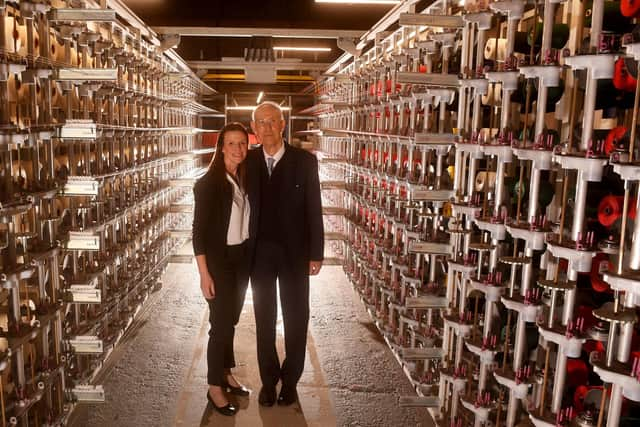
About 50 people work at Marton Mills, just over two-thirds in manufacturing, with a night shift and a day shift. “So we don’t stop the machines at all, it’s continuous,” Duncan says.
“We have 20 weaving machines, three different types,” says production manager Rob Brannan on a tour of the mill. “There’s still quite a bit of hand work.” All the pieces go to mending, most to an outmenders, but more expensive woollens are done in-house, before the fabric goes to finishing – cleaning and putting on a finish, to give a lustrously soft drape. Duncan says: “Our skilled workforce is the backbone of our business, and our finest asset.”
martonmills.com