
Medieval tomb hidden under city streets back at York Minster for first time in 500 years
Much mystery and intrigue surrounds the life – and death – of St William of York with many stories of disputes, murder, and divine intervention.

Now fragments of a medieval shrine dedicated to him as the city’s patron saint have returned to York Minster for the first time in almost 500 years.
And with a landmark exhibition, framed by a special cinema experience, experts delve deeper into history to shine a light on its untold past.
Dr Jennie England is the Minster’s research coordinator, who curated the exhibition and who herself features in the new film.
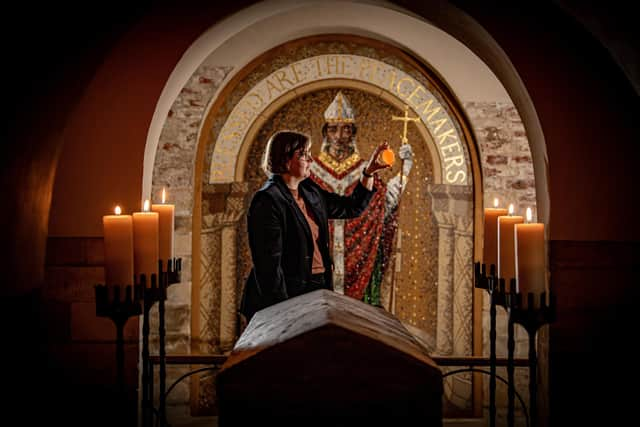

This year marks the 800th anniversary of St William’s canonisation, she said, presenting an opportunity to reflect on his legacy.
"The return of these fragments of St William’s shrine to York Minster after nearly 500 years is hugely significant," said Dr England.
"Although our methods would be unimaginable to the craftspeople who created this medieval masterpiece, our commitment to ensuring that as many people as possible can connect with this holy and historic individual is much the same as theirs."
The life of St William of York is said to have been shaped by faith and devotion, but with his legacy one of controversy and intrigue.
Although a much-loved figure by many in the city, William’s two appointments as Archbishop of York were also riddled with political and religious disputes.
When he became violently ill celebrating Mass, rumours had quickly spread that his communion chalice had been poisoned by one of his enemies. The true circumstances surrounding William’s untimely death, experts admit, remain an unsolved mystery.
There were many miracles too, attributed to his divine intervention, as pilgrims sought help and healing at his tomb and he was proclaimed a saint by Pope Honorius III in 1226.
But under English Reformation, a vast two-storey shrine which had been built over the site of his tomb was dismantled and buried beneath the streets of York.
Experts say the care which was taken to hide the pieces might suggest a hope that one day the shrine would be found and restored.
Now, in the new exhibition: St William of York: Life and Legacy, visitors will have the rare chance to see fragments that survive inside the Minster itself.
Rediscovered in excavations and cared for in the Yorkshire Museum, they have been lent to the cathedral by York Museums Trust.
Scanning the pieces, visual effects studio Viridian FX has been able to bring the medieval structure to life, with a digital reconstruction of the shine at the centrepiece of a new film by Hewitt & Walker.
Dr England said the treasures, with pieces selected by the collections team, are to share the life of a man who “devoted himself to city and cathedral”.
“We invite everybody to come and discover the film and exhibition and encounter a patron saint whose influence still resonates 800 years after his canonisation,” she said.
The exhibition opens tomorrow and will run through this year.