
Meet the expert textile weaver who has the biggest collection of fabrics and patterns outside of London
Richard Smith calls it a passion – but admits that it’s a bit of an obsession as well. He tells Phil Penfold about his extraordinary collection that documents the art of the fabric-weaving industry.
On the way back from a European trade trip, and eager to conclude a major deal, Bingley businessman Richard Smith was at the airport with his wife Lynne, waiting for their flights home. Then came the news. There had been a major incident, thousands of miles away, and all air travel was cancelled. The date? September 11, 2001. The day of infamy that saw the collapse of the Twin Towers in New York City, after an unprecedented attack by al-Queda.
The knock-on effect for millions of people still cannot be estimated. For Richard, 66, it put his businesses in peril, with that vital deal unsealed, and things were never the same again. “It’s so strange, isn’t it, that something happens, and that the consequences are never quite what you’d expect, or predict,” he says
The 9/11 attacks were just the start of a whole new life for Richard and Lynne, who live only a few yards from the world-famous Five Rise Locks. The fabric weaving firms established by Richard’s grandfather went under not after, and Richard can vividly remember the day that he had to tell an 80-strong workforce that their factory was closing. He was determined to tell them all personally – shirking his duty to be upfront and honest is not in his nature. “Who else could do it, but me?” he says quietly today, “it was one of the worst days of my life”. He had to find a new sense of direction, and he discovered it pretty quickly. Richard is now one of a small group of people who is an expert in the weaving trade, its history and heritage, and he has become the custodian of the biggest archive of artefacts connected with its development of fabrics and patterns, and the way that they were created, outside the Victoria and Albert Museum in London.
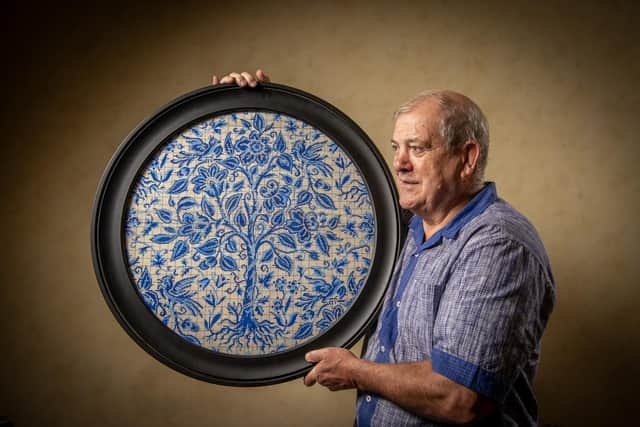

This vast collection is housed in a secret location in Bradford, and it has also taken over the entire ground floor of the couple’s home – as well as what was the spare room on the floor above. There are fabrics, there are remnants, there are patterns, there are pieces of equipment. It is a priceless cornucopia of what was once the biggest industry in Yorkshire and the north. Richard has become the go-to expert, much in demand as a speaker on the craft and its histor
Richard would love to find a permanent home for his bursting-at-the-seams collection, and wonders if it might be possible for it to be housed at the nearby Salt’s Mill. And he’d also love for an exhibition he mounted not-so-long back, called Patterns from the Past (which featured colourful classics of Jacquard point paper designs) to be revived and expanded, and to open as part of the upcoming Bradford Year of Culture.
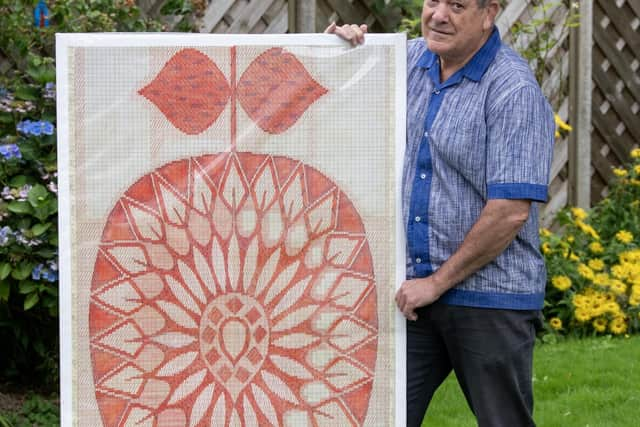
Lynne and Richard now own and run the Point Paper Art Company, which uses the archive – built up over the last three decades. Richard’s family were E and S Smith, which traded successfully, and which was a major name in the business, between 1935 and 2005. They were based at Stadium Mills, in Odsal. But it’s not just that business which is represented in the collection – Richard has been active in rescuing other priceless pieces from other businesses of the heyday of the weaving and manufacturing enterprises, sometimes in the nick of time, and just as they were about to be skipped, burned, or dumped. Point Paper Art offers unique framed pictures and prints of classic patterns, as well as notebooks and accessories either bound in, or made from, the original cloths. It is taking the art and design of the past to a wholly new audience and they are frequently found at events like the York River Art exhibition, and at fairs in venues in places as varied as Manchester and Bath.
The fabric lengths were originally woven as prototypes for designs and colourway trials which – nearly always – went into production. They were created by the Mill’s textile designers for a vast range of furnishing projects which were snapped up by major chains of hotels, cruise liners, domestic interiors and film sets around the world. These orders kept the mill busy (and profitable) for nearly a century. Some of them went into full production – others were just ideas, and never made it. It’s one of the best “back catalogues” in Britain, most of it is of museum quality. Anyone who buys something from the gifts and accessories range today gets a piece of Yorkshire weaving history.
Richard is also seeking an archivist who will start a comprehensive catalogue of the collection – but that may be some time off.
So what, exactly, is “point paper”? Well, before the advent of computer-aided deign (CAD), drawings of woven textile patterns were “translated” by skilled craftsmen onto special graphs, called “point papers”. These complicated drawings were then transferred by textile technicians, who created the weaving instruction cards that then made their way onto the looms. Think of an older player piano, where music was made by a long sheet of perforated paper being run over a metal cylinder. The loom cards were one hundred times more complicated, and “read” dot by dot, hole by hole. Richard still takes great pride in studying one of the point papers (and he has many thousands of them, mostly of them as vivid as the day that they were first drawn) and translating their “instructions”. It’s a skill that very few have in these computerised times. The cards themselves, with their perforations, are works of art in their own right. What Richard, Lynne and Point Paper are doing is the ultimate in re-cycling and re-purposing, making the past come alive for the visual pleasure of today.
The cards were a French invention, from Monsieur Joseph Marie Jaquard, in 1804. Jaquard narrowly escaped the guillotine, became favoured by Napoleon, and died an extraordinarily wealthy man. His name lives on, and his crowning achievement was to increase the speed of the weaving method – from nimble hands to mechanised reading. And, reveals Richard, his invention, instead of being superseded, gather momentum over the decades. In fact, his method of weaving designs has now been adapted to the computer age. “Nothing in this business ever stays the same.” Richard (who was educated at Giggleswick School) didn’t go straight into the family firm, as his father Stanley had done in his mid-teens. “I went into the timber trade,” he says. “And I’ve got plenty of stories about working practices at Hull docks that might well best remain undiscussed. Interesting business, back then.” He was lured back to the family mill by his father, and the rest is weaving history.
The archive is open to anyone wanting to research the Point Paper background for study, and it bring the inventive joy and colour of the artform to new audiences. Richard observes that so many things can impact on business and invention when it is least expected. For him, it was 9/11. The Foot and Mouth epidemics hurt the specialist makers of fabric rosettes hard. Fashion and tastes can change – there are few who make men’s neckwear these days – far fewer wear ties to work or for leisure. But things do return. William Morris and Arts and Crafts designs were in the wilderness for years, but are now in vogue again. For Richard, Point Paper and its many designs are a lifestyle. But are they an obsession or a passion? He says: “A passion, of course. A passion”. Then there’s a pause, and he adds: “But with quite a bit of obsession thrown in!”
www.pointpaperartcoshop.com