
Micklegate, York: The historic Yorkshire street with an incredible wealth of history
York’s Clements Hall Local History Group focuses on exploring the amazing history of the neighbourhood of Clementhorpe, Scarcroft, South Bank and Bishophill areas of York.
The organisation’s book about Nunnery Lane and Clementhorpe was judged joint winner of Best Community Publication 2021, in the CILIP Alan Ball Local History Awards.
The latest fascinating publication is Micklegate The Great Street of York. The area has an abundance of historic and trading information.
The book’s focus is on the use of the buildings and there is much about the street in the modern period which is sure to evoke memories from readers.


A start is made at Ouse Bridge, then a progression travels along Bridge Street describing each building.
This is before a journey past Skeldergate along the south side of Micklegate towards Micklegate Bar until returning back along the north side to North Street.
Micklegate may be regarded as the most handsome of York’s streets. In fact, architectural historian Pevsner concurred by saying: ‘[Micklegate] without doubt the most rewarding street in York’
Early records date from the 12th century when it was known as Myglagata, the Great Street, a thriving and prosperous quarter.
It passed through the former Roman colonia, but not on the original Roman road to the centre. Many examples of Roman remains have been found in archaeological investigations.
During the 1980s, on the site of the Queen’s Hotel at the Skeldergate corner, the remains of a Roman bath house were revealed.
Following the Viking invasion, the old Roman route became redundant and now Micklegate led to a different crossing of the Ouse.
In early Norman times, Micklegate and Skeldergate were important trading areas and by the 13th century the entire street was completely filled with houses.

There was also a large Benedictine priory estate just inside the bar providing a significant contribution to the local economy.
Medieval Micklegate and adjoining streets once boasted a number of churches, though over the years the number has been reduced.
At this period, Micklegate featured long and narrow burgage plots owned by a burgess.
Developments in the 17th and 18th centuries saw these amalgamated for the erections of larger fashionable houses for wealthy merchants and aristocrats.
These properties included Bathurst House owned by Charles Bathurst who was High Sheriff of Yorkshire in 1727, and Micklegate House the property of John Bourchier of Beningbrough.
The new Micklegate book states that most properties in Micklegate were rebuilt or refronted in the Georgian period c. 1714 to 1837 and adds ‘with an increasing proportion of shops after 1800’.
It is explained that Micklegate gentry living in grand houses made use of sedan chairs to travel into the centre of York, as pavements were either non-existent, very muddy or uneven. Noted in the early 18th century were five public hire ‘chairmen’ living in the street, who could be called upon.
For travel outside the city two coaching inns – the Falcon and the Pack Horse Inn provided services though this was thwarted when railways reached the city in 1839.
As the 19th century progressed, Micklegate’s prestige declined slightly with a number of back gardens being used for craft workshops.
Predictably, Micklegate has seen many inns, pubs and beerhouses along its throughfare.
As Micklegate Bar was the main entry into the into the medieval walled city for visitors it was a natural location for licensed premises to provide facilities for visitors and accommodate their horses.
Horse-drawn trams were introduced to the city by the York Tramways Company. Tramway No. 1 opened in 1882, extending to Clifford Street, Micklegate through Micklegate Bar.
Blossom Street and finally reaching the Mount terminus. Following the conversion to an overhead electric tramways system, horse tram services ceased in January 1910.
It was also decided not to operate services along Micklegate.
Fortunately, the area did not witness aerial bombardment during WWII unlike other places in the city.
Members of the Clements Hall Local History Group have been meticulous and untiring in researching the short route leading to Micklegate, as well as the many buildings along its the north and south sides.
On the approach from the east, the Ouse Bridge is crossed.
It is claimed the Romans almost certainly built a bridge over the River Ouse but the line of the current one was established sometime before the Norman conquest.
A new bridge was built in two halves and formally opened by the Lord Mayor on August 19 1820; tolls being abandoned nine years later.
Between the Ouse bridge and Micklegate is Bridge Street originally New Bridge Street until 1870. Quite a few elegant buildings here date from 1817 to 1825.
The Micklegate account, covering quite number of the pages, starts on the south east end at its junction with Skeldergate.
Nos 7-9 became the Queen’s Hotel in 1845 and 31 years later the Eboracum Lodge of Freemasons was founded in The Lodge Room.
Following demolition in 1975 an archaeological investigation took place. Discovered were Roman, Anglo Scandinavian and Medieval remains. A replacement structure was completed in 1990 and named Queen’s House.
St Martin’s Church (later becoming The Church of St Martin-cum-Gregory) may be traced to the Domesday Book.
Much of the current building is 14th century but the tower faced with stone was erected in the 15th century.
The church contains the graves of two renowned glass painters: Henry Giles and William Peckitt.
From 1662, the churchyard became home to a regular wholesale butter market, and a Corporation order decreed that all York butter should be sold there.
The church of Holy Trinity was for centuries the most significant on Micklegate.
The present building is quite a large church, but a mere shadow of what it once was – the church of a vanished priory founded in 1089, shortly after the Normans invaded England.
Like most remaining medieval churches Holy Trinity is now a mish mash of architectural styles and dates.
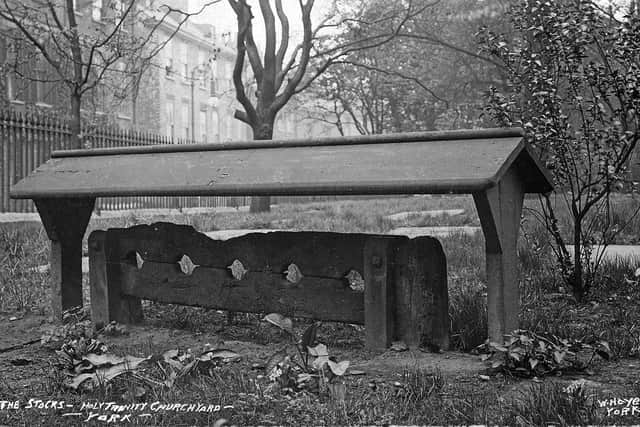
In the churchyard, close to the entrance gate, is a 2006 reconstruction of the city’s wooden punishment stocks; stocks having been sited there from the 16th century.
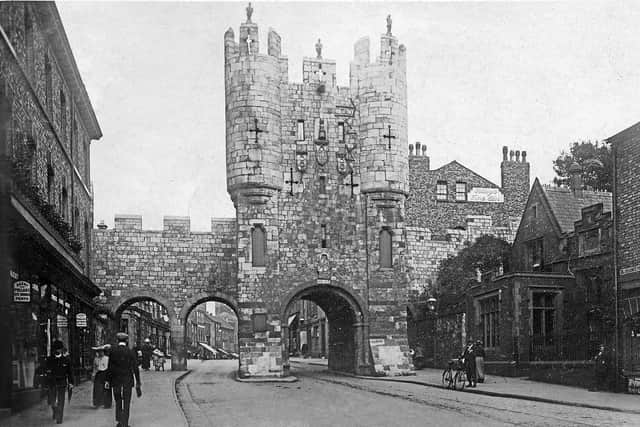
The prominent, Grade I-listed Micklegate Bar, is regarded as the principal bar of York, guarding the entrance from the south.
The lower part of the bar was built in the 12th century and the upper storeys in the 14th century, both renovated many times.
The building was inhabited from 1196 and tolls were recorded as payable there in 1280. It became the site where the heads of traitors were mounted on spikes, for all to observe.
The rooms upstairs have seen many uses: a prison, a police house, a venue for a fencing club, and the site of a museum – now permanently closed.
The Bar is the scene of a special ceremony, where traditionally the monarch stops and asks permission to enter the city. Charles III was welcomed there in 2022 after his accession to the throne.
No. 68 Micklegate has a fascinating history. Between 1650 and 1709 this was the home of Edmund Gyles plumber and glazier and his 14 children.
Edmund was elected City Husband after the siege of York in 1644, responsible for overseeing repairs to the city’s walls and bars damaged in the Civil War.
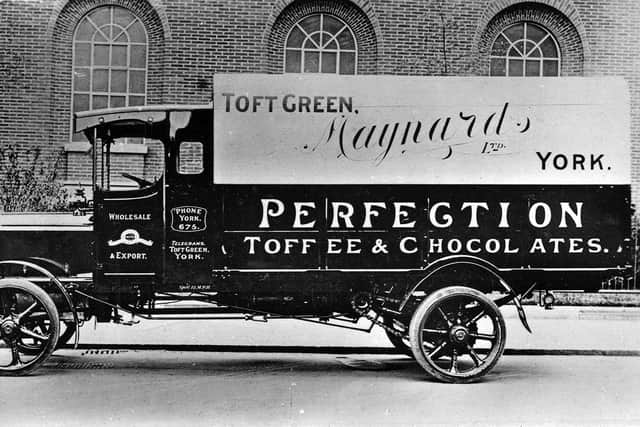
Much later, Maynard’s confectioners, ‘purveyors of boiled sweets and wine gums’ arrived in 1931. This was a London family business, which expanded to a number of outlets, with several in York, including one at the railway station.
The firm was bought by Cadbury in the 1990s and by 2016 had joined with Bassetts
Owners of 92 Micklegate (the current house dating from around 1789) included James Backhouse, seedsman, from 1817 until his death in 1845 and his brother James Backhouse nurseryman and seedsman.
As well as being a famous botanist and nurseryman, James was also a Quaker missionary.
By 1963, the property had become the offices for Pulleyn, Heselton & Co., until at least 1973.
Then, it was the home of York Conservation Trust, who shared it with the Council for British Archaeology. The building is presently a family home.
Further reading: Clements Hall Local History Group Micklegate The Great Street of York (2025).
Thanks to Susan Major for help with this piece.