
Monk Bretton Priory: Yorkshire's ancient monument with a history for dramatic events
Monk Bretton Priory captures the attention of visitors each year and provides a stage for various colourful dramatic events.
English Heritage, Barnsley Council and the Friends of Monk Priory make all of this possible.
One popular event has been the Medieval Mayhem Weekend where people discover how battles were fought and won, how armour and weaponry developed through the ages.
They learn about the lives of people who lived at the time, from basket weavers to blacksmiths.
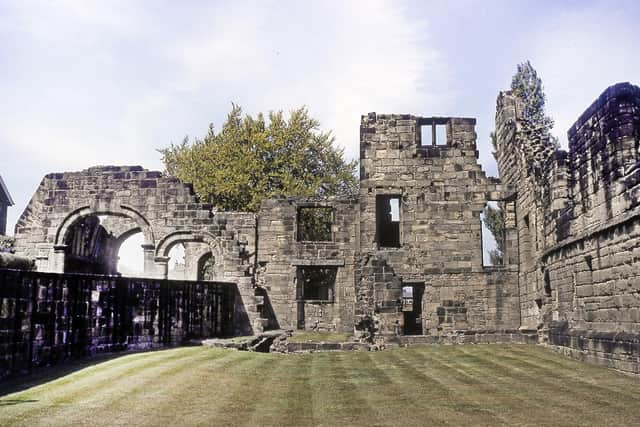

The weekend features Knights Tournaments, Jester Shows, archery, a Medieval Puppet Theatre and much more. There is also a farmer’s market plus food and drink outlets.
Monk Bretton Priory was founded around 1154 by Adam Fitzswaine who was a local landowner. The Priory was considered a daughter house of the wealthy Cluniac St John’s Priory at Pontefract.
According to the Lewes Priory Trust website the Cluniac order was a reforming offshoot of the Order of St Benedict founded in Italy during 529 AD.
The first monastery was Cluny Abbey founded in 910 AD by William I Count of Auvergne.

The website adds: ‘The monks lived by the Rule of St Benedict. There were over 1,000 dependent houses in Europe which were organised into 10 provinces…over the medieval period there were 50 Cluniac foundations in UK’.
An account by F.C. Price in the South Yorkshire Times of December 28, 1957 claimed there were bitter feuds between Monk Bretton and St John’s during the 13th century.
The Prior of Pontefract claimed that Bretton was not an independent priory but only a cell of St John’s, and as a consequence he had the right of appointing the Prior of Bretton.
On the other hand, the monks of Bretton claimed the privilege of electing their own leader. So acrimonious did the quarrel become that in 1255 Pope Alexander IV had to intervene.

He instructed the Dean and Archdeacon of Lincoln to inquire and settle the affair. Little success seems to have been achieved because in 1267 the sub-prior reported that Bretton had no prior for 15 years.
Soon, the Monk Bretton monks were to be involved in further trouble which led to the severance of their connection with Cluny. In 1281 Monk Bretton Priory became a Benedictine house.
Squabbles and disputes over control did not prevent the monks from devoting time to the more important tasks of farming, building and praying.
Much of their income was derived from wool which was one of England’s most valuable and profitable products in the Middle Ages.

During the 12th century, the Monk Bretton chapter house, parlour and sleeping quarters were constructed. The refectory is even considered to date from 1280.
With prosperity, the Priory continued to expand; the cellarium and the Prior’s lodging house were both built in the 14th century, and the chancel and gatehouse date from the 15th century.
The monastery was twice devastated by the black plague, in 1349 when it lost its Prior and two monks, and in 1383 when a Prior and two monks were lost.
Monk Bretton Priory survived the first dissolution of the monasteries in 1536 but succumbed like the remainder three years later.
The Prior and 13 monks surrendered to the officials of Henry VIII under the Act of Supremacy. All the monks received pensions ranging from the Prior’s £40 a year to sums as low as £5 6s 8d.
Monk Bretton’s gross income from various properties in Lincolnshire, Lancashire, Derbyshire and Nottinghamshire as well as in the immediate neighbourhood, plus certain moieties of the churches of Bolton, Hickleton, Darton and Royston amounted to £328.

The sale of the Priory’s cattle, goods and other objects realised £347.
Afterwards, the Priory was quickly plundered for building materials. The north aisle of the church was dismantled and reconstructed as the parish church at Wentworth near Rotherham, surviving until the late 18th century.
Fifty-nine tons of lead together with the structure’s seven bells and church plate were taken to London and melted down.
William Talbot, Earl of Shrewsbury, bought the estate in 1589 whilst the west range of the cloister was converted into a country house for his son Henry.
Over the following centuries the Priory site changed hands several times.
An enquiry opened on during February 1928 at the Town Hall, Barnsley to ascertain the value of the remains of Monk Bretton Priory near the town.
The Priory was purchased by the Barnsley Corporation with the purpose of converting the adjoining land into a public park, the ruins were to be chief ornament. A further piece of land adjoining was earmarked for a housing scheme.
The arrangement between the vendor of the land and Priory, John Vincent Horne, farmer, and the Corporation was that the price should be determined by the official arbitrator under the Lands Clauses Act.
Under this agreement, John Wilmot, of Birmingham sat as official arbitrator.
The vendor’s view was that the land itself was worth £8,700. The value of the buildings as farm buildings was put at £1,058. Besides this, there was special value attached to the archaeological remains.
It was pointed out that during the previous 30 or 40 years there had been a tremendous growth of interest ‘in matters medieval’.
That had led to the development of a real commercial and money value attaching to the possession of these buildings, both for their preservation and through the competition of Americans to acquire such buildings for the purpose of removing them to America.
Horne claimed that before 1914 little or nothing was known about Monk Bretton Priory remains. After buying the farm, he discovered them and carried out excavations at a cost of between £600 and £700.
After that work was carried out, and he secured the interest of the Yorkshire Archaeological Society who spent some £200 in carrying on the excavations.
He admitted that hundreds of tons of stone from the ruins had been sold for road making, but this was only rubble. He had not sold any stone of archaeological value.
Arguing that the value of the archaeological monument was £11,000, he was making a total claim of £20,820.
One account from May 12, 1928 said that Barnsley Town Council was applying to the Ministry of Health for sanction to loans totalling £9,350 to cover the purchase of Monk Bretton Priory, 73 acres of land on part of which the ruins stood, and farm buildings.
After the arbitration hearing, the arbitrator had fixed the price at £8,940.
On April 1, 1934, it was announced that Monk Bretton Priory was to be preserved as an ancient monument and, on that day, it was handed over by the Barnsley Corporation to the Office of Works (and eventually English Heritage, created in 1984).
Around this time, during excavations by the Office of Works, a stone tomb was unearthed containing the well-preserved skeleton of a man.
The tomb was revealed by the levering up of a massive slab of sandstone in the floor of the nave.
Although, according to English Heritage, little remains today of the Monk Bretton Priory church there are several particularly fine examples of medieval grave slabs.
The information continues: ‘Some of these still retain lead lettering set into the stone; others are decorated with beautiful incised crosses.’
Located beyond the cloister at the south east corner of the site are the well-preserved drains that flushed the latrine block with running water from the River Dearne. The imposing Priory gatehouse is still almost intact, although roofless.
Excavations undertaken in 2010 at Monk Bretton Priory represented the first substantive investigation of the monastery since its initial clearance in the 1920s and 1950s and the only campaign of works to be fully recorded and published.
The website tandfonline notes that evidence of the post-Dissolution remodelling of earlier medieval structures was encountered, as was a rich assemblage of finds belonging to all periods of occupation.
Although relatively small in scale, the excavations provide an interesting insight into how the new owners sought to repurpose the religious house to secular use.
Thanks to Professor Dr Paul Buckland for help with this piece.