
'Motorbikes seem to get under your skin' - West Leeds Motor Club keep scrambling sport alive
Scrambling used to be all the rage and was regularly shown on the BBC and one club in Leeds is keeping the sport alive. Julian Cole caught up with the loyal members of the West Leeds Motor Club.
There is a hill in West Leeds where trial riders sometimes can be heard, alongside the ghostly rumble of engines from a century ago. Some say the hill is in Pudsey, while others locate it in Farnley. Either way, Post Hill is a wooded wildlife retreat that also has a long oily history.
One hundred years ago, the company that owned the Yorkshire Post and its sister title the Yorkshire Evening Post, gifted the hill to the West Leeds Motor Club, giving the land for trials and events in perpetuity for a certain number of days a year – hence the name Post Hill.
The motorcycle club grew quickly, especially after the Second World War, and its mud-splattered history is explored on the club’s website.

Suffice to say that things now are not as they once were. At the height of the club’s popularity in the 1950s and 1960s, the BBC used to film scrambling events at Post Hill on Saturday afternoons as part of Grandstand. Murray Walker, the famed motorsport commentator, cut his teeth in broadcasts from there, the first time the sport had been filmed.
At one point, Post Hill embraced 32 clubs and was able to call on 3,000 riders for trials, scrambles, grass track or road racing events, according to the website. Numbers are down nowadays, although the enthusiasm remains.
In the early days motorcyclists rode up the western aspect of Post Hill, once said to be the steepest hill climb in the world. Today that climb is a vertiginous cobbled footpath. Stand at the bottom and gaze upwards and it seems crazy that heavy old motorcycles once belted up such a gradient.
They were not the only vehicles to try. In 1931, as 2,000 spectators gathered for an event captured in a vintage British Movietone report, tragedy unfolded when a ‘dozer’ was upended on the steepest section, tipping in deadly slow motion. A local doctor in the vehicle died.
The footage also shows motorbikes beetling against gravity on the impossible slope. Back then the top of the hill was baren apart from a few shrubby bushes, whereas now it is thickly wooded.
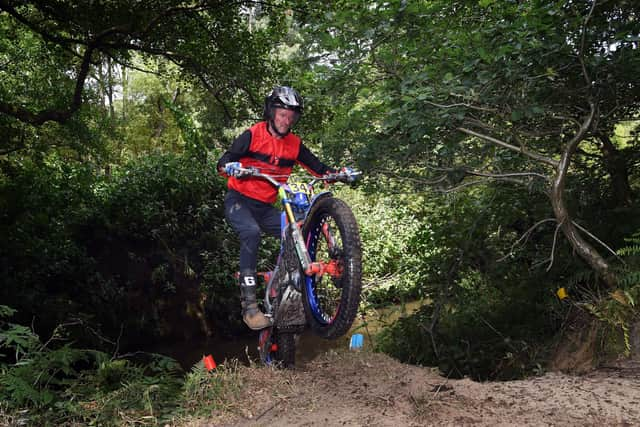
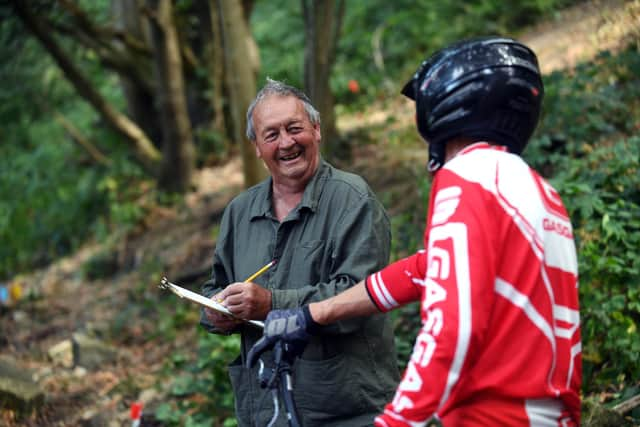
It was sunny and dry when I visited the club, the ground turned to dust. In dappled shade, Dennis Pitts, a motorcycle veteran with a long club history, was checking out part of the route as a marshal for a Yorkshire Centre Championship trial event. The riders now follow tracks threaded through the wooded hillside.
Dennis explained that the trials started after the Frist World War when car drivers wanted to test their hill climbing skills.
“The further up you got, the less marks you lost, and the least lost during the day was the winner,” he says, from beneath his flat cap.
“And then motorcycling took over and it’s exactly the same thing but with trialling it was more about reliability, because English bikes weren’t renowned for being good. Same thing, grass hill climbs and then rocky hill climbs. They’re still called reliability trials but with modern machinery only in extreme circumstances does one break down.”
The riders lose points for touching or ‘dabbing’ the ground with their feet, while no marks are deducted if the feet stay on the bike.
As engines revved off in the distance somewhere, I asked “Did you used to do this?”
“Oh, aye,” Dennis said. “My first bike was a GPO Bantam that I adapted when I was 11.”
Does that mean it was used by the Post Office?
“Definitely, it was red,” he says with a big laugh.
“First I’d do was take the leg shields off. It cost me £7 10 shillings. I progressed from there up to semi-works rider, but I was more interested in my job, I was a fireman. Competitive wise I stopped when I was 68 or 69.”
Dennis, who is 78, once also rode in the enduros, an off-road race.
“It’s long distance, like motorcross. It used to be a 70-mile track in the forest, and you used enduro bikes which are basically now detuned motorcrosses. I did that for six years. First year I won the experts championship. Then I went on to capacity championship and I picked a 175, and I won it.”
Motorcycling is in his blood.
His father was club secretary and rode a trials bike to work, then used it to compete on a Sunday. This left Dennis and his mother without transport, aside from the bus. Dennis’s father solved that problem by buying a motorbike and sidecar. Then wondered how to get his bike to events.
A solution came in the unlikely shape of a fold-down metal bed, and a friend with a garage. The bed was cut, stripped and welded and turned into a trailer for the sidecar.
“Once I got beyond five, I was behind my dad. My mother took the dog then. I’ve got a photograph of me on this Triumph with the old carriage map-carried on the tank and I’m stretching over the tank.”
Sadly, the family tradition is not being continued.
“My lad’s into golf,” says Dennis. His two daughters are not interested either.
Dennis still rides road bikes.
“It’s been my life, still is. I’m going soon to Austria, Italy and maybe over into a bit of communism.”
He has two motorbikes, a BMW R80/RT tourer from 1994 and a BMW R100/RS sports model from 1980.
The last one is “a bit rare and a bit quick”.
Is he still a speed demon at heart, then?
“No,” he says, stretching the word on a long exhalation.
“I’ve no need to tear away now. I’ve had my time. You learn to appreciate the finer things in life, like the countryside.”
Leaving Dennis to his marshalling, it was time to explore Post Hill. Just beyond the footpath on the old steep climb, a less punishing route rose to where Paul Whitaker watched over riders as they scrambled up a deep gulley. While most of the hill was dust dry, this crevice had mud enough to make back wheels spin.
The riders zigzagged by in noisy single file, and only one managed the slippery ascent without removing his feet from the foot pegs. Paul marked the scores in his notebook.
A further walk led me to the top of the hill, then gradually down, hopping out of the way at the approaching buzz of an engine.
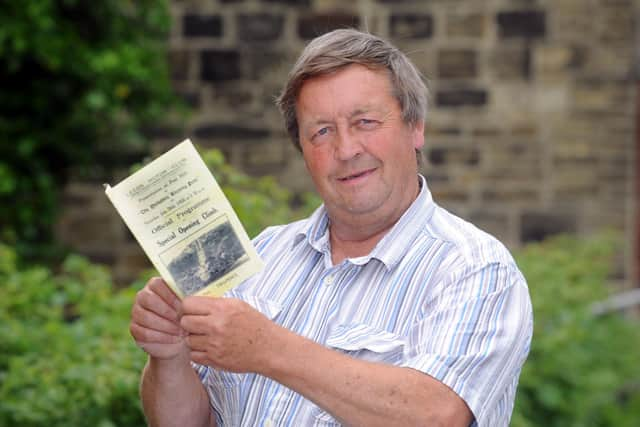
John Kershaw also has deep links to the club. Until recently he was club president, a role he held for six years.
“Motorbikes seem to get under your skin. As a youngster in the 1960s we had an old BSA we used to ride round a local disused colliery,” says John.
“I started competing in trials in the mid -1970s, encouraged by Tommy Beck, my wife’s father who was a long-time member of WL. Dennis was at that time a Yorkshire Centre Champion.”
John was injured in an accident touring in Germany with his wife, Jean. They toured Europe twice a year for 20 years, but John has scaled back now.
“I still have a touring bike, but age catches up eventually and now I just have one on the road for marking out events and running about.”
For more information on the club and its history visit www.westleeds.co.uk