
Mount Grace Priory: The fascinating history of Yorkshire’s medieval monastery and its secluded monks
As more and more people become disillusioned with modern life and retreat to the countryside and nature, Mount Grace priory – the second most important Carthusian site in Britain and the best preserved – offers an example of a comparable religious endeavour from several centuries ago.
In the Middle Ages, Christian monasticism spread throughout Europe and one of the orders established was the Carthusians. This was done by Bruno of Cologne in 1084 because he grew tired of politics and ambition surrounding the Catholic Church and believed total seclusion was the best way to channel divine spirituality.
The Bishop of Grenoble, Hugh of Chateauneuf, gifted Bruno land in the valley of Chartreuse where a hermitage was built. With six others, Bruno erected timber cells and communal structures. He later travelled to Italy for the establishment of a second monastery and died there during 1101.
Other communities were founded across Europe and these were mainly in France. By the end of the century, the first Carthusian monastery was started in England at Witham, Somerset. Funded by Henry II, the friary was first led by a monk from the original monastery, Grande Chartreuse, then by Hugh of Avalon, later Bishop of Lincoln and canonised as St Hugh in the 13th century.
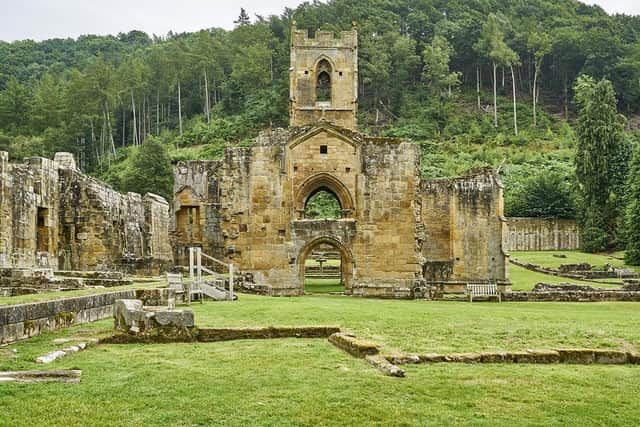

During the early 1200s a second Carthusian monastery began at Hatherop, Gloucestershire, though later moved to Hinton, Somerset. Afterwards, no others were founded until the mid-14th century, then several appeared over a fifty-year period. Amongst this number was Mount Grace Priory, North Yorkshire.
Thomas de Holand, 3rd Earl of Kent and 1st Duke of Surrey, was behind the foundation of Mount Grace in 1398 and the land granted was in his manor of Bordelbi. He also obtained several other priories, which had been confiscated by the crown during the Hundred Years’ War, from his uncle Richard II and these were endowed to Mount Grace to help fund construction and upkeep.
The monastery almost failed to develop as de Holand was part of a plot to overthrow Henry IV in 1400 and he was executed for treason. Yet, the Earldom passed to his brother and Mount Grace was allowed to continue with a grant of £100 from the King.
Uncertainty remained over the priory’s existence for the next few years until Thomas Beaufort, Earl of Dorset (later Duke of Exeter), took charge of improving the buildings and church at Mount Grace. He also arranged for the King to give four subsidiary priories to Mount Grace which replaced one lost and improved the income.
After Beaufort’s death, Sir William de Ingleby became patron of the priory and soon after, in 1440, the status of Mount Grace was confirmed by Henry VI. By 1450, the monastery was in a position to acquire lands and also had the stature to be gifted property by local families and others – King Edward IV gave Mount Grace two manors to fund the construction of a chantry.
The building work at the priory initially started in timber and was gradually changed to stone when finances allowed. The monastery was enclosed to heighten the sense of seclusion and consisted of a church placed centrally in the grounds, with the monks’ cells on the north side and those for the lay brothers south east. The original guest house and service buildings were on the south west and south sides of the site.
As the religious observance mainly took place in the cells, the church was modest and as new was just a single-storey rectangular structure with four bays divided between the monks and lay brothers. Under Beaufort the church was altered and this work saw the addition of a tower, further space was provided in the monks’ choir and changes were made to the windows. Later in the 15th century burial chapels were added to the church.
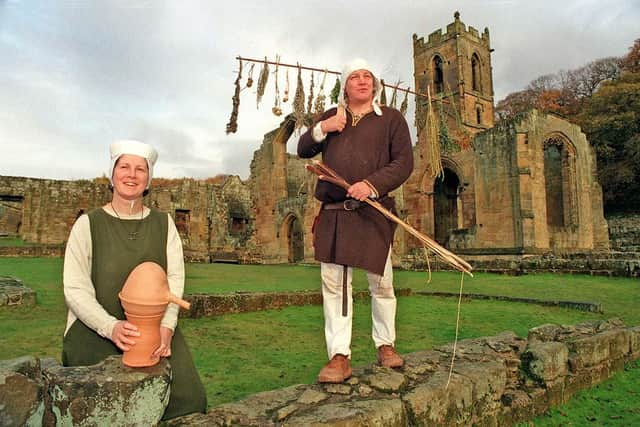
The great cloister was laid out at the time of the priory’s foundation, yet the 15 cells were built over a number of years. These had two storeys and were in one corner of an enclosed garden where the monks grew medicinal herbs, culinary herbs, root vegetables and flowers. The cells had three ground floor rooms: living room; bedroom; oratory. Upstairs was a general work room where monks could perform tasks such as weaving, bookbinding, illuminating manuscripts and making tokens for pilgrims.
The general daily routine for the monks was to perform the Divine Offices, yet the Carthusians differed in doing these solitarily, whereas other orders gathered together. The Carthusians only regularly grouped with each other for Matins (nightly) and Vespers (afternoons). Meals were also eaten in the cells, apart from Sundays or other celebration days. Food was brought to the monks and water was provided through taps fed by pipes from a spring nearby. Their diet mainly consisted of fish and pulses, whilst the lay brothers produced beer and bread for the consumption of all. Meat was prohibited, though eggs were allowed.
At the time of the Dissolution of the Monasteries, Mount Grace had an annual income of £323, which was quite substantial for the priory. John Wilson, Mount Grace prior, accepted the Act of Supremacy – where Henry VIII became head of the Church of England – but two monks declined and they were imprisoned at the monastery. Mount Grace surrendered to the crown in December 1539, with the prior given a pension of £60 and the monks around £17.
As the priory residents were evicted, Mount Grace soon fell into ruin and the land was leased before sold in 1541. The property was acquired by Ralph Rokeby during 1545 and on the marriage of his great-granddaughter Grace to Conyers Darcy, 8th Lord Darcy, later 1st Earl of Holderness, the land passed to the couple as a wedding gift in 1616.
Evidence suggests that Lord Darcy and his wife were behind the conversion of the priory guest house into a dwelling following their marriage. After Lord Darcy’s elevation to his father’s titles, the estate was sold to Captain Thomas Lascelles, a Parliamentarian soldier, and was handed through his descendants and extended family members to the late 19th century. At this time, historian William Brown took possession and oversaw archaeological excavations by Sir William St John Hope. Before the century’s end, Brown sold Mount Grace to prominent metallurgist and manufacturer Sir Isaac Lowthian Bell.
The Society for the Protection of Ancient Buildings had been formed in the 1870s and in the following decade became concerned with the fate of Mount Grace priory ruins. Bell, being based locally, was contacted for support of their preservation, to which he agreed. Between 1898 and 1901, Bell and his architect A.M. Poynter oversaw renovations of the house in a sympathetic arts and crafts style.
The 17th-century house had been repurposed as two farmhouses and was in a state of great disrepair when work began. During the process, medieval features of the priory guest house were revealed and interiors from the original house restored. Though Bell died in 1904, his son and heirs enjoyed Mount Grace for many years and welcomed a number of distinguished visitors.
The declining fortunes of the Bell family saw Mount Grace handed to the government in lieu of death duties for Sir Isaac Lowthian Bell’s grandson when he died in 1944. There was some uncertainty over the estate’s future, but in the 1950s the house and priory were given to the National Trust. The house had a tenant to the 1970s, whilst excavations were carried out by the Ministry of Works and two well houses were found in the north-east corner. Later, a cell was reconstructed to provide visitors with a better impression of monastic life.
From the late 1980s to 2010, the house was under restoration as there had again been some neglect and is now a fine example of an arts and crafts-inspired interior from the turn of the century. Both the house and priory ruins are open for most of the year under the care of English Heritage on behalf of the National Trust.
Thanks to Professor Dr Paul Buckland and Kate Maughan-Brown (English Heritage) for help with this piece.