
Newton on Ouse: Hallmark of a mansion’s lasting legacy
With approaching 150,000 visitors a year, Beningborough Hall’s influence continues to hang heavily over Georgian estate village, Newton on Ouse, north of York.
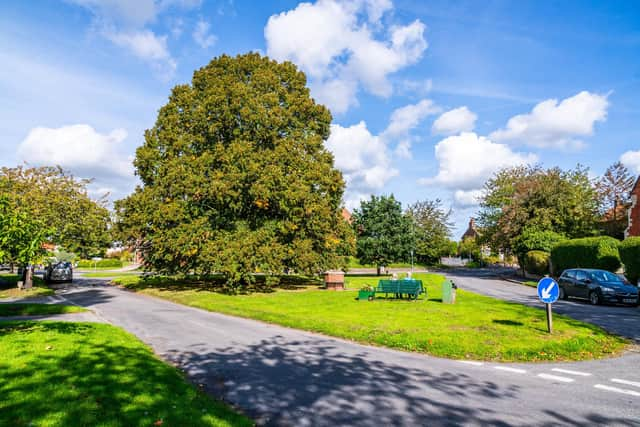
The pencil-straight main street, Cherry Tree Avenue, that leads to the grade I listed mansion’s impressive northern entrance is striking all year round due to the sheer number of trees on its verges, but April and May sees a spectacular display of white and pink blossoms.
The cherry trees belonged to racehorse breeder Lady Chesterfield, who took responsibility for them while she lived at the hall until 1957, after which it was given to the National Trust.

Newton Lodge gateway on Cherry Tree Avenue comprises an ashlar entrance arch with gates and lodges with 12-pane sash windows. It is identical to the entrance of Thirkleby Hall, a landmark on the A19, south of Thirsk.
Beningborough Hall was built by the Bourchier family, which started to shape the village after buying the estate in 1539. The halls owners included parliamentarian Sir John Bourchier, who was among the first to sign Charles I death warrant.
A lengthy driveway passing through parkland leads to the hall, which is considered among the finest of the National Trust’s assets in the North due to its exquisite Baroque architecture.
Completed in 1716, visitors pass through a walled forecourt with central gates flanked by the Clock Tower and Bell Tower pavilions which lead to a courtyard, a kitchen garden featuring a path through a tunnel of espalier pears trained over cast-iron arches, a brew house, a huge stable block and a laundry.
About 100m south-east of the main hall remains an earlier house which it is thought was built in the 16th century, near terraced lawns, a new Mediterranean Garden, a ha-ha and flat parkland which extends across 120 hectares to the River Ouse.
The low-lying floodplain is prone to seasonal high water and becomes impassable for the steady stream of people who walk from the village along the well-trodden banks of the river towards small sandy beaches at the Ouse’s confluence with the River Nidd.
During the coarse fishing season Newton on Ouse Angling Club fishes for barbel in the deep water off Cherry Fields, the area between Beningbrough gate and a 19th century castellated water tower.
To the village’s north is the Ouse’s confluence with the River Kyle, which at just under six miles in length, ranks among the country’s shortest classified rivers.
The water table and drainage has limited building on the village’s margins and an extensive recreation ground, which has served as a venue for community events, has been retained.
The opening of the York to Newcastle railway, what is now the East Coast Mainline, a mile to the east of Newton on Ouse in the early 1840s stimulated the growth of housing, farming and light industry on the estate. For example, that decade saw the Newton Brick and Tile works, which became significant local employer, in full production at east end of Moor Lane.
Most land and housing in Newton-on-Ouse remained part of the estate until the Dawnay family, which had bought it in the 19th century, offered tenants were given the chance to buy their homes.
To avoid death duties, the surviving Dawnays gave away properties it had built, including the red brick village school and schoolmaster's house on the east side of Cherry Tree Avenue. Designed by the architect of York railway station, the property now serves as a home.
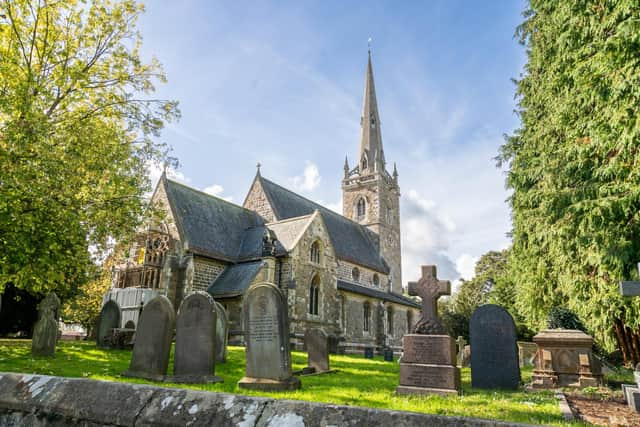
The family’s legacy is written large across the village, none more so than with All Saints’ Church, where they bankrolled two rebuilds in the 19th century, adding to the 900-year-old coursed dressed sandstone tower with a 150ft limestone spire, which can be seen from Brimham Rocks, 20 miles to the west.
The Friends of All Saints are currently focusing on repairing the spectacular East window. Its lights are like a biblical Who’s Who? with scenes depicting Jesus being raised up to heaven, Elijah being fed by raven, Adam and Eve’s expulsion from Eden, Moses on Mount Sinai, Noah producing burnt offerings and Peter escaping from King Herod’s jail. Its creator, Thomas Willement, went on to become one of the most successful of England’s stained glass artists.
The church’s graveyard features rows of Australian, Canadian and British airmen who served during the Second World War at RAF Linton on Ouse, which is about a mile from the village. The airmen became a regular fixture in Newton on Ouse with Beningbrough Hall having been requisitioned as living quarters. It has been calculated that almost half of the 1,500 wartime lodgers were killed or captured in bombing raids on Europe.
One of the graves remembers Squadron Leader Kenneth Edwards who died when a De Havilland Flamingo crashed at Great Ouseburn. Its passengers included four top-ranking Russians.
In June 1944 Newton-on-Ouse saw six airmen killed when their Halifax bomber crashed into a house on Back Lane, from the rubble of which a young woman and her new-born son emerged without serious injury. A memorial cairn to the airmen stands near the crash site.
Eighty years later Newton on Ouse’s relationship with the former military base remains in focus with some residents raising objections to Home Office plans to provide accommodation for asylum seekers, saying it could significantly impact on their quality of life and livelihoods.
Businesses in Newton on Ouse include the 18th century Dawnay Arms, a gastropub, on the south side of Moor Lane, which has a back garden stretching to the river, and the homely Blacksmiths Arms on Cherry Tree Lane, which supports the village’s clubs and teams.