
North Ferriby: The Yorkshire village which hid Bronze Age boats for thousands of years
It’s 89 years since teenager Ted Wright and his brother Christopher were standing by a reed pond on Humber Estuary’s foreshore at North Ferriby and spotted several large oak planks protruding from the mud.

Little did the boys realise they were at a boatyard dating to about 2000BC and beneath the silt lay ancient trading vessels, now believed to be Europe's oldest seacraft.
Several plank-built boats, made from oak, a willow stem and caulked with moss and about 16m in length, well preserved by anaerobic waterlogged conditions, have since been rescued from the site, and displayed at museums in Hull, seven miles to the east, and London.
With surroundings now owned by the village’s particularly active Riding for the Disabled Association, the Bronze Age maritime centre was exposed after the Humber’s deep water channel shifted to the north side in the 1930s, eroding ancient layers of peat and silt.
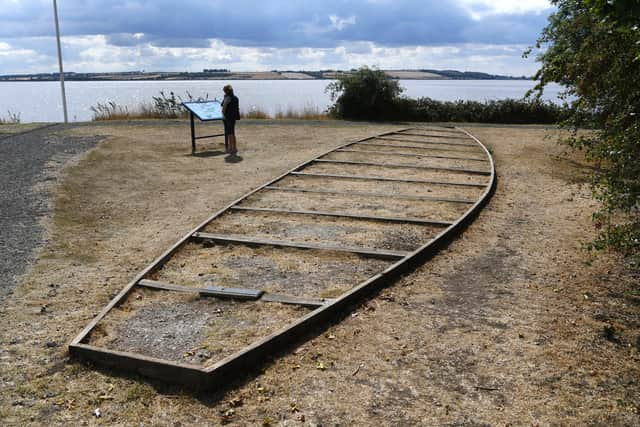

The north bank of the Humber at North Ferriby, named after a ferry which continued into the 19th century, features a memorial to the boatyard – the form of one of the ancient boats – and further along the foreshore gives way to grassland meadows at North Ferriby Ings.
As well as forming the route of starting leg of the 79-mile Yorkshire Wolds Way, the waterside area to the east of Humber Road features rare brackish water crowfoot, a flowering acquatic member of the buttercup family.
At the foot of Humber Road there are far-reaching views across the expanse of water, where dolphins have increasingly been spotted in recent years, to Far Ings Nature Reserve chain of flooded clay pits and extensive reed beds.
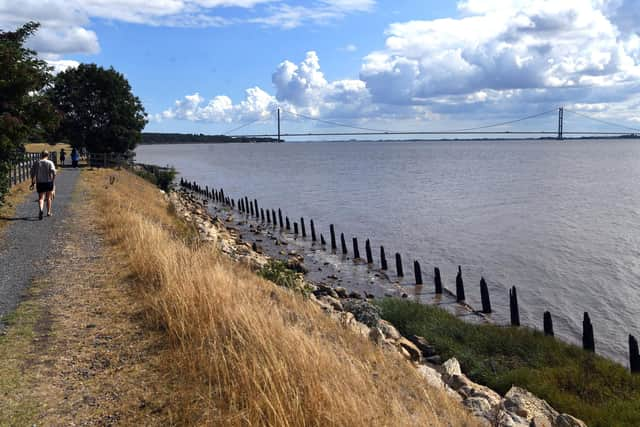
There are also excellent views of the 2.2km Humber Bridge, one of the world's longest single span suspension bridges, which when it opened in 1981 ended a century of campagning by locals to enable road journeys south without a detour via Goole.
Meanwhile, last November saw Amazon launch a “fulfilment centre” to the west of the village, the size of 11 football pitch, which cost £550m to build and equip. It employs 2,000 staff.
Big business is no stranger to the village. For centuries the main route to Hull from the west passed through North Ferriby, which is reflected by the high volume of substantial 18th and 19th century merchants residences, framed by lengthy walls and hedges, which continue to dominate its historic core.
Recent years have seen North Ferriby become known for having four of East Yorkshire and Humberside’s eight priciest streets – Kemp Road, where the average house sells for £841,273, followed by Croft Park, West Leys Road and Woodgates Mount.
Hull is referenced to in many places across the village.
On the opposite side of the High Street to a cream Hull Corporation telephone box, stands Ferriby House, a grand three-storey Adam-style property built in Flemish bond and sporting Corinthian columns for two-time Hull mayor and ship owner Sir Henry Etherington, who helped found Hull Infirmary.
It’s impressive stable block, which has been used as a telephone exchange, can be seen off Turners Lane, named after the philanthropic family which owned much of the village during the Victorian era.
Near the railway bridge on Church Lane, there are the Anne Turner Memorial Allotments and playing fields, which are home to North Ferriby FC, supporters of which have endured a rollercoaster experience over the past decade.
Opposite the allotments, the area extending north from Priory Avenue formed part of the site of a priory, which was established by a monastic order based on the Knights of St Jerusalem in the 12th century.
It remained a huge influence on the village until the Dissolution in 1536 and documents relating to a quick succession of priors in 1349 indicate the village was hit by the Black Death.
Since 1983, Ferriby House has served as a nursing home, providing accommodation for residential, palliative and respite care at the southernmost tip of the Yorkshire Wolds.
Opposite the Methodist Church on the High Street, Aston Hall Drive refers to a late 17th century merchants house, long since demolished, which was rebuilt in the 1740s by William Wilberforce, grandfather of the anti-slavery campaigner.
While many of the village’s older buildings are red brick or white painted render with slate, clay pantiles or Rosemary tile roofs, on the other side of the High Street there’s the landmark Duke of Cumberland pub, launched by Hull Brewery Company in 1928, its exposed ornamental timbers being typical of properties that Hull’s merchants built in villages near the city in the early 20th century.
A few doors down, the Ferriby Hall was first established at the High Street’s junction with Swanland Hill by another mayor of hull, Robert Carlile, in 1696 before being rebuilt in the early 19th century and later repurposed as a country club.
Behind it there’s a squash and racketball club which bills itself as “one of the friendliest, most easy going clubs in the county”.
Ferriby Hall’s latest incarnation, as Indian fine dining restaurant Ruthvika, offers unusual dishes such as guinea fowl dosa tacos.
On the other sides of the High Street’s crossroads with Church Lane, there is the 18th century Tithe Farmhouse, a tall Portland stone cross to commemorate the village’s 36 servicemen killed in the world wars and facing it the well maintained Coronation Gardens.
The unusually verdant village has a striking number of trees lining its roads, none more so than Church Lane as it passes North Ferriby Church of England Primary School, which Ofsted rated as ‘good’ in 2023, a municipal library as well as a well used community hub.
Further along the lane, the community has another venue in the Village Hall as well as the geometrical style All Saints Church, noteworthy for its three-stage west tower and broach spire and memorial in the chancel to an 18th century couple, featuring full-sized effigies kneeling in prayer.