
Parkgate: The Yorkshire suburb which went from industrial powerhouse to retail success
From a hive of industrial activity to housing a vibrant retail park perhaps describes Parkgate’s development over the past 200 years.
Good waterway, road and rail connections have also provided benefits.
In 1823 Samuel Sanderson and a Mr Watson leased 2,000 square yards of land from Earl Fitzwillim and established the Parkgate Ironworks, the company producing wrought-iron bars, iron castings and tin plate.
Grace’s Guide mentions the works were located at the junction of Rotherham Road and Taylor’s Lane with part of the establishment facing on to the Greasbrough Canal which was completed around 1780 by the 2nd Marquess of Rockingham.

By 1832 the ironworks site was in the hands of a Birmingham syndicate. Other owners followed as the century progressed and the site extended.
Anthony Munford in Iron & Steel Town An Industrial History of Rotherham (2003) notes that for some five years from 1856 ‘Park Gate was the only works in the country able to roll armour plate for the Royal Navy.’
He adds that the large plates for Brunel’s Great Eastern, launched in 1858, ‘were rolled at Park Gate’. The success of the ironworks brought workers and their families from other parts of the country.
This contributed to the expansion of Parkgate with houses and facilities being provided for the work force.
The Parkgate Iron Company Ltd was founded in 1864 under William Landsdowne Beale. Expansion at the firm included more blast furnaces being brought into use and new plant added.
The 1880s saw the company moving from making wrought iron to steel. To reflect this shift in the manufacturing base the company was restyled The Parkgate Iron & Steel Co. in 1889.
Charles J. Stoddart became managing director. He also served four terms as Mayor of Rotherham.
Parkgate was connected to the railway system via two stations. Rawmarsh railway station opened on May 1, 1853.
It was situated on the Midland line extending from Derby to Leeds which had opened in 1840. The station was renamed Rawmarsh and Parkgate, November 1, 1869.
The Great Central Railway Company opened Aldwarke railway station in July 1873. During June 1891 the Prince and Princess of Wales arrived at this station whilst guests of the Earl and Countess Fitzwilliam at Wentworth Woodhouse.
On November 1 1895, the station was renamed Parkgate & Aldwarke.
References note that activity at Aldwarke Main Colliery – about a mile away from Parkgate – began from the 1860s.
Alan Hill in The South Yorkshire Coalfield (2001) mentions that there were four shafts sunk in two pairs at Aldwarke, which divided the colliery into two mines – the Parkgate mine and the Swallow Wood, Barnsley mine.
He continues: ‘At the Parkgate mine the No. 1, downcast and No. 2, upcast shafts were sunk to the Parkgate seam at 450 yards…’ Sheffield steelmakers John Brown & Company (Limited) acquired the pit in 1873.
Road transport development at Parkgate is noted by Charles Hall in Rotherham & District Transport (1996).
He writes that by 1881 there were at least two Parkgate proprietors on the road Wm Faulkner – a china dealer and cab proprietor – and Wm Wilson who was also a grocer. Both operated buses every hour from College Square in Rotherham from 10.30 am.
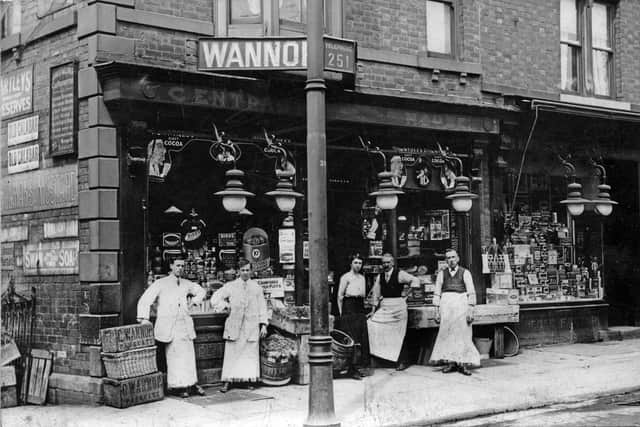
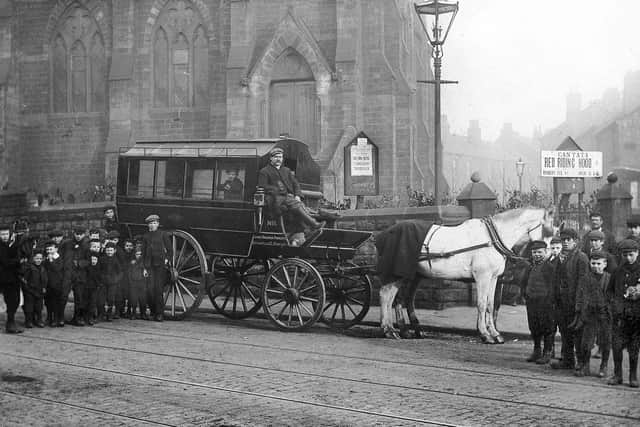
An advert shows that Faulkner of Wannop Street, Parkgate could also provide: landaus, broughams, charabancs, wedding and party carriages, and a glass hearse.
A postcard, produced c.1910, depicts one of his vehicles outside a Methodist chapel on Broad Street.
During June 1913 James Faulkner of Parkgate was charged with having allowed a horse to be driven when in an unfit condition.
He was fined ten shillings (50p) with costs. The 20th century saw both decline and redevelopment in Parkgate.
The Parkgate Iron & Steel works became famous in film history during 1901.
Footage captured by the pioneering filmmakers Sagar Mitchell and James Kenyon included a fascinating glimpse into the company’s workers who are shown exiting the factory gates and play-fighting.
A winding accident occurred at Aldwarke colliery on Tuesday morning February 23, 1904 and only one man, Arthur Ramsden survived out of a party of eight.
The tragedy occurred in the No. 2 upcast shaft of the Parkgate mine when a cage plunged 400-yards to the bottom of the pit.
On Saturday night October 1, 1904 a marble tablet was unveiled at the Miners Institute, Parkgate in memory of those who lost their lives – four miners and three trammers.
A Miners Institute was built in Parkgate during 1914 and housed the memorial tablet. The building once provided a range of services for local miners and their families.
A blue plaque was unveiled on the building by Rotherham Civic Society in November 2023 to honour Albert Sykes (1924-2008) a well-known youth leader.
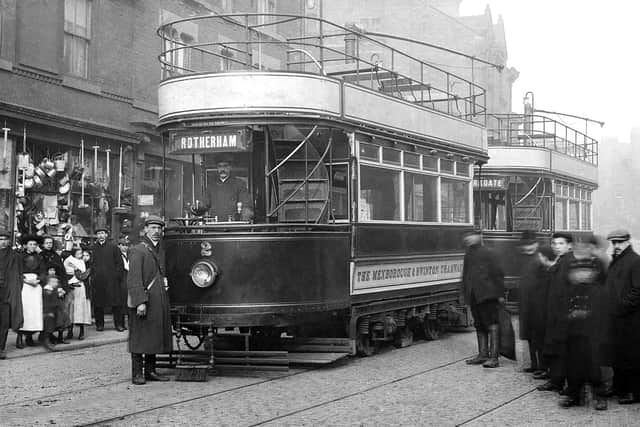
Plans to connect Rotherham and Parkgate to a tramway were submitted to Parliament as early as 1876 and again 1881 under the Parkgate and Rawmarsh Tramways Act.
But, it was left to the Mexborough & Swinton Tramways to place Parkgate on an electric tramway when a section of an undertaking from College Square in Rotherham to Rawmarsh Hill was opened February 6, 1907.
The complete standard gauge primary 5.5-mile route constructed by the National Electric Construction Company eventually extended north from Rotherham connecting Parkgate, Rawmarsh and Swinton terminating at the Old Toll Bar in Denaby.
The whole line was opened on August 3, 1907. Following the changeover, Rotherham Corporation trams also ran to Parkgate.
By March 1929 the entire Mexborough & Swinton tram system was turned over to trolleybus operation. Then, to motorbuses by early 1961.
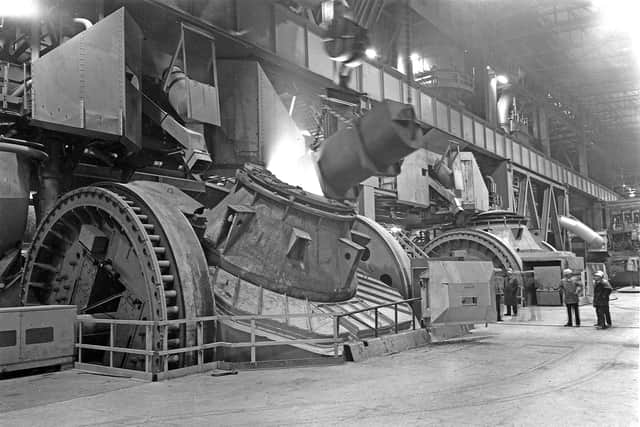
The Parkgate Iron & Steel company’s output included high class steel with employees numbering between 1,500 to 2,000 shortly before the First World War.
In the Second World War amongst the items produced by the company were brake drums for heavy bombers.
During November 1948 the Iron & Steel Bill was introduced to the House of Commons and nationalisation of the industry went into effect from 1951.
The Parkgate Iron & Steel Company became part of the Iron and Steel Corporation of Great Britain.
In 1956 Tube Investments of Birmingham acquired the Parkgate Iron & Steel company from the Holding and Realization Agency.
According to Alan Hill, Aldwarke colliery was closed on July 30, 1961 due to exhaustion of its seams. Parkgate lost connection to the rail network when the Parkgate & Aldwarke station closed on October 29, 1951 and the Parkgate & Rawmarsh station on January 1, 1968.
On reclaimed land formerly occupied by the company, Parkgate Retail World was developed by the Stadium Group to become the UK’s second-largest retail park.
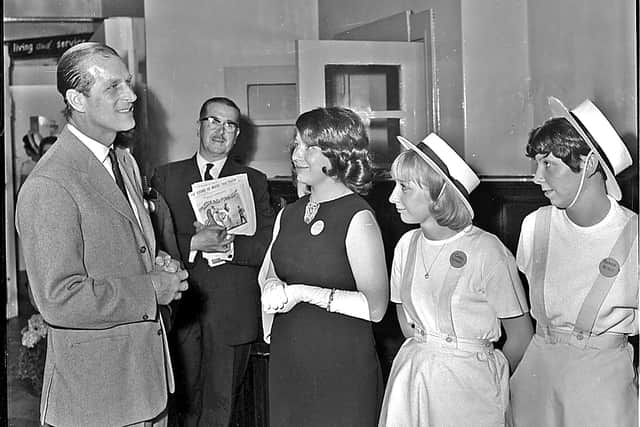
TV star Helen Worth cut the tape at the official opening of the complex on October 2, 1987. In 2021 Parkgate had reportedly attracted 10.123 million shopper visits.
A tram-train station used by Stagecoach Supertram was opened at Parkgate on October 25, 2018.