
Pilkington Bros: The Yorkshire glass company which turned a tiny hamlet into a thriving suburb
Pilkington Bros began glass production in Kirk Sandall, South Yorkshire, during the early 1920s.
Around a century earlier, according to the gracesguide website, William Pilkington had been involved with the St Helens Crown Glass Company at that Lancashire town.
Later, company names involving Pilkington family members included Greenall and Pilkington’s but by 1849 it was known as Pilkington Brothers, then in 1894 Pilkington Brothers Ltd.
The reason for establishing the Kirk Sandall factory to produce plate glass was said to be due to its ideal location.

This was besides the close proximity of Hull for the large export trade. Also, a report from November 1919 said: ‘The glass trade in the Don and Dearne Valleys is booming…’
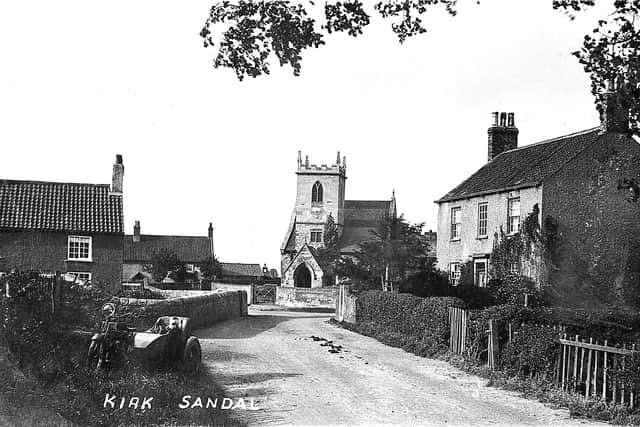
In the early 20th century, the tiny old Kirk Sandall village was clustered round the parish church dedicated to St Oswald, the warrior king of Northumbria.
The building is partly Norman and may have Saxon foundations. It contained the tomb of an Archbishop, John Rokeby, Archbishop of Dublin in 1512.
The prospect of Pilkington Bros establishing the Kirk Sandall works aroused great attention and interest. Most people admitted they had been looking for a development of this kind for 30 years.

The glass factory was to have a frontage to the River Don and plans and designs for it had been prepared by the company’s own engineer.
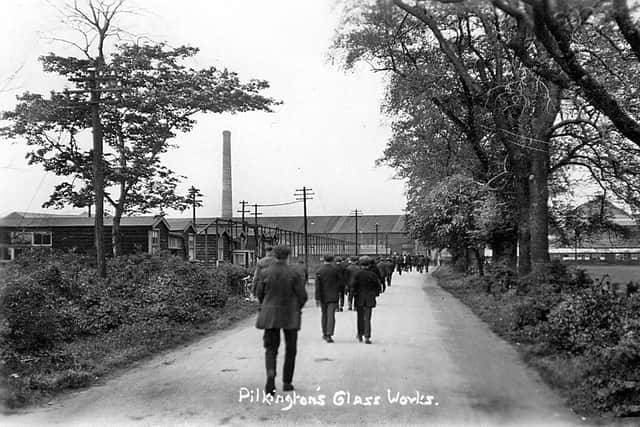
It was expected that in due course a small town of hutments would appear at Kirk Sandall, for the accommodation of the several hundred men expected to be employed in erecting the new factory.
Approval was given by Doncaster Rural District Council at the end of February 1920 for the layout of a new garden village at Kirk Sandall in connection with the Pilkington Bros glass works.
It provided for about 2,000 houses over an area of 250 acres.
A report from April 9, 1920 said that a start was imminent on the first portion of the new village. The contract for this was placed with H. Arnold & Son.
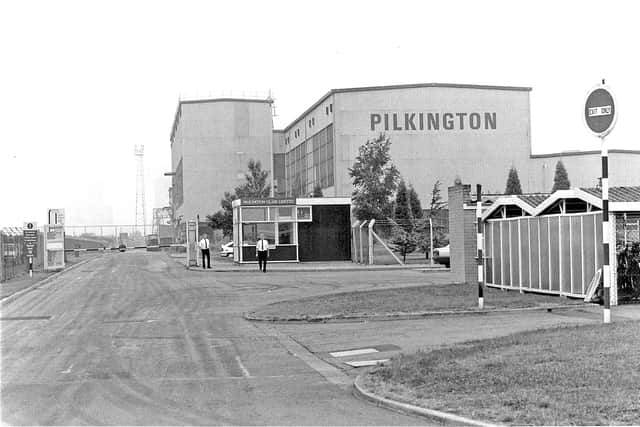
The Pilkington Bros glass works commenced production in August 1921.
By April 1925, 320 houses had been erected and it was claimed there were just a few of the non-parlour type.
But, no house had less than three bedrooms while a good many had four, and every house boasted a bathroom.
The names of many of the streets and squares were a reminder of the close family ties with St Helens: Windle Square, St Helen Square, Sutton Road, Denton’s Green Lane and Cowley Place.
The rents were the firm’s business and some were as low as 7s 6d a week, and there was also a scheme where occupiers could buy the houses with weekly payments.
Electric light fittings were supplied from the works at a low charge.
It was rumoured that the establishment of the new industry would necessitate the removal of the ancient St Oswald church.
Yet, Pilkington Bros had no intention of doing this. Instead, the firm pledged to give financial support to a new building when required.
The company gave satisfactory guarantees to the West Riding County Council Education Committee with regard to educational needs.
Pilkington Bros agreed to make a substantial contribution toward the cost of a new school in place of the old ‘Free School.’
The Bioscope of December 9, 1926 said that Pilkington’s were equipping a private theatre at their works which would be used for commercial purposes and demonstrations of the glass screen they were producing.
In subsequent years, a number of buildings were erected to provide the community with its needs.
Good progress was reported in 1928 with the laying out of Pilkington Bros new sportsground at Kirk Sandall, including a football enclosure to accommodate 20,000 people.
A fine pavilion was erected for Pilkington Bros Cricket Club, who had joined the Yorkshire Council, by late December 1928. It had cost over £1,000.
A foundation stone for a new Congregational church was laid by R.A. Pilkington and was opened on November 14, 1929.
A new Roman Catholic church was opened at Kirk Sandall on July 3, 1930 by Mgr W. Hawksworth, Vicar-General in the absence of Dr Cowgill, Bishop of Leeds.
Erected on a site given by Pilkington Bros the building had accommodation for 200 people and cost about £2,000.
During August 1933 Pilkington Bros placed all the people at their glass works on a 42-hour week instead of 48 and were to pay the same wages as for the longer week.
The reduction in the working hours would mean ‘the employment of a large number of extra work people.’
In the same month Pilkington Bros were producing a new kind of glass which it claimed could be used in every home.
It was called Vitrolite and at Kirk Sandall new plant was installed to cope with the increasing number of orders.
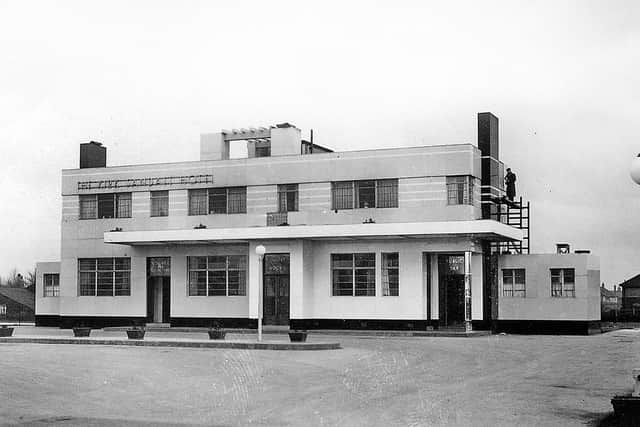
One of the most interesting structures to appear was undoubtedly the Kirk Sandall Hotel, which was completed by October 1934.
An account from October 13, 1934 said that every possible part of the new Kirk Sandall Hotel, recently constructed by Pilkington Bros is made of glass.
Not content with having windows of the material, table tops, floors, and walls, but even chimney pots were made of it.
The decorations were a kaleidoscope of colour. Blues and greens were mixed admirably. It was a perfect demonstration of the application of glass to a type of building particularly suited to its uses.
Later, the building was renamed Glassmaker and one of the landlords was boxer Fred Pownery. Then, in 2000, it was refurbished to carry the name Glasshouse.
On the opening night in November 2000 ‘Eastenders’ stars Ross Kemp and Dean Gaffney made an appearance.
On November 5 1937, the Princess Royal went to Kirk Sandall to visit the Red Triangle Boys Club, provided by Pilkington Bros in commemoration of the Silver Jubilee of King George V.
The Princess was conducted round the glass works by Goeffrey Pilkington, chairman of directors. In the firm’s new offices, she signed the visitor’s book, and was presented with a plate glass fruit dish.
Pilkington Bros were to increase wages on the family principal at the beginning of 1938. This gave an increase of five shillings (25p) a week to married workers for each child of school age over three in number. The firm was understood to be the third British organisation to adopt the scheme.
Before the Second World War, Pilkington Bros acquired an interest in the Glasgow fibre glass firm of Chance Brothers & Co. During the hostilities the factory was requisitioned for work munitions and glass tubing.
In the post war years, interests were acquired and shared with other companies.
A floatation on the public stock market occurred in 1970, the company becoming Pilkington PLC.
News came in 2006 that Pilkington’s was taken over by Nippon Sheet Glass of Japan. Sadly, the Pilkington Kirk Sandall site was closed in October 2009.