
Rievaulx Abbey: How Parliament helped save one of the jewels of Yorkshire
The continued existence, preservation, understanding and enjoyment of Rievaulx Abbey (pronounced ree-VOH) sited near Helmsley, is perhaps down to several acts of Parliament. These were passed in the late 19th and early 20th centuries.
An Act to strengthen government protection of historic sites was the Ancient Monuments Consolidation and Amendment Act of 1913.
This gave local councils the power to issue ‘Preservation Orders’ for threatened monuments besides consolidating the 1882 Act and reinforcing the government’s role in preserving nationally important historic structures.
During the first 20 years of the act’s existence, around 229 sites came into the care of the Office of Works.
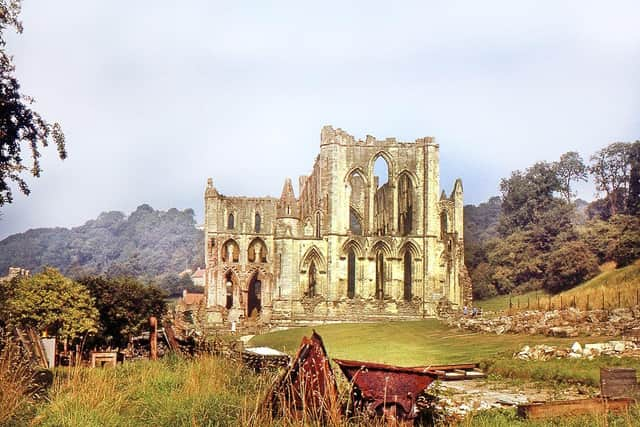

Charles Peers the Chief Inspector of Ancient Monuments visited Rievaulx Abbey in 1912 and was determined to exert pressure to protect and preserve the site.
He is quoted as saying: ‘Rievaulx is perhaps the most beautiful of our ruined abbeys and its permanent preservation is a work which would meet with everyone’s approval.’
The intervention of the First World War delayed matters.
However, on July 20, 1917, following the death of the estate owner Lord Feversham at the Somme, Rievaulx Abbey was officially transferred into the guardianship of the Office of Works.
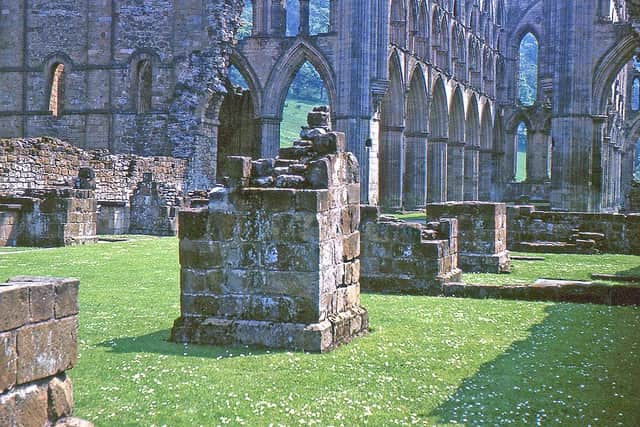
Founded in 1132, Rievaulx Abbey was the first monastery of the reforming Cistercian order in the north of England.
Coming over from Clairvaux in Bergundy, the Rievaulx founding party comprised about 10 monks and 20 lay brothers.
For their monasteries, the Cistercians chose land in isolated areas for a number of reasons: it was cheap to buy and made it easier to enforce seclusion and strict enclosure.
Sheltered and secluded, Rievaulx was erected in a narrow valley, on a plateau of high ground at the foot of the hill leading from the Helmsley and Stokesley main road.
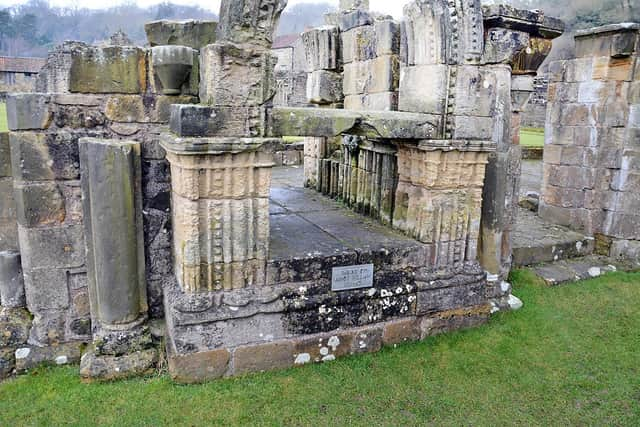
Abbot William, a native of Yorkshire and educated in York, was chosen to lead the new community at Rievaulx.
The purpose was to establish it as an outpost from which more colonies were to be sent out to achieve the goal of claiming the north.
Mainly sandstone was used to build Rievaulx Abbey and was quarried within a 10-mile radius of the site.
It is estimated that approx. 90,000 tons of stone came from the Wethercote quarries some six miles north of Rievaulx.
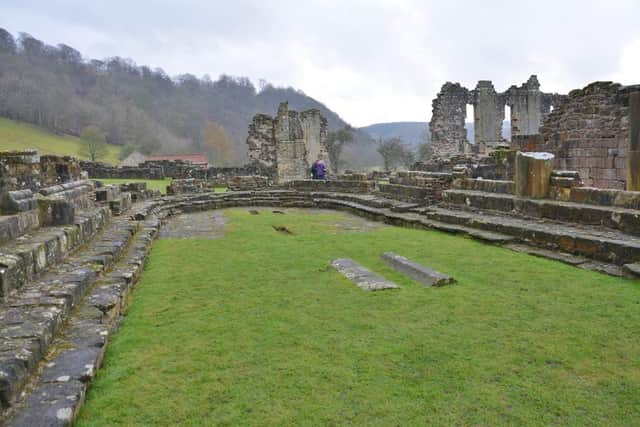
The most influential abbot at Rievaulx, was undoubtedly Aelred, who took control of the abbey in 1147 until 1167. During this time Rievaulx's community grew to a staggering 650 men.
To accommodate them at Rievaulx, larger buildings were constructed making Aelred one of the great builder abbots of the 12th century.
On December 3, 1538, Abbot Blyton and 21 monks gathered in the chapter house for the last time and 'voluntarily' surrendered their magnificent monastery to Henry VIII's royal commissioners.
Over the period 1536-1540, 843 religious houses were closed down.
After Rievaulx's suppression, the estates were sold to Thomas Manners, 1st Earl Rutland (d.1543).
He was closely associated with the royal court and the gradual demolition of the abbey followed though the King as usual retained most of the roof leads and bells.
Yet, after the dissolution, the site became the centre of commercial activity. The abbey forge was used to set up an ironworks.
From around the 18th century Rievaulx Abbey in its ‘romantic’ ruinous state was of interest to a number of people particularly poets and artists.
Much celebrated British artist, J.M.W. Turner (1775-1851), depicted the area several times during his career.
In his Rievaulx work, it has been said: ‘Turner portrays the abbey ruins being reclaimed by nature, capturing the core Romantic theme of the permanence of nature contrasted with the fragility of human, man-made structures.’
Noted watercolourist, Thomas Girtin (1775-1802) also created works depicting the Abbey.
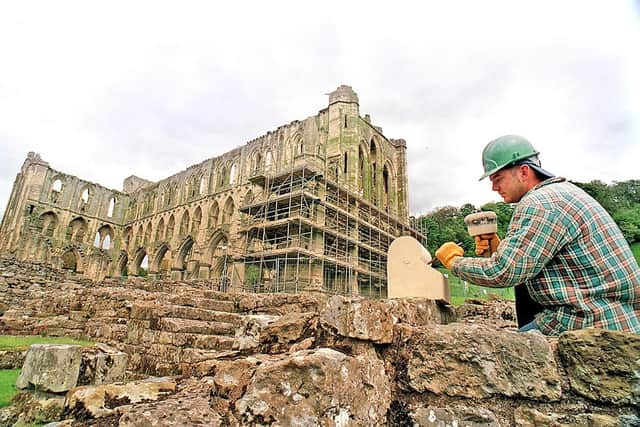
In a February 16, 1920 report headed ‘Rievaulx Abbey Preservation Work on the Glory of North Yorkshire’, it was said that over the previous 18 months considerable progress had been made on renovating the structure.
Scaffolding was erected for the purpose of removing the ivy which had overgrown the ruin and threatened the stability of much of the upper masonry.
This delicate and difficult task necessitated the removal of some of the ancient stones and the crumbling walls were strengthened.
Accumulation of earth in the nave and transepts was removed, uncovering the bases of the pillars and incidentally bringing to light many fallen fragments of the building which had long been buried.
Trees which had taken root close to the walls and by their underground growth were threatening the very existence of the structure were removed and the unsteady walls made safe.
It was added: ‘Already it is possible to appreciate many of the long-concealed beauties of the abbey…’
During July 1920, it was revealed that during the restoration and excavation at the abbey ‘two small leaden caskets containing the relic of some saint, have been discovered under one of the altars which have been laid bare.’
Much interest was shown in the Abbey’s restoration.
On Wednesday August 22, 1923 an account said the Queen, Princess Mary and Viscount Lascelles visited Helmsley, and saw ‘the beautiful ruins of Rievaulx Abbey…and were greatly interested in the noble pile.’
By 1924, it was announced that thousands of tons of debris had been removed to a depth of from eight to 12 feet.
The foundations of the whole of the conventual building were being unearthed, and the quadrangle and cloisters were plainly revealed. A portion of the work was carried out by war veterans.
Pontifical High Mass was celebrated at Rievaulx Abbey on Sunday July 10, 1932 for the first time according to The Catholic News (of July 16 of that year) in nearly 400 years.
This was in the presence of 15,000 people from all parts of the north of England. The event was organised by the Middlesbrough diocesan authorities to commemorate the octocentenary of the foundation of what was the first Cistercian Monastery in Yorkshire.
The abbey church was filled to overflowing and thousands of worshippers assembled on the wooded hillsides and the roads overlooking the abbey.
The Ministry of Public Building and Works in a 1966 report on the ancient monuments and historic buildings in its care said that in the previous year 68,400 people had visited Rievaulx Abbey. Four years later the figure was reported at 70,600.
English Heritage which now manages the Abbey continues with work on the structure.
Over the last few years restoration of the tanning vats has taken place. The English Heritage guide booklet informs it was in the tannery that leather was made from animal skins to be sold.
It was a long, hard and smelly process and it is surprising, says the booklet, that the Rievaulx tannery should have been so near the dormitory and other buildings where the monks lived and worked.
The Rievaulx tannery had three bays and was tiled, surviving vats can now be seen, close to where the monks’ reredorters and dormitory once stood.
It is added: ‘It is not known when exactly the tannery was moved here, but this may have occurred in the early 15th century when the monks’ dormitory was shortened.
Besides a tannery, the abbey also had a fulling mill, swine house, forge, corn mill and blast furnace. A museum on site has been established and is packed with artefacts and everyday objects used by the monks.
To meet the interest in the structure from schools and other educational bodies English Heritage has devised an Activity Trail.
A series of worksheets helps pupils and students explore how Rievaulx Abbey was established, its former function, eventual demise and rescue, to become a major tourist attraction not only in Yorkshire but the rest of the country.
Thanks to Kate Maughan-Brown at English Heritage for help with this piece.