
Rudston: The Yorkshire village with a prehistoric monolith which has been immortalised by David Hockney
Yorkshire has an array of impressive megalithic sites.

There's the Twelve Apostles on Ilkley Moor and the Devil's Arrows on farmland outside Boroughbridge, but the Rudston Monolith is unique, particularly as a Yorkshire Wolds village has developed around it.
The Grade I-listed monument in Rudston, between Driffield and Bridlington, rises up nearly 8m above ground and is 5m in circumference making it the largest single standing stone in England.
Excavations carried out in the 18th century by Sir William Strickland, a Government Minister in the administration of the first British prime minister Sir Robert Walpole, revealed many human skulls at its base, indicating a ritualistic function and also that the monolith may extend as deep below ground as it does above.
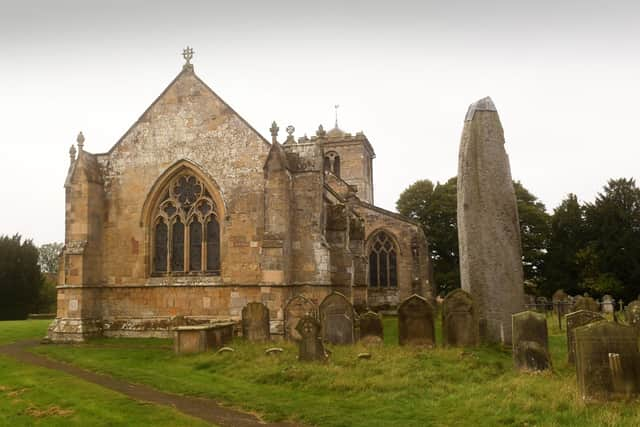

Its weight has been etimated at 40 tonnes, the same as a mature humpback whale.
It has remained in the same place since the Late Neolithic or Early Bronze Age, leading to claims that Rudston is the longest continuously inhabited village in England, however, in 2014 the title was confirmed as belonging to Amesbury, near Stonehenge, in Wiltshire.
For prehistoric pagans it was a holy place and remained so for their Saxon successors, who are thought to have fixed a cross to the top, which has since crumbled.
Nevertheless, the village's name is thought to derive from the old English word rood, meaning cross, and stone, and the freestanding stone continues to be a venue where the longest day of the year is celebrated.
Mystery continues to surround how the colossal stone arrived at the site, especially given the closest gritstone outcrop is almost ten miles away.
Theories have included that it was dragged on sleds and carried to the site by the glacier which shaped the Forge Valley.
The stone commands a central position in sites of archaeological interest, partcularly three cursus monuments, surrounding Rudston.
Southside Mount Barrow, which is thought to have been created for the body of an infant, stands nearly three metres high and has a diameter of around 30m on a hillside.
The Breeze Farm Cursus is on another hillside, near Kilham Grange, while to the north of Rudston the Glebe Farm Cursus and the Argham Cursus, which are visible from the ground depending on what is growing in the fields.
The Romans also settled in the area, building a villa in the fourth century to the Rudston's south-west by the Woldgate road between York and Bridlington.
First excavated in 1839, some of the North's best examples of Roman mosaics and painted wall plaster have been unearthed there before being lifted and displayed in the Hull Museum of Transport and Archaeology.
While it is thought there may have been a Saxon church built beside the monolith, it is known that a chapel was built, just feet from the stone in about 1100.
The remains of the Norman church, which include the lower part of the four-foot thick walled tower, were added to in 13th century with south and north aisles, to form what is recognised today as All Saints' Church.
Most of the church's stained glass was destroyed by a land mine during the Second World War and has been replaced with modern depictions, such as the east window above the altar, which shows figures ranging from the Venerable Bede, St Cuthbert and anti-slavery campaigner William Wilberforce.
Alongside the monolith, the graveyard contains numerous graves with intact wrought iron railings and is the resting place for pacifist Winifred Holtby, whose novel South Riding was published posthumously in 1936, as well as ten-year-old Alistair John, whose likeness, dressed in his best Sunday attire, is rendered beside the stone.
Facing the churchyard, on a prominent position on the edge of the village beside the Bridlington to Malton road, stands the village's war memorial, an eye-catching 6m-high white-painted stone cross that was unveiled in 1919.
For those wanting to explore the village's incredible past, The Rudston Heritage Centre is open during daylight hours most days of the year, in the north aisle of the church, and features a 3D model of the village and wall panels.
Entering the village from the monolith site, there's Corner Garden, a former chalk pit site which was used by the residents as rubbish dump for many years before the parish council transformed it into a nature reserve and picnic area nine years ago.
The haven that has been developed is one indicator of the community's strength. With a population of about 400, Rudston's village hall, at the end of the narrow Marton Lane, is another.
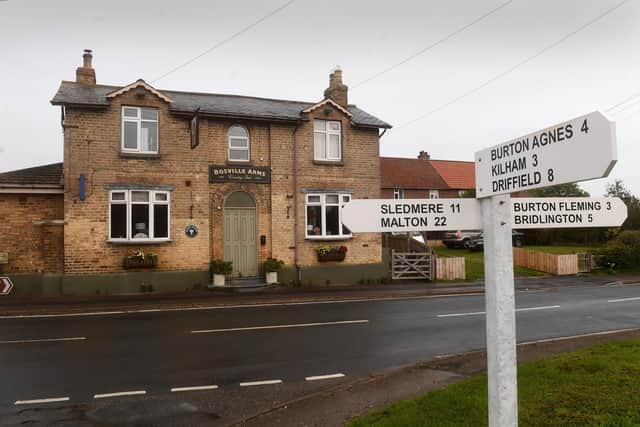
At the other end of the delightfully named Thwing Road, facing its junction with Long Street, stands another village institution, the 150-year-old Bosville Arms.
It's four years since the inn was relaunched as a community-run venture following residents raising some £200,000 to create a social space. It hosts regular community events, such as a nostalgic discos and men's nights.
At the other end of Long Street, passing farms and numerous modern homes, there's the diminutive 17th century Buttercup Cottage, which further underlines the village's heritage credentials.
The landscape surrounding the village also attracts attention for the intermittent chalk Gypsey Race stream.
It surfaces at Rudston and runs beside the tree-lined Burton Fleming Road and playing fields to the north before passing through the village's heart.
It has been dubbed the Waters of Woe, with locals claiming it has forecast events, such as wars and a plague, by rising up the year before.
In the summer some Rudston residents voiced anger over Ridge Clean Energy's plans to build 150m-high wind turbines on the landscape, just to the south of the village, immortalised by David Hockney's Bigger Trees painting.
The firm has stated the renewable energy scheme would generate sufficient electricity to power 24,000 homes.
Nevertheless, one resident said: "We saw a book of Hockney paintings when we used to holiday and we would come to see the village. Then we decided we were going to move to the village because of the paintings and the views.”