
Scampston, near Malton: Village that highlights great outdoors
Mid-way between York and Scarborough and five miles north-east of Malton, the village of Scampston did not exist until after a descendant of one of William the Conqueror’s knights in the 17th century bought a swathe of potential parkland to base his family’s seat.
While it was not until the 1770s that Sir William St Quintin laid out parkland designed by Lancelot ‘Capaibility’ Brown, the diversion of the main route between the city and seaside resort, which is now the A64, proposed in 1736 is thought to have been part of a plan for the improvement or creation of a park.
After being elected as an MP for Hull and becoming Receiver-General for Ireland and a Lord Commissioner of the Treasury, St Quintin bought the estate, a level site suitable for growing crops on the southern fringe of the Vale of Pickering. The diverse rural business running the 170-hectare Scampston Park continues to have interests in agriculture, horticulture, tourism, property management, arboriculture, and field sports.
With the local economy being heavily weighted towards the outdoors, the estate has worked alongside Natural England on a Higher Level Environmental Stewardship scheme, improving hedgerows, field margins, parkland and wetland habitats for ground nesting birds. It’s clear the estate takes pride in its environment as well as its heritage, with various well-maintained historic features in and around the village.

The landmark Scampston Bridge on the A64 is thought to have been designed in 1775 by Lancelot ‘Capability’ Brown, using a mix of red brick in English garden wall bond with sandstone parapet and dressings. Closer to Rillington off the A64 stands the original principal entrance to Scampston Hall, which has been owned by the Legard family and their direct St Quintin ancestors for 300 years, the village appears to have significantly developed in the 19th and 20th centuries. Scampston lies south-west of the estate’s hall and the main access to both the village and the historic home are along the ruler straight Sands Lane, from Rillington.
By the 2021 census Scampston’s population had risen to 352, most of whom live on one of the Y-shaped village’s two main routes, Outgang Lane and Town Street. The former road features a real pot pourri of property types spanning the decades, highlighting the unusually piecemeal development of an estate village. At its junction with Town Street, there is a triangular green with mature trees, a K8 telephone box and the Farmhouse Bakery and Coffee shop. The popular venue for villagers offers home-made pasties and an array of sweet treats, such as sticky orange chocolate cake.
The small green also offers views of the roof and bellcote of a small Victorian church, which was built in 1845 almost beside the road, with light yellow and and light grey Norman stones brought from a nearby thatched chapel which also served nearby Rillington. Historians have said enough of the chapel’s stone was recycled in the new place of worship that Colonel William St Quintin avoided the need to get it consecrated as well as the fees.
On the south side of Town Street, stands the mid-19th century Keeper’s Cottage, built with a pinkish brick in English garden wall bond, while opposite there are the 19th century mottled brick Cundill and Dallimore cottages.
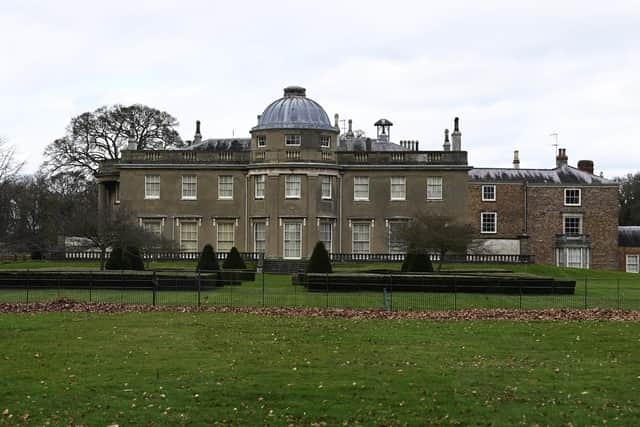
Further along Town Street are early 19th century cast iron gates and sandstone gate piers with shallow pilasters supporting scrolled volutes at each side and ball-and-pedestal finials, heralding the entrance to Scampston Hall, at the other end of a 180m drive.
Last year the Legard family opened the hall’s doors to the public for Upstairs, Downstairs tours to reveal its Regency interiors, which they have restored as well as having carried out major works to the building’s fabric.
Conservation efforts have also been ploughed into the hall’s magnificent art, porcelain and book collections as well as the scullery and cellar and hidden quarters downstairs. The walls of what once was a butler's pantry are lined with bells to summon staff.
The art collection features several works by Thomas Gainsborough, a friend of Sir William when they spent a season in Bath.
The impressive property, boasting a detached hemicycle of giant Tuscan columns and tall 12-pane sash windows on the ground floor, has featured in a number of productions, including Mad to be Normal, a feature-length biopic about the controversial psychiatrist RD Laing and a production of An Inspector Calls, starring Miranda Richardson and David Thewlis. The gardens surrounding the country house have proved a strong draw too. Last year, in a Facebook post gardening expert Monty Don wrote: “Sitting at my desk writng about Scampston Hall in North Yorkshire and just revelling in how incredibly good it is.”
Renowned garden designer Piet Oudolf has used yew, box, grasses and limes to emphasise sections. Visitors are steered towards the pyramid-like Mount to appreciate the complex planting in its full glory. About 90m from the house, and in contrast to it, there’s a listed triple-span bridge carrying T-shaped, three-bay pavilion, built over the beck. The pavilion has pairs of Ionic columns over bridge pilasters, with a frieze of wheatear festoons.
Maintaining the artistic tradition of the hall, The Bothies Community Art Club meets in the walled garden’s conservatory. The community will also be welcomed to the property for free for the hall’s annual Residents Weekend later this month. The parkland remains in high demand as a venue for large-scale rural showcases. May will see the parkland host the Yorkshire Game and Country Fair, while the two-day Yorkshire Traction Engine Rally is staged there in September.
However, in January organisers of the Malton Show cancelled this summer’s event, due to losses and a deficit of volunteers.