
Scarborough: Postcards from a time gone by show glimpse into history of beloved seaside resort
I have heard that mailing postcards is not as popular as it used to be.
People can use, more conveniently, their mobiles to send a photograph of a scene, or an event, along with a message.
This was not the case in the early 20th century when postcards, produced in their thousands, and depicting a variety of subjects, were the only means of quick communication. Those sent from Scarborough at this period illustrate the postcard trend perfectly.
Finding their way on to postcards were a number of the town’s buildings and recreational facilities that had been erected in the 19th century. Then, in the 20th century, photographers found other subjects: trams, military meetings and lifeboat launches as suitable subjects for postcards.

On Thursday July 19, 1827 Scarborough’s Cliff Bridge was opened to the public by a grand procession which included the Archbishop of York.
After the return of the procession, the York Mail, drawn by four horses, tried the bridge’s strength effectively, by passing along it and returning at full speed.
This was amidst the deafening applause of thousands of spectators.
The purpose of the bridge, built by the Cliff Bridge Company, and costing around £7,000, was to link the centre of the town with the new south side attractions. Stretching 414ft (126.2m) and 13ft (4.1m) wide, the bridge towers 75ft (22.8m) above the valley.
Scarborough Corporation acquired the bridge in 1951. It was designated a Grade II listed building in December 1953. A major renovation project took place on the structure between 2009 and 2010.
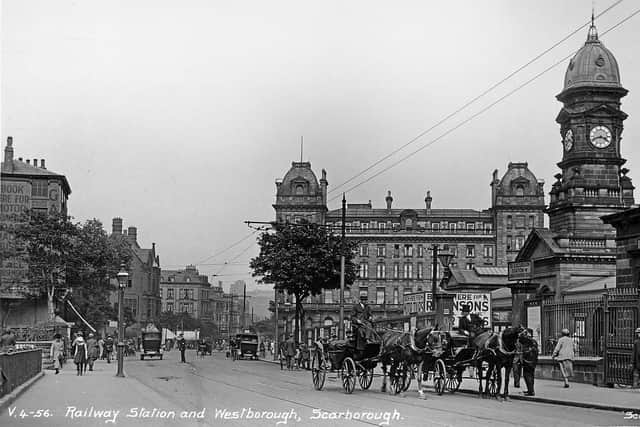
Railway architect G.T. Andrews produced designs for the original Scarborough railway station which opened on the York to Scarborough line on July, 7, 1845. The Baroque-style tower, which dominated later postcard views of the station, was not added until 1883-4 during a reconstruction by architect William Bell.
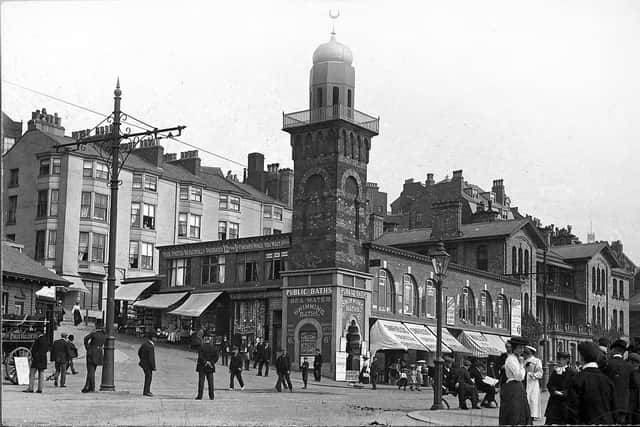
Scarborough’s Public Baths were ready for public use on April 23, 1859.
During the previous year, a company had been formed at Scarborough for the erection of the baths which were situated on the south shore, at the foot of Blands Cliff.
The buildings were described as being in the ‘Saracenic style of architecture’ with a lofty Moresque tower and dome.
The building’s sea front displayed a succession of Moorish arches, in red and white bricks, and stone pilasters and dressings.
At the outset, the main area of the building was a room 40ft high, 56ft long by 50ft wide, and contained a tidal swimming bath of tepid sea water and was fitted with ‘dressing boxes’ for at least 50 bathers at one time.
There was a ladies’ plunge bath and hot, cold, shower and slipper baths of both sea and fresh water, with arrangements for vapour and other medicated baths.
The sea water which supplied the baths was drawn from the sea at a distance of upwards of a quarter of a mile from the shore.
It was brought through pipes, and ebbed and flowed into the building every tide. The company’s engineer was Josiah Forster Fairbank, civil engineer of Scarborough, from whose designs the buildings were erected.
Much later, the building was turned into an amusements arcade, called Corrigans and then Coney Island.
On Saturday May 26 1877, it was announced that an event of great interest and importance at Scarborough had occurred.
This was the opening for the first time to the public of a magnificent Aquarium which had been constructed in the valley under the Cliff Bridge at a cost of about £120,000.
The architect and engineer was Eugenius Birch, of Westminster Chambers, London. Kirk & Parry of Sleaford were the contractors. The length of the building was about 500 feet, and the width 250 feet and covered an area of about three acres.
Constructed underground, 200,000 cubic yards of earth were removed in its construction. One newspaper said that the Aquarium featured ‘Mahometan Indian characteristics.’
Taken over by the Council in 1925, it traded under the Gala Land title but was demolished in 1966.
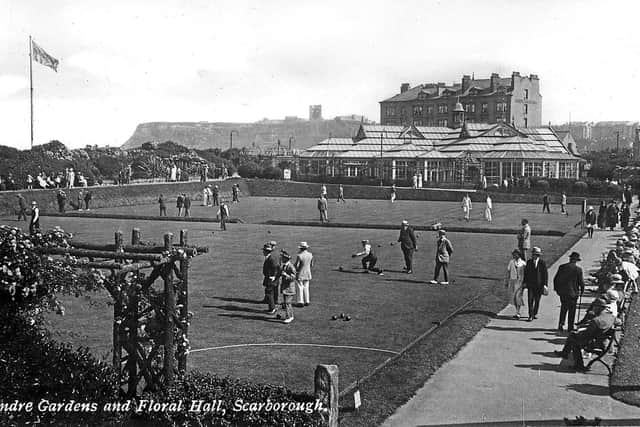
Scarborough Corporation bought Alexandra Field in 1889 and by 1908 Alexandra Gardens and a Floral Hall were available to the public.
The Mayor of Scarborough (Councillor W. Ascough), on Saturday July 2, 1910, formally opened the new Floral Hall, on the north side of Scarborough, which the Corporation had erected at a cost of £3,000.
The new building could seat at least 1,200 people and it was said that artistic and effective floral decorations had been carried out internally.
The Mayor said they could not have too many attractions for a town like Scarborough. Not only would the new Floral Hall be an attraction to the town, but he prophesised that it would not cost the ratepayers one farthing.
In the past, the north side entertainers had been at the mercy of the weather, but now they had a building which would make them in a measure independent of the weather.
The start of a British tramway system often brought out photographers to record the event. Scarborough’s opening on Friday May 6, 1904 was no exception and some postcards depicted the Mayoress (Mrs Morgan) as a tram driver.
A Miss Fowler, the daughter of a councillor, handed a beautiful bouquet to the Mayoress, who stepped on to the first car. This was lavishly decorated with flags and garlands of flowers and she switched on the current with a presentation silver switch.
Immediately, the bells of all the cars rang out and the crowd cheered as the Mayoress declared that the tramways were opened.
She wished success to the tramway company and the benefit of the town. A tour of the town was then made by the various cars, the first two being reserved for the tramway company directors and members of the Corporation.
The main streets were thronged with people and it was said: ‘tradespeople rushed to their shop doors, housemaids peered down from upper windows, cabbies gazed mournfully over their horses’ backs…and the children, who seemed to be enjoying a holiday from school, yelled with delight’.
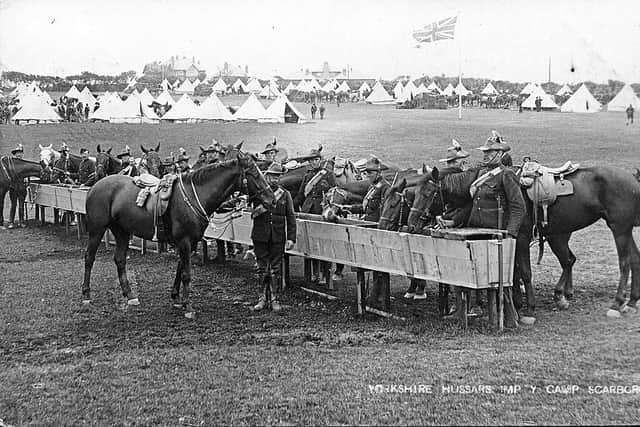
Fine weather favoured photographers on June 15, 1905 as they recorded the annual inspection of the Yorkshire Hussars Imperial Yeomanry encamped at Scarborough.
Colonel Lowe, inspecting officer of auxiliary forces, took the four squadrons in turn, and saw them put through ordinary squadron drill, dismounted work, and drilling the troop leaders.
The turnout was good, and the riding excellent. There were about 350 men on parade under the command of Major C.W.E Duncombe.
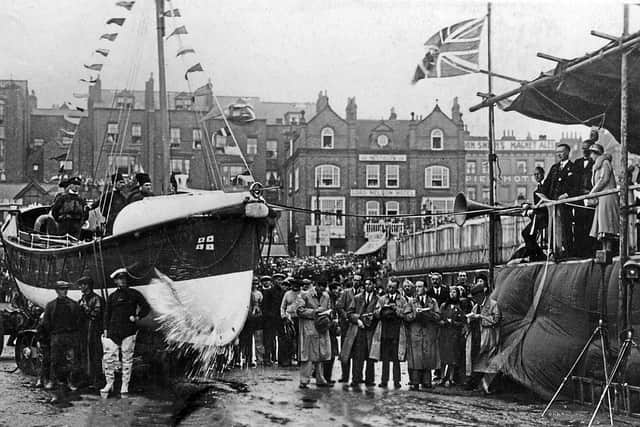
Although it was a wet day on Wednesday August 5, 1931, postcard photographers – and the general public - were not deterred as they wanted to watch H.M.H. Princess Mary christen two new East Coast lifeboats.
The ‘Stanhope Smart’ at Bridlington and the Herbert Joy II, at Scarborough. Upon arrival at Scarborough, H.R.H was met and escorted to the Grand Hotel, where she had lunch with the Mayor and Mayoress and a few others.
She then visited the south foreshore, where on the beach, opposite the lifeboat house, the christening ceremony took place.
One report said the ‘Herbert Joy II’ was the second motor lifeboat Scarborough had possessed, as well as nine rowing and sailing boats, and in 131 years 359 lives had been saved.
Commander E. Drury, the Chief Inspector of Lifeboats, said the new lifeboat had cost £4,200. It was the gift of Alexander O. Joy, of Leeds and London, in memory of his brother, Herbert Joy, who was drowned in a squall of Scarborough while returning to his yacht in the bay.
The account mentioned that Scarborough was the oldest lifeboat station in the county, the first lifeboat having rescued a crew of seven of a Newcastle vessel in 1801.
This was a quarter of a century before the Royal Lifeboat Institution was founded. Scarborough’s lifeboat was then supported by the nobility and others.