
Scarborough's Penny Bank: The pioneering saving club for 18th Century women and their elaborate recipes
John Vincent examines 18th century books and manuscripts which offer instructions on making elaborate meals, strange whiskies and remedies.
The well-to-do ladies of late 18th century Scarborough filled in their days as they had done for generations: outdoing each other with the originality of their recipes for elaborate meals and remedies for everything from piles to palsy.
One such lady hoarded hundreds of these jottings in a book bound in vellum, assembled in 1791 and containing instructions for the preparation or such dishes as 3 Pitta pattas ala Bashamell, Hartshorne Jelley, Pott Hare, Duck Flummery, Venison Pastye, and Lady Sackville's method of preparing tea cakes.
What's remarkable about this unpublished tome, is that the compiler did not confine herself to domestic issues but drew up the constitution of a pioneering Penny Bank, Scarborough's savings club for women.
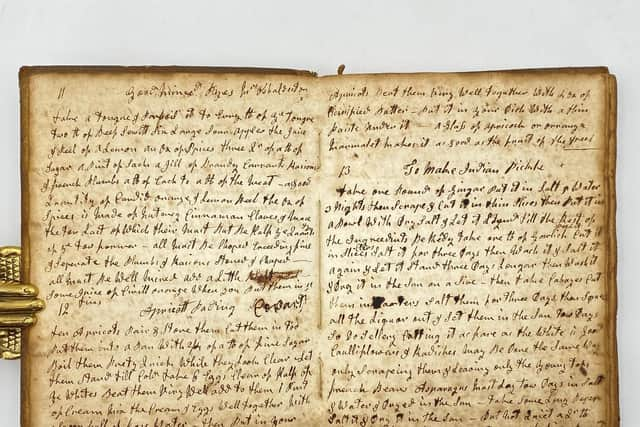

"Each Lady on the Committee to collect her own subscriptions once a week or monthly, "it was ordained...a Jewish Repository shall be obtained by each Lady on the Committee to be sent round amongst her Subscribers".
Six committee members are recorded on the committee: "Mrs Atkinson, Mother Robinson, Misses Brown, Ashely, Elizabeth Lee, Mary Fisher, Secretary A Wainwright" – the latter apparently the author of the manuscript, offered in its entirety by Ilkley-based Christian White Rare Books at £1,750.
Scarborough's Penny Bank was founded on July 7, 1813, and nearly 40 years later attracted the attention of Charles Dickens, who records in his journal, All the Year Round, the average deposit: "At Scarborough, it has been only eightpence, and the average balance kept in the Bank by its customers is six shillings and fourpence".
He observes: "There ought to be such a Bank in every poor district." What happened to this female-run bank I wonder....
Another remarkable offering from Dr White, at £5,000, is an aristocratic manuscript from 1720 in the form of an Irish collection of recipes by one Penelope Stratford which include two original directions for "uscabaugh" – water of life in Gaelic, or whisky as it became in English.
The first is attributed to a Dr Fennell, almost certainly 17th century Irish doctor and politician Gerald Fennell.
His recipe runs to three pages and includes such oddities as primrose flowers, a pound of dried and bruised aniseeds, lily of the valley, rosewood, borage, the dubious addition of "ambergreece" (ambergris?) and 12 pounds of "Cittron sticks as thin as possible Strung with a needle on a very long thread so long as may hang into ye middle of ye barrel." A strange concoction indeed…..
The second whisky recipe concludes with Ireland's national symbol named as the final ingredient – "a few shameroughs [shamrocks] all a little bruised".
Then there's Martha Smith's mid-18th century handwritten recipes and household remedies, finally published in the 1950s.
Listed are cures, including "Ointment For the Bots Worms in Children", a "Receipt (sic) for the Stone and Gravel", how "To Cuer a Childs Sore face" and remedies for "Piles, palsey, gnat bites, Consumption, Toothache, Hydrophocia and The famous American recipt (sic) for Rheumatism". It is offered at £1, 500.
The 1805 Austwick Hall copy of Drunken Barnaby's Four Journeys to the North of England, by Richard Brathwaite under the pseudonym Corymbaeus, recording the drunken character Barnaby's trips in rhymed Latin and doggerel English verse, originally written in 1716, was offered at £95.
It was snapped up immediately and repatriated to Austwick Hall, a historic manor house above the village of Austwick, recorded in the Domesday Book and mentioned in 1551, when it was purchased by Sir John Yorke from the Duke of Suffolk.
Also of local interest: Local Jottings, Being a Lecture on the History, Antiquities, and Worthies of the Ancient Parish of Giggleswick, delivered in the Music Hall, Settle, on the 27th of February, 1883 by solicitor Thomas Brayshaw (1854-1931), a local historian living in Stackhouse, near Settle, who was closely associated with Giggleswick School. The leather-bound is priced at £95.
A second edition, 1801 copy of The Life of John Metcalf, Commonly Called Blind Jack of Knaresborough, anonymously written, is offered at £150 and includes "Many Entertaining Anecdotes of his Exploits in Hunting, Card Playing, & Some Particulars Against the Rebels in 1745".
Two ancient maps of Yorkshire are offered at £125 each. One is A New Map of the County of York, divided into its Ridings and their Subdivisions...by Thomas Dix, published in 1830, and the other an 1809 second edition copy of Laurie and Whittle's New Map of the County of York, laid down from Astronomical Observations...and dedicated to "The Rt. Hon. Edward Lascelles Baron Harewood of Harewood".