
Selby: The long history of Yorkshire town from its abbey to coal mining
Certain important developments feature in Selby’s long history and mainly concern the Abbey, railways, a road, bridges and coal mining.
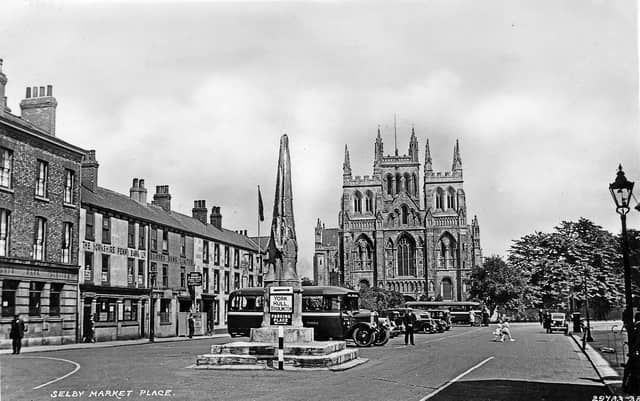

Selby may have originated as a settlement under the title of Seletun and this was mentioned in the Anglo Saxon Chronicle of AD 779.
Permission was granted to monk Benedict of Auxerre in France, from William the Conqueror, to found Selby Abbey in 1069. In time, it became one of the wealthiest in Yorkshire. From 1256 it was a ‘Mitred Abbey’.
Following the surrender of the Abbey on December 6, 1539, the abbey church struggled to survive but became the Selby Abbey parish church in 1618. The building underwent a number of changing fortunes in later years. One of the most dramatic was the fall of the central Norman tower in 1690.
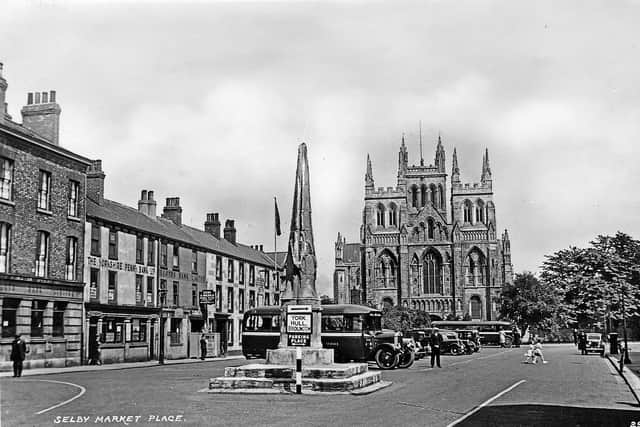
It fell to the south, carrying with it the greater part of the transept on that side of the church. In 1902, the tower was rebuilt.
This completed a restoration begun earlier in the 19th century, with the removal of a gallery in the Lady Chapel, side galleries and a plastered wall that separated the choir from the nave.
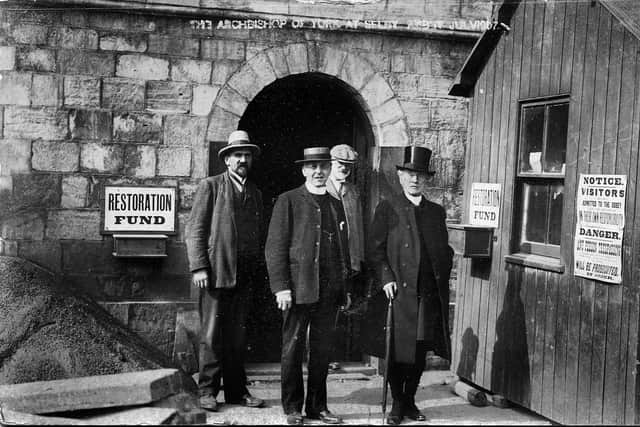
A disastrous fire occurred at Selby Abbey on Friday night and Saturday morning October 19/20 1906. Thousands of people from all parts of Yorkshire visited Selby on Saturday and Sunday to gaze at the scene of desolation left by the fire.
Miraculously, amid the general ruin, it was amazing to discover the beautiful East window, one of the finest examples of a Jesse window to be found in the country, had escaped with comparatively little damage.
The Vicar of Selby saw the Archbishop of York on Saturday afternoon at Bishopthorpe and was told everything possible would be done to restore the Abbey.
The Bishops at Hull, Sheffield and Wakefield said they would give support. At a cost of over £40,000, the Abbey was completely restored. On the first anniversary of the great fire, Selby Abbey's restored nave was opened for Divine Service on Saturday October 19, 1907.
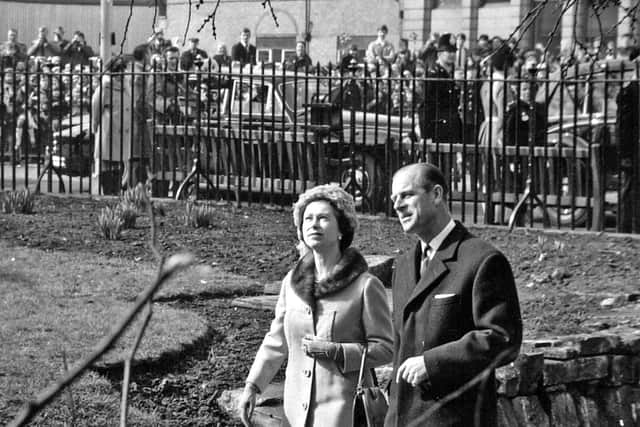
Further restoration work was completed and celebrated with the Archbishop of York in attendance on October 19, 1909. Selby Abbey was visited by the Queen and Prince Philip in April, 1969, and Prince Charles, October, 2002.
Selby has road and railway bridges. M.V. Wooley (1973) states that before a road toll bridge was introduced the only means of crossing the River Ouse was by ferry.
Records noted that in 1789 over 105,000 pedestrians, 75,000 horses, 30,000 farm animals and 500 vehicles had used the ferries. In spite of protestations from ferry and river navigation companies, the construction of a tolled swing bridge was deemed a necessity.
Selby canal engineer William Jessop was brought in to make recommendations and a bridge was constructed under the Selby Bridge Act in 1791. Thereafter, the history of the bridge includes stories of collisions with ships, repair and reconstruction and many parliamentary debates.
For years, motor vehicles queuing to pay tolls strangled traffic passing along the A19, but charges were scrapped following a £500,000 buyout by Selby District Council and North Yorkshire County Council. Local business also contributed. Many motorists jumped for joy on September 19, 1919 to celebrate the first free crossing of the River Ouse at Selby Toll Bridge.
Motorists popped champagne corks again in 2004 with the opening of the Selby by-pass, thus providing the long-awaited alternative route.
A railway – Yorkshire’s earliest main line – extending between Leeds and Selby opened to passengers in September 1834 and freight in December of the same year. The line was constructed by contractors Messrs Nowel.
On September 27 1834, The Leeds Times said: ‘The arrival of the [first] train at Selby, and its departure from that town, were signalized by the discharge of a number of small cannon.’
According to Bill Fawcett in A History of North Eastern Architecture (2001), the Selby and Leeds stations were the first significant railway facilities to be built in the North-East.
The designs have been attributed to James Walker and George Smith. Selby station was used predominantly as a railhead for river traffic – or a transhipment shed. It comprised a three-span roof with passenger lines and goods tracks, but no platforms.
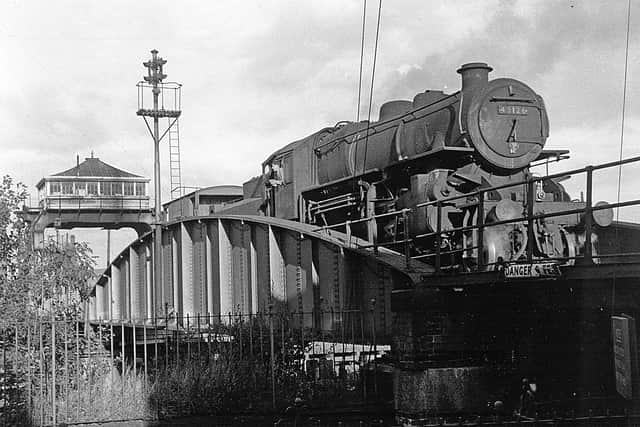
The Leeds and Selby Railway was joined by the Hull and Selby Railway in 1840. The lines were connected at Selby via a cast-iron bascule bridge. Another Selby station was built in 1841, with the first one becoming a goods station.
Fawcett says little is known of the second station but it did have platforms. This second station was rebuilt in 1873 to the designs of the North Eastern Railway (NER) architect Thomas Prosser. From 1871, the East Coast Main Line traversed Selby using the bascule bridge to head north or south.
In 1887, a new railway swing bridge was devised by NER engineer, Thomas Elliott Harrison, the bascule one eventually being demolished. The new bridge opened in February 1891 and the total cost was about £30,000. A major reconstruction of the station occurred in 1889-1891.
On February 6, 1985, the Yorkshire Post said that Miss Christine Moss had become the first female operator of the swing bridge. An £8m refurbishment in the latter half of 2014 was described by Network Rail as the most significant to the structure since it was built.
Attempts to find coal on Yorkshire's north east side were made at Kellington during the 1950s and workable seams were discovered: the Beeston Seam and Warren House Seam.
Further drilling took place around Selby in 1964 with drill cores revealing amazing results. Most important was the discovery of the Barnsley Seam, running towards the east, good and thick in some areas.
Further exploration was deemed necessary as it looked like a lucrative, new coal field had been found at Selby. On April 1, 1976, Anthony Crossland, the Secretary of State for the Environment, granted the NCB planning permission for the Selby site.
He felt the richness of coal under the 110 square miles around Selby was a national asset too valuable to ignore.
The Duchess of Kent took charge of a drill at Wistow to mark the start of mining in Selby on October 29, 1976.
Secretary of State for Energy, Tony Benn said: “Britain can look forward to ample supplies of energy as far ahead as we can see."
Concern over subsidence occurring to Selby Abbey was given special attention. An area beneath the Abbey was defined and would not be touched, and called the 'Selby Pillar'.
By April 6, 1983 the Yorkshire Post was stating full-scale mining would start in the Selby pit complex in six weeks. Gascoigne Wood was to be nerve centre for the entire scheme. The cost of constructing the 124 miles of underground roadways cost £1.3 billion. The other five colliery sites were at Wistow, Stillingfleet, Riccall, North Selby; and Whitemoor.
In the same year on October 3, the Selby Diversion was completed and took the East Coast Main Line west, and away from the town. This was to avoid an area of potential subsidence over the Selby Coalfield.
A start was made in July 1980 with the following people in attendance: Glynn England (CEGB), Peter Parker (BR), and Derek Ezra (NCB). A. Monk & Company undertook the work, at a cost of £63 million.
Thereafter, ECML trains no longer called or passed through Selby, and avoided the speed restriction on the swing bridge.
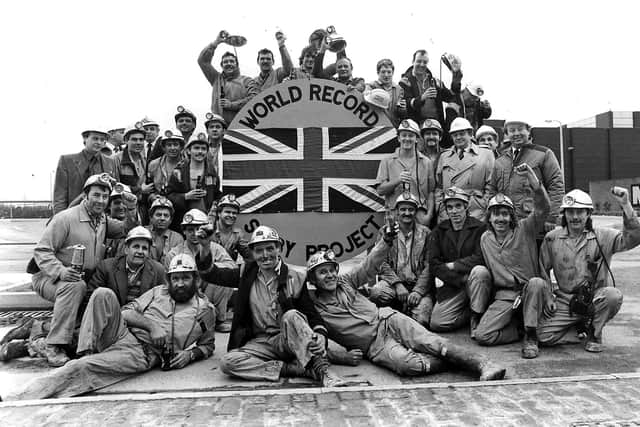
Selby coalfield's output rose gradually after the Miner's Strike, peaking in 1993/94 with an output of 12 million tonnes. Under the re-organisation of the coal industry in 1994, Selby coalfield was acquired by RJB Mining.
Losses occurred thereafter, until the entire complex was closed by October 2004.