
Sheffield Blitz: I discovered my grandma's memoir and was inspired for 15 years to research Second World War attacks on our city
Neil Anderson has spent 15 years researching the Sheffield Blitz. He speaks to Laura Reid as he releases a special collection in the run up to the 85th anniversary.

Like many of her generation, Dorothy Glover never spoke about her experiences during the Second World War. But the discovery of an unpublished memoir following her death led her grandson Neil Anderson to dedicate 15 years of his life to exploring what happened in Sheffield when the country was in the grips of conflict.
What started for Neil as a quest to find out about what happened to his family during the Sheffield Blitz of 1940 turned into a decade-and-a-half of research shedding light on what were the worst nights of German Luftwaffe bombing to hit his hometown.
"I knew little bits about the Sheffield Blitz but to be honest, very little,” the 59-year-old admits. “When my grandma died (in 2009, at the age of 93), she left this memoir that we discovered. Like many grandparents, she never really talked about her experiences in the war, but there was a lot in this memoir about her life in Sheffield in World War Two…

"The family stayed in a communal air raid shelter in the Fir Vale area of the city. All she wrote about was the squabbling, night after night after night and how she absolutely despised the neighbours. She told of what it was like being cooped up in this tiny air raid shelter with these multiple families, the arguments that used to kick off. There was something in that that just piqued my interest and set me off on this voyage of discovery.”
Neil’s research has included interviews with hundreds of survivors and collaboration with the Imperial War Museum, as well as weeks searching through archives in both the UK and Germany. Now, as the 85th anniversary of those dark days approaches, he is launching a special collection of books, pulling together his work on Sheffield’s wartime trauma.
Sheffield Blitz: The Definitive Collection includes four books: Sheffield’s Date With Hitler – an introduction to the attacks; Forgotten Memories From A Forgotten Blitz - the harrowing stories of survivors; Defiant! - the Sheffield spirit that brought the city back from the brink; and Countdown to Sheffield Blitz - detailing Hitler’s assault on Sheffield, climaxing with a dramatic strike in 1944. The package also features a map of Sheffield showing where each bomb was dropped and copies of three German bombing maps detailing where in the city was a target.
“So many people cited the reason for the Germans hitting Sheffield being that they wanted to wipe out the armament factories,” says Neil, a PR consultant, historian and a lecturer at Sheffield Hallam University. “They were hit but not with any kind of great force and nothing was knocked out of production for any length of time. And I could never understand why there were bombs dropping right across the city. There was hardly a suburb of Sheffield that wasn't hit.

"The German bombing maps of Sheffield have the armament factories marked as targets, but they're actually down as secondary targets. Prime targets are things like hospitals, schools, railways...That brought me to a theory that maybe this was far more of a kind of raid to terrorise the Sheffield public into submission. Nearly a tenth of the city's population became homeless over the two nights (of the Blitz) in December 1940. So, it was a major attack.”
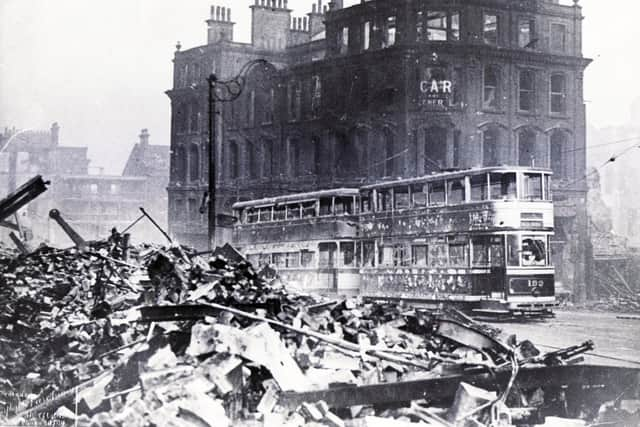
The main attacks on Sheffield took place on the nights of 12 and 15 December 1940. That first night, large parts of the city centre were devastated, bombed and ravaged by fire. Two nights later, the industrial part of the city was hit, including Brown Bayleys steelworks. Almost 700 people were killed during the air raids and more than 82,000 houses destroyed.
Those he interviewed told Neil of the horrors they witnessed. What they described painted a picture of years of fear, resilience and survival. “The air raid sirens went off the first time over Sheffield on the day war was declared in September 1939,” Neil explains. “And the last bomb wasn't dropped until Christmas Eve 1944. So it was years and years of fear…that these people endured.”
The more he has researched, the more Neil has been determined to educate others about what happened and to commemorate those in Sheffield affected by the war. The Sheffield Blitz Memorial Trust was established with others sharing his passion and the group has created a memorial trail with an app and a permanent exhibition on the blitz at Sheffield’s National Emergency Services Museum.
With support from the National Lottery Heritage Fund, it is now running the Sheffield Blitz 85th project, recording the memories of the last living generation affected by the 1940 bombings—those who were children during the Second World War. Neil’s father is one of them; his house was damaged, the windows blown out.
"He grew up in Attercliffe which was the hub of all the steelworks,” Neil says. “He says he remembers pleading with his parents not to send him away to be evacuated. He wasn't evacuated. None of his friends were and they were in the absolute eye of the storm. And that really amazed me that they just wanted to stay together. Apparently Sheffield had one of the lowest evacuation rates in the country.”
Neil will officially launch his collection with a talk at Sheffield Central Library at 6pm on June 11, when he will reflect on his 15 years of research. “It is all about trying to educate people about what the city endured all those years ago, what the Sheffield people endured,” he says. “It was a very, very dark period, but Sheffield came through it. I think even Winston Churchill held Sheffield up as an example to the whole country - how this city fared with this horrendous attack. It's very important to commemorate it, remember it, and learn from it.”