
Sir Nigel Gresley: One of the world's greatest engineers who carried out extraordinary feats in Yorkshire
On June 19th, 2026 it will be 150 years since one of the world’s greatest locomotive and carriage engineers, Sir Nigel Gresley, was born. Most of his greatest achievements were realised in Yorkshire at Doncaster Works.
Herbert Nigel Gresley was the son of Reverend Nigel Gresley of Netherseal, Derbyshire.
He was educated at Marlborough College, then apprenticed at Crewe Works of the London & North Western Railway under F.W. Webb.
At age 22, Gresley moved on to Horwich Works of the Lancashire & Yorkshire Railway and studied further under J.A.F. Aspinall.

Gresley broadened his railway knowledge by transferring into the carriage and wagon department, spending several years there.
In 1905, Gresley became the head of carriages and wagons for the Great Northern Railway which started nearly 20 years of work in Doncaster.
He had the freedom to innovate in this role and started quickly with a bogie wagon in which the wheelsets were able to swivel when necessary, aiding the turning of the vehicle.
For carriages, Gresley switched from wooden underframes to steel and this improved safety, load carrying capacity and durability.
Gresley’s early coach sets were successful enough to be perpetuated as part of the East Coast Joint Stock operated by the three main companies sharing the East Coast Main Line.
Although he had been with the GNR for a relatively short space of time and just 35 years old, Gresley was given the role of Locomotive Superintendent following the retirement of H.A. Ivatt in 1911.
As freight and coal traffic was the GNR’s main concern, Gresley’s early locomotives catered for these trains.
Yet, the engines provided an opportunity for new design ideas to be tested and Gresley decided to favour three cylinders, for which he developed a new type of valve gear.
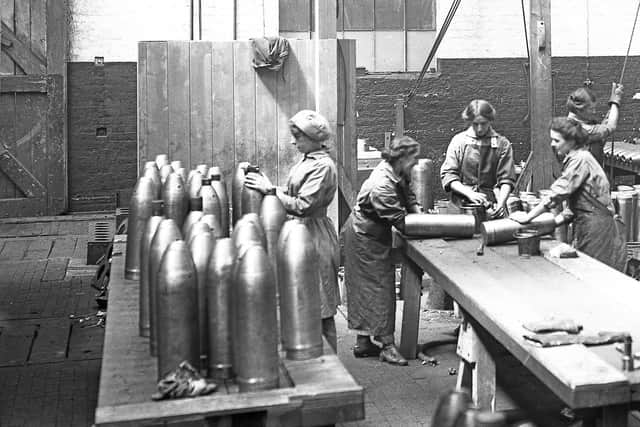
During the First World War, Gresley stayed at Doncaster Works to oversee the production of war materials, including shells, fuses and wagons.
As a number of employees joined the Armed Forces, many women were employed at Doncaster to help with the extra workload. Gresley was particularly complementary about their contribution.
For his own role in the conflict, Gresley was made an Officer of the British Empire in 1920.
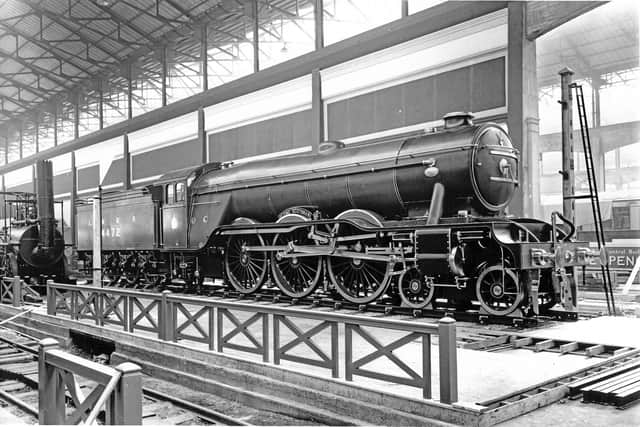
In the final year of the GNR before Grouping in 1923, the first A1 Class 4-6-2 ‘Pacific’ locomotive, no. 1470 Great Northern, was erected at Doncaster and subsequently joined the lineage of distinguished engines to run on the East Coast Main Line.
The A1s were also the first Pacific class to be built in Britain.
The GNR’s successor was the London & North Eastern Railway and Gresley was chosen to lead the rolling stock department.
One of the first A1s built for the LNER was no. 4472 Flying Scotsman, which went on to become the most famous steam locomotive in the world.
In 1928 no. 4472 was the first locomotive to travel non-stop from London King’s Cross to Edinburgh Waverley, then in 1934 Flying Scotsman was the first steam engine to be officially recorded travelling at 100 miles per hour.
In order for the non-stop service to be introduced, Gresley designed the corridor tender which was a pioneering development. This allowed the crew to change without stopping.
The passageway was supposedly determined by Gresley using his dining room chairs set a distance from the wall and him crawling in the space between.
Through a long-standing agreement, the services from London to Scotland were timed leisurely to prevent dangerous competition. By the early 1930s, this was no longer satisfactory.
The ‘Flying Scotsman’ train’s timings were improved in 1932 and thoughts turned to providing other express services.
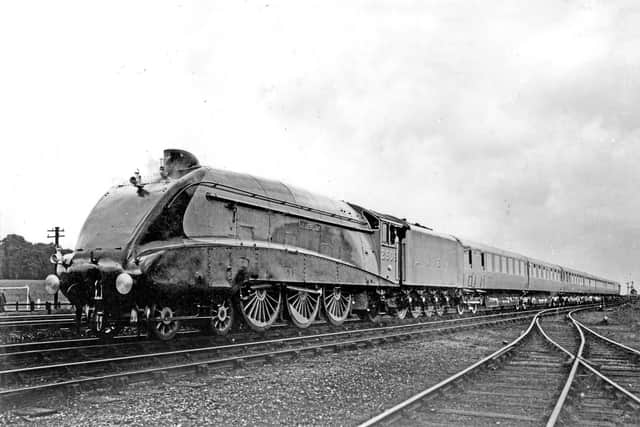
Inspired by diesel railcars on the continent, the LNER devised the ‘Silver Jubilee’ service in 1935 to run between King’s Cross and Newcastle. This was timed at four hours with a stop at Darlington.
To achieve the schedule, Gresley determined that streamlining was necessary to improve efficiency and save fuel.
The science of streamlining was little-known at the time, though Gresley had tests conducted in a wind tunnel, partially to determine a suitable design to improve smoke deflection which was a concern of the era.
New A4 Class Pacific locomotives were provided for the service and these built on the successful design of the A1s and A3s.
Four appeared from Doncaster Works initially, followed by another 26 for general service and five for a second high-speed service introduced in 1936.
The ‘Coronation’ replaced the ‘Flying Scotsman’ as the non-stop and travelled between King’s Cross and Edinburgh in just six hours.
Another service started was the ‘West Riding Limited’ between King’s Cross and Leeds and Bradford.
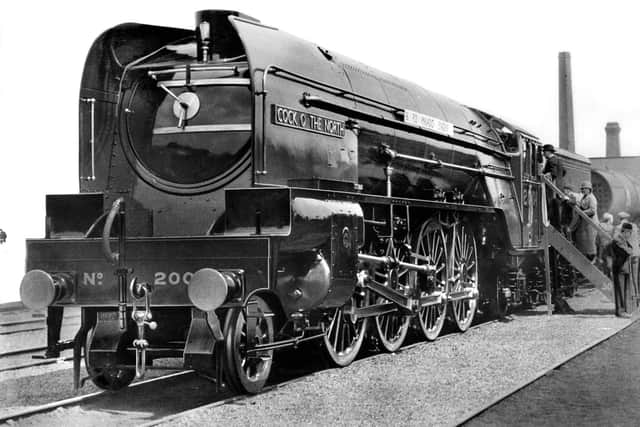
Gresley had been interested in improving the efficiency of the steam locomotive for many years and several features to do this were fitted to P2 Class 2-8-2 no. 2001 Cock o’ the North, built in 1934.
The engine proved to be the most powerful express locomotive in the country at the time. For his services to the railway, Gresley was awarded a knighthood in the birthday honours of Edward VIII in 1936.
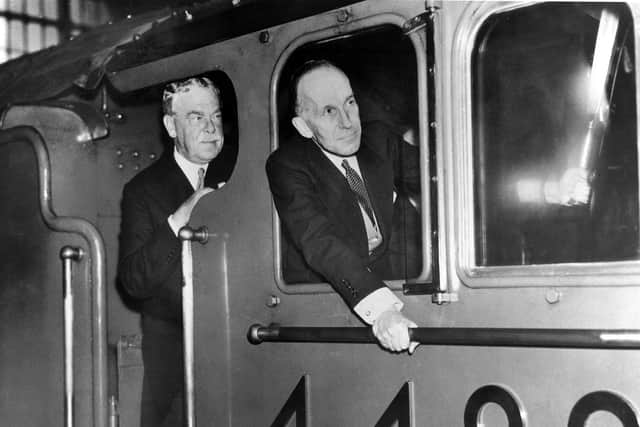
During the following year, the 100th Gresley Pacific was built at Doncaster and no. 4498 was named Sir Nigel Gresley at a special ceremony to honour the designer.
The LNER was particularly publicity conscious and used events and records to their advantage on many occasions. A4 no. 2509 Silver Link bettered the speed record during a press demonstration of the ‘Silver Jubilee’ in 1935, attaining 112 mph and on several instances travelled over 100 mph.
The company lost the speed record to the rival London Midland & Scottish Railway in the mid-1930s, then the Germans.
Gresley and the LNER were determined to recapture the accolade in 1938 and arranged a special run on July 3rd, 1938.
A4 Class no. 4468 Mallard was chosen as the engine was equipped with a special exhaust system, previously used with no. 2001.
Driver Duddington from Doncaster shed was specifically given the task, along with Fireman Tommy Bray.
Going down Stoke bank, south of Grantham, the pair managed to coax 125 mph out of Mallard, with a brief maximum of 126. The record set has remained unbeaten to the present.
On April 5, 1941, Gresley died aged just 64. He left the LNER in a strong position to meet the demands and challenges of the Second World War.
During his career around 2,000 locomotives were built to his designs, with a similar number of carriages also created.
Sixteen Gresley locomotives have been preserved subsequently, including no. 4472 Flying Scotsman, no. 4468 Mallard and no. 4498 Sir Nigel Gresley. There are also around 80 coaches still in existence.
The A4 Class is strongly represented with six of the 35 class members preserved.
Two are based overseas in Canada and the USA. No. 4472 toured North America in the 1970s and Australia during the 1980s before being bought for the national collection.
Following the news that Doncaster Works is to close, an event commemorating the occasion and the 150th anniversary of Gresley’s birth is to take place on June 20, 2026.