
Snaith: The stunning Yorkshire market town with a fascinating history
Located eight miles south east of Selby and nine miles south west of Howden, Snaith has been referred to in the past as Snaed, and Esneit.
The howdenshirehistory website states this could refer to a detached piece of land.
Snaith is briefly mentioned in the Domesday Book of 1086 though the above website concedes ‘there is little detailed information.’
The jewel in Snaith’s long history is without doubt the Church of St Lawrence and the snaithpriory website states proudly: ‘There was originally a Saxon church on this site, and the present priory is over 950 years old. It survived The Reformation, and several issues caused by neglect, but it is now watertight…’.
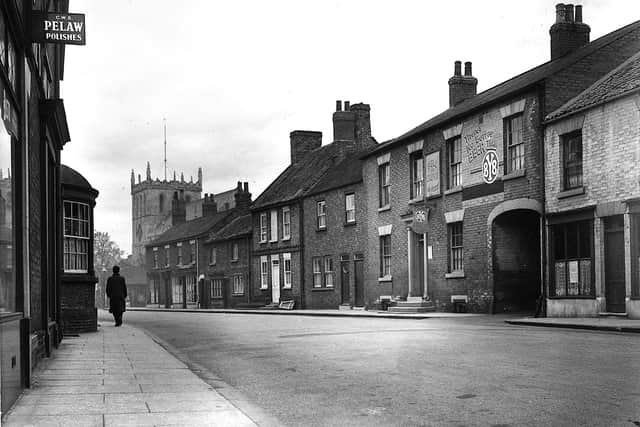

The nationalchurchtrust website adds: ‘A daughter church of Selby Abbey, it is thought to have been a pilgrimage site for the followers of St Scytha and St Ethelreda.
‘Until the 1860s it was a ‘’Peculiar’’ boasting its own Consistory Court. Within the church is a large 1837 sculpture of John Christopher Burton Dawnay, 5th Viscount Downe by English Sculptor Sir Francis Leggatt Chantrey.
‘In the History of the Priory and Peculiar, the County of York, Rev. Charles Best Robinson informs: ‘There was considerable difficulty in finding a block of white Carrara Marble sufficiently large for this sepulchral memorial.’
King Henry III granted Snaith a Charter in 1223 to hold markets and fairs. Over the years, the market has changed the days it has been opened: Sunday until 1585, then Friday; Thursday from 1782.

Baines (1822) notes Snaith’s population as 834 and lists a varied number of traders including a straw-hat maker, master mariner, wheelwright and carpenter, worsted spinner and a cheesemonger and bacon factor.
A Snaith Hall was formerly occupied by the Yarburgh family – once the lords of Snaith – and it survived until possibly the late 17th or early 18th century.
On the howdenshirehistory website there is a tiny drawing of the original Snaith Hall. It is a detail from the enclosure map of 1754.
According to Pevsner (1959) the Snaith Hall existing today is a Regency house, and about the conservatory of 1840-1850, he poses the question: ‘Is it by Joseph Paxton?’
Sadly, after falling into decay this feature no longer exists.
The new Hall’s builder was local solicitor and landowner William Shearburn. It had no connection with the earlier Snaith Hall.
Following the death of William’s widow, Mary, in 1874, the Hall was occupied by a number of tenants.
Amongst these were J. Humble Rocket joint managing director of the Goole tillage company. By 1891, it was back in Shearburn ownership but relinquished shortly after the Second World War.

The Hall was later converted into a bed and breakfast and then a restaurant. It was first listed in April 1952 and now provides residential care.
Snaith was connected to the burgeoning railway system when a station was opened with the Wakefield, Pontefract & Goole Railway on April 1, 1848.
The line had been authorised in 1845 and was taken over by the Manchester & Leeds Railway before opening.
The latter company became the Lancashire & Yorkshire Railway in 1847.
Later, the station came under the London Midland & Scottish Railway at the 1923 Grouping, and to British Railways on nationalisation in 1948.
Currently, it is managed by Northern Trains on the Pontefract line between Knottingley and Goole.

Amongst the other developments in 19th century Snaith was the building in 1862 of the classically designed Methodist Chapel with a balcony feature inside.
It cost £2,600 with seating for over 400 people. Records from 1835, indicate there were earlier Methodist places of worship in Snaith.
During Wednesday March 22, 1865 the Yorkshire Gazette said the opening services in connection with the new organ recently erected in the Wesleyan Chapel Snaith were commenced by the performance of a selection of sacred music from Abel Dean of Halifax, assisted by five members of the Huddersfield Choral Society.
On Tuesday morning October 1, 1878, the new grammar school at Snaith, which was built on a plot of land just outside the town on the road to Pollington was opened by G. Bateson de Yarburgh, of Heslington Hall.
It replaced an earlier building that had existed from 1626. The new school took the name of The Grammar School, or The Church School or The National School.
It had accommodation for 143 children.
Closing as a school in 1958, it was replaced by the new Snaith School further along Pontefract Road. Thereafter, the 1878 building found other uses and occupants.
Shortly before the turn of the century, an article said that the new Police-court premises at Snaith were progressing apace and were expected to be completed later in the year.
On April 29, 1897, two memorial stones were laid – one by Ralph Creyke, chairman of the magistrates of the Lower Osgoldcross Division, and the other by George Dunstan, County councillor for the division.
On June 28 1900, the fall of Pretoria (South Africa) was celebrated at Snaith by the procession of a mounted ‘commando’.
It was made up of about 150 horses and 125 cyclists, all in fancy military costumes, accompanied by two ‘guns’, two ambulance wagons, mounted constabulary, fire engine etc.
A piece from August 21, 1922 mentions that the Snaith agricultural show established 50 years earlier ‘gave place to the great Commando, of almost national fame. This attraction, unhappily lapsed in 1910, since when only one show – on a small scale was held last year.’
Then, with a new committee the Snaith and District Agricultural Show was held for the first time on Saturday August 19, 1922.
An old toll bridge over the River Aire and connecting Snaith and Carlton was replaced by a new structure further north in September 1927.
The old bridge was built in 1777 by Thomas Stapleton of Carlton Hall. Prior to that time there was a ferry where the bridge was built.
The Act passed in 1776 for the building of a toll bridge gives the following as one of the reasons: ‘That the ferry was dangerous for coffins passing over. Carlton at that time had no burial ground, and had to bury its dead in Snaith churchyard across the river. The old bridge with stone piers was designed purely for horse traffic. It was neither wide enough nor strong enough for motor vehicles.’
The new bridge, which was reported as 256 feet long and weighed 700 tons, had cost about £64,000.
The wartimememoriesproject website records RAF Snaith (Pollington) as being built in 1940.
The squadrons stationed at Snaith included No. 150 Squadron July 1941 to October 1942; No. 51 Squadron October 1942 to May 1945; No. 578 Squadron January 1944 to February 1944.
The airfield closed in the 1950s and in the 1970s the M62 built in stages during the decade sliced through the northern part of the flying field south of Snaith itself.
A late 20th century development in Snaith was the establishment in 1983 of the Old Mill Brewery.
A family-owned brewery, it is housed in an 18th century former corn mill and maltings. Information states: ‘Equipped with a highly specified, modern brewing plant Old Mill Brewery has retraced the footsteps of the traditional brewer.’