
St Cedd’s Well, Lastingham: The Yorkshire fountain which can heal the sick according to local legend
Born around AD 620, Cedd was one of the most famous Anglo-Saxon monks and bishops, and played a significant part in spreading Christianity throughout England.
He was venerated as a saint soon after his death at Lastingham in North Yorkshire.
Nothing is known of his parents but according to the Venerable Bede, the early Middle Ages scholar writing in the chronicle Ecclesiastical History of the English People, Cedd and three younger brothers were brought up on the island of Lindisfarne by the influential Irish monk, Aidan.
All four children became wandering missionary priests, Cedd being credited with the effective evangelisation of the Kingdom of East Saxon which comprised today’s counties of Essex, Hertfordshire and Middlesex.

Around 660 he was appointed abbot of a new timber-built monastery at Lastingham, and is said to have been a significant participant in the landmark Synod of Whitby in 664, where fundamental disputes in English Christianity were resolved including fixing how the date of Easter was chosen.
He died of the plague later that year and was succeeded as abbot at Lastingham by his brother Chad.
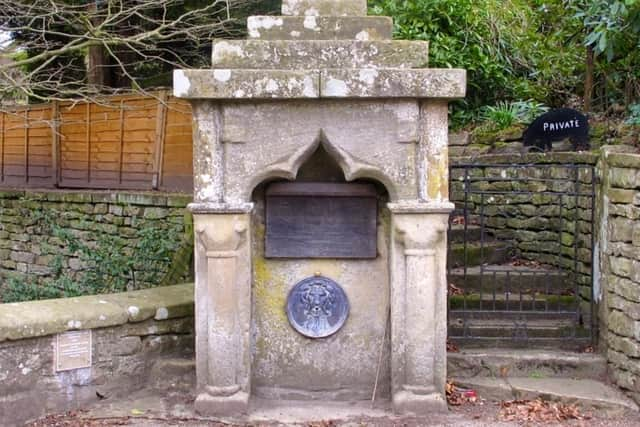
He is commemorated in the village by St. Cedd’s Well, a public fountain built in the 19th century with sandstone taken from 12th century Rosedale Abbey.
It is the most prominent of Lastingham’s four so-called “holy wells” or “sacred springs” - water sources which, acccording to local legend, began to flow at the behest of a saint or had the power to heal ailments.
A weathered Latin inscription on St. Cedd’s Well refers to his foundation of the monastery.
Another well is dedicated to his brother St. Chad.
Two further wells are named respectively after St. Ovin, who helped establish the monastery which later became Ely Cathedral, and St. Mary Magdalene, devoted follower and friend of Jesus Christ.