
Sutton upon Derwent: One of Yorkshire's poshest villages with a 'prestigious' tennis club
Eight miles south-east of York, Sutton upon Derwent sits perched 34ft above sea level surveying its realm.

Agricultural land, much of which is owned by the Crown, flanks the eastern boundary of the T-shaped village and flood plain meadows with names such as The Dimple and The Swallow stand guard over the banks of the River Derwent along its western fringe.
At its northern extremity, the grade II* listed 17th century Sutton Bridge over a particularly meandering section of the river separates the East Yorkshire village from its North Yorkshire neighbour, Elvington, just a stone's throw away.
There is an affinity or sense of solidarity between the villages.
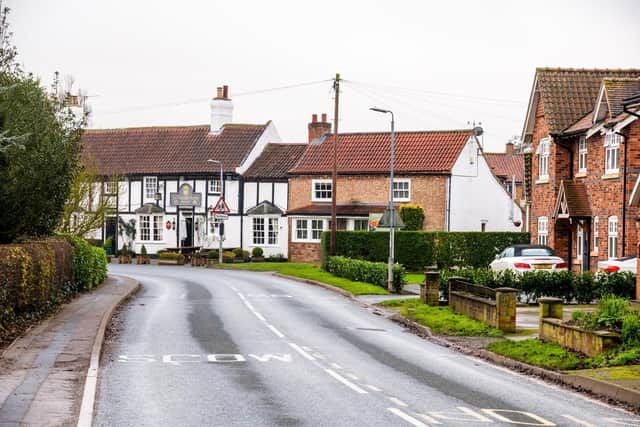

When residents of Sutton on Derwent's appropriately named Main Street were forced to evacuate as "unprecedented" flood waters spilled off farmland and into their homes last year, volunteers from the neighbouring village joined efforts to keep the water at bay and halted motorists creating waves by driving along the inundated street.
Residents are optimistic the village will be prioritised for a drainage improvement scheme, which a recent meeting of the parish council heard was "the best that could be expected considering current financial restraints" facing East Riding of Yorkshire Council.
To the village's south is the Lower Derwent Valley National Nature Reserve which supports a breeding and wintering bird population of more than 80 species, leading to it being declared a Special Protection Area.
Wigeon arrive in their tens of thousands from breeding grounds in Iceland and northern Europe to graze at the edge of the flooded meadows, while parties of pochard, pintail, whooper swans and teal follow, with the number of wildfowl peaking in February and March.

The area around Sutton upon Derwent is believed to have been settled during the Roman occupation, as it lays on the route south from York, bypassing marshes to the Humber crossing point at Brough.
However, the earliest heritage in the village includes a fragment of an 11th century cross shaft found in the Church of Saint Michael and All Angels on Main Street.
It is thought to be Anglo Danish in origin and created decades before the 1066 Battle of Stamford Bridge, just six miles upstream.
It is thought the western end of the chancel may be of the early 12th century, and a stone panel there shows St George slaying the dragon one one face, and Princess Cleolinda, who was to be sacrificed to the dragon on the other.

The church plate includes a 13th century chalice and paten discovered laid on the breast of a skeleton, believed to belong to a 13th century rector, under the floor between two of the south isle piers in the Nave.
The churchyard holds a Cenotaph to villagers fallen in the two world wars, wih 10 names listed, four of whom were brothers named Ellis.
Main Street features numerous other historic properties, including the late 17th century Cross Gates Farmhouse and Manor Farmhouse, and the late 18th century Orchard Cottage and Wheelwright Cottage.
An iron Weslyan Chapel, which was built in 1882, was relocated from the garden of the latter property in the 1930s and sold to Bishop Wilton to form its village hall.
There was at least one alehouse in Sutton in the early 18th century and in October it was reported the family-run St Vincent Arms in Main Street, a grade II-listed traditional pub restaurant, parts of which date back to 1670, was still on the market after a year, despite the pub boasting four separate dining areas and an 80-cover restaurant.
The pub's name highlights the village's links with the Jervis family, which held the manor for hundreds of years before selling it to the Crown in the 1940s, as well as the title Viscount St Vincent.
The church features a large marble memorial tablet to the 4th Viscount St Vincent, who was killed in the battle of Abou Klea, Sudan, in 1885, while modern village developments have included St Vincent's Close and Jervis Court.
The pub and a high proportion of high-end properties, such as the Victorian Old Rectory Hotel, contributed towards the village being named by the Daily Telegraph as among the country's "poshest", based on criteria including historical links, amenities and quality of life.
While average house prices in the village earlier this year stood at just over £422,000, a relatively unremarkable figure compared to Yorkshire villages such as Kirkby Overblow, near Harrogate, where the average property costs some £340,000 more.
Sutton on Derwent's Woodhouse Grange Cricket Club, on Sandhill Lane, is a past winner of the National Village Cricket Knock Out tournament and the village's tennis club, which has been known to stage balls, heralds itself among "the most prestigious" in the area.
Its grass tennis courts set the tone in the heart of the settlement, alongside an attractive village hall, a well-used community venue.
The Beacon Green grounds hosts events such as the village's Bonfire Night, fair and beer festival and every August sees the Sutton Upon Derwent Classic Car Show attracting scores of vintage vehicles and sometimes a flypast by a Spitfire from the RAF’s Battle of Britain Memorial Flight.
Other amenities include a Church of England primary school which secured its future by federating with another in Bugthorpe in 2021.
The most recent Ofsted inspection found the school had maintained its good rating.
However, some residents said they felt the village had been marginalised when two years ago, The Wolds Learning Partnership consulted on amending the admissions policy at Woldgate School and Sixth Form College.
The parish council said the proposed change could have "a severe impact" on the primary school, and "the sustainability and desirability" of the village.
It stated: "Indeed, one of the biggest draws to bring new families into the village is the presence of a good primary school, so it is our opinion that the health of our local primary school has a direct impact on the health of the village, and therefore on every resident/household, whether they have children in attendance at the school or not."