
Temple Newsam House: History of much-loved mansion known as 'the Hampton Court of the North'
The shift from private to public ownership of Temple Newsam House and estate in the early 1920s was a good one.
It has provided the public with an outstanding museum for the decorative arts whilst the grounds offer a remarkable venue for varied activities.
The Domesday Book of 1086 notes Newsam under the old English name of Neuhusum, meaning ‘new houses’. Prior to this, two Anglo-Saxon thanes, Dunstan and Glunier, are recorded amongst the earliest owners.
Around 1155, Henry de Lacy handed over the manor of Newsam to the Knights Templars. The organisation created Temple Newsam Preceptory or farmstead, south of the present Temple Newsam House.
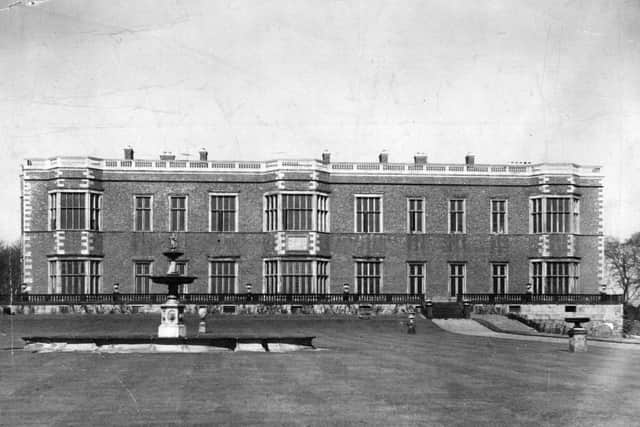

The Templars lost the land when the order was dissolved in 1307. During 1327, Edward III granted the manor Temple Newsam to May, the countess of Pembroke. It is suspected that she built a house at Temple Newsam.
Temple Newsam House (1951) records: ‘It is now believed with some supporting evidence, that Thomas Darcy [1467-1537] was responsible for some of the building in the present structure.
It is possible that he rebuilt or altered an earlier house of which there are no records.’ Passing down several generations of occupants, the house underwent redevelopment in certain sections.
Nikolaus Pevsner (1959) writes: ‘The house is called Carolean to be historically accurate; in its style it is in fact still Jacobean…’
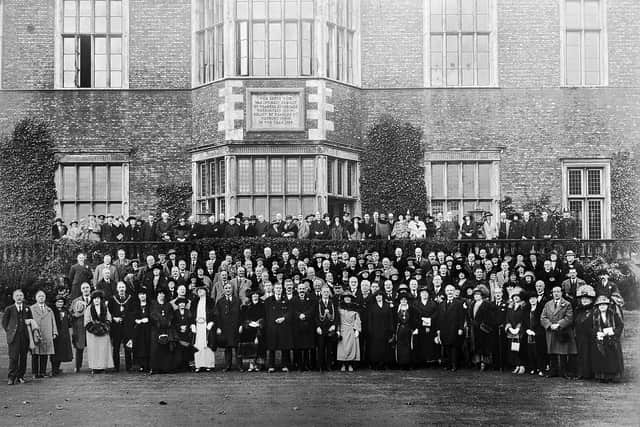
At the outset of the 20th century, Temple Newsam House and estate was occupied by the Hon. Mrs Meynell-Ingram, the daughter of the first Viscount Halifax.
Her husband, Hugo Meynell-Ingram who died in 1871, inherited Temple Newsam and other valuable properties from his aunt, the Marchioness of Hertford – co-heir of Charles Ingram, last Viscount Irvine. Mrs Meynell-Ingram died after a long illness, on December 21, 1904, aged 64.
She left Temple Newsam to her nephew the Hon. Edward Frederick Lindley Wood, 3rd Viscount Halifax (b.1881). He was the surviving son of her brother, the 2nd Viscount Halifax.
Edward’s three elder brothers died young, leaving him to his father’s fortune and seat in the House of Lords.
He married Lady Dorothy Onslow during 1909. Five years later, Lady Dora made a newspaper appeal for clothes ‘for the numbers of wounded Belgian soldiers who have come to hospital in England since the occupation of Antwerp and Ostend by the Germans’.
In 1922, E.F. Lindley Wood presented Temple Newsam and the 900-acre park to Leeds City Council along with a number of other gifts. Many suggestions were made as the uses to which it might be put.
It was suggested that the mansion should become a lodging for Assize judges visiting the city, an official residence for the Lord Mayor, a retreat for disabled ex-servicemen or feeble old age pensioners, a home for consumptives, or a hostel for students.
However, it was decided that Leeds people would support the mansion being made a public attraction and preserved for all time as an historic show place.
On March 5, 1923, the Freedom of Leeds was conferred on the Hon E.F.L. Wood at Leeds Town Hall. A report said he had left many of the mansion’s great portraits ‘of Lord Darnley; of his widow, Mary Queen of Scots; of his mother, the Countess Lennox; and of his son, King James I…’
E.F.L. Wood said he was unable, through the burden of taxation, to properly maintain the property.
An account from Monday October 22, 1923 said the number of visitors to the mansion and estate of Temple Newsam over the previous weekend augured well for the popularity of Leeds’s latest possession.
A crowd awaited admission ‘on Friday some time before the mansion was announced to be open to the public, and on Saturday, and again yesterday, there was a gratifying number of visitors.’
Sir Montague Barlow, Minister of Labour, unlocked the door of the mansion and declared the estate open.
The band of the 7th (Leeds Rifles) Battalion of the West Yorkshire Regiment played selections close to the house during Saturday afternoon, and in the evening, fireworks and the glow of many electric lights brightened the scene.

At the time it was said that the mansion would become known as ‘the Hampton Court of the North.’
One of the terms of the sale agreement made in 1922 between E.F. Lindley Wood (Lord Irwin from 1925-1934) and Leeds Council was that at least once a year Holy Communion should be celebrated in the Chapel Mansion.
The eighth anniversary saw a service attended by the Lord Mayor and other civic officials, in addition to villagers from Whitkirk. The Vicar of Whitkirk took the service and the collection was given to St Mary’s church, Whitkirk, which boasted an unbroken connection with Temple Newsam since the 12th century.
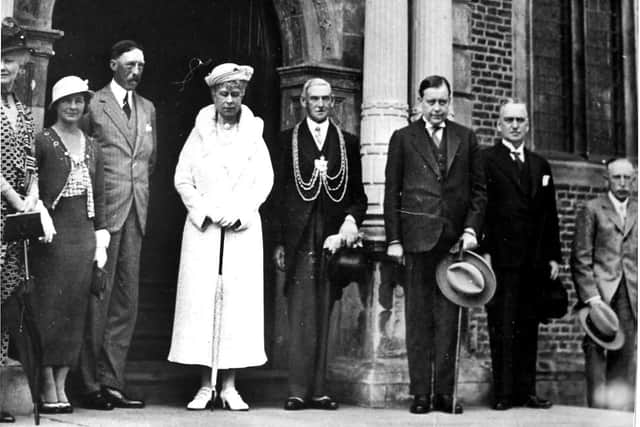
Queen Mary visited Temple Newsam on August 27, 1933, where she was met by the Lord Mayor and Lady Mayoress of Leeds (Alderman and Mrs R.H. Blackburn).
The Queen visited every room in the Mansion, except the armoury, and took a keen interest in everything she saw, especially the tapestries and the valuable wallpapers.
In the Damask and Blue Room her Majesty was amused by the story of the ‘ghost hunt’ which Donald Kabery (chairman of the Temple Newsam Committee) and other members of the city council had conducted a few weeks earlier.
When the Lord Mayor mentioned this, the Queen turned to Donald Kabery and asked him if he had the good fortune to meet the ghost, and he smiled when admitting there had been no luck.
In 1938, Temple Newsam was placed under the same direction as the City Art Gallery and has developed successfully as a museum of the decorative arts.
The house has acquired items to augment the permanent collection and been the recipient of a number of donations on permanent or semipermanent agreements.
One of the most significant permanent loans is the Chippendale Society’s collection of Chippendale works.
The website – the shinemag.com – mentions open cast mining began at Temple Newsam in 1942 and added: ‘The beautiful landscape, designed by Capability Brown, was destroyed. After the pits closed in the 1980s, the parkland was relandscaped and the mines were forgotten.’
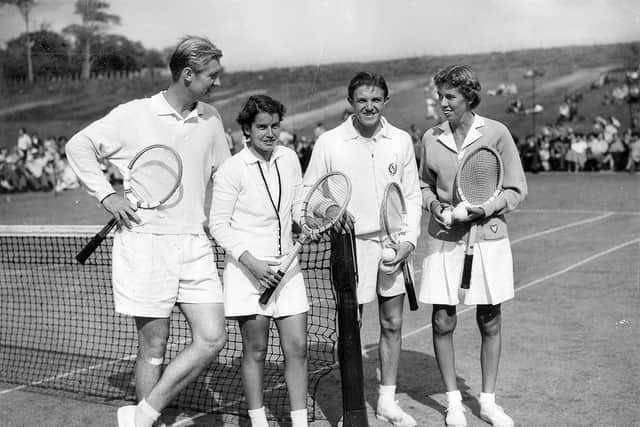
Three of America’s top tennis players performed on a makeshift tennis court at Temple Newsam on Sunday June 5, 1955, to raise funds for the training of young Leeds players.
There was Miss Doris Hart, the 1954 American champion; Miss L. Felix, ranked number eight in the United States; and Hugh Stewart, holder of the 1954 Wimbledon Plate. A crowd of nearly 3,000 watched the matches.
Besides offering much to see and appreciate within the house, the Leeds Council-run Temple Newsam estate has provided facilities for sports including football, golf, running, cycling, horse riding, and orienteering.
An annual event, Party in the Park, was held in the grounds of Temple Newsam by Leeds City Council and 96.3 Radio Aire. It was staged the day after Opera in the Park at the same location. The event started in 1994.
During 1995, the Northern Ballet Theatre’s ballet ‘Romeo and Juliet’ was performed under a 30,000 sq. ft canvas marquee in Temple Newsam Park. A wooden sprung dance floor with full stage set and lighting gave the dancers ideal conditions to perform the Shakespearian tragedy to Prokofiev’s music.
Nightime filming took place during 2000 at Temple Newsam. This was for the television series ‘Micawber’ starring David Jason.
A view in Leeds Library shows a scene from the amphitheatre, looking towards the stable block, which had been dressed to look like a circus. The ITV four-part comedy drama was broadcast on Boxing Day, 2001.
On Saturday July 16, 2005, 24-year-old, Katherine Jenkins and the BBC Philharmonic Orchestra headlined Opera in the Park at Temple Newsam.
The following day, at the annual Party in the Park, the following acts appeared: Lemar, Mel C, Liberty X, Rooster, Andy Scott Lee and Ben Adams. They performed to a sell-out crowd of 70,000.
Thanks to Leeds Library Service, West Yorkshire Archive Service, and Linda Middleton for help with this piece.