
The 200-year history of railway lines running through Wensleydale
A railway through Wensleydale was originally to be part of a major trunk route connecting England and Scotland.
Yet, the line built had humble origins and went on to gain some importance as a secondary cross-country route by coincidence. Part of the railway is now a heritage attraction helping local tourism.
Early railway schemes mainly developed around areas of heavy industry which Wensleydale lacked. Nevertheless, local landowners were keen to be on a rail network.
The Yorkshire & Glasgow Union Railway was promoted in the mid-1840s to run from York to Penrith through Wensleydale.

Connections were to be made at either end with existing lines, creating an alternative route between England and Scotland.
The first line from London to Scotland was not ready until 1848, whereas the coast-to-coast journey was possible in Northern England a decade earlier.
A rival project was developed around the same time and the two groups decided to join forces as the Northern Counties Union Railway.
This undertaking received an Act of Parliament in 1846 and was authorised to raise £3,000,000.
In the last years of the decade there was a general financial collapse and the NCUR failed with little progress made.
The first section of a line to Wensleydale was started in the mid-1840s as the Newcastle & Darlington Junction Railway, later part of the North Eastern Railway, laid tracks from Northallerton to Leeming.
The company was originally authorised to reach Bedale, but the scheme was also halted by money considerations.
The people of Wensleydale were not deterred by these setbacks. Early in the 1850s, the Bedale & Leyburn Railway was established to further progress the rail line.
This was achieved relatively quickly and around 18 months passed before the first section of the 11-mile route was ready for traffic to Bedale in 1855.
Goods traffic to Leyburn started before the end of the year, whilst the first passengers were carried on May 19, 1856.
Worked from the outset by the NER, the Leyburn line was acquired by the company at the end of the decade.
There was still a demand in the area for the railway to be extended westwards to Hawes and in the early 1860s steps were taken to achieve this aim.
In the meantime, the Midland Railway was eager for access to Scotland and promoted the Settle and Carlisle route in the mid-1860s.
Partially a strategic move against another company, the MR later tried to back out but was forced by Parliament to construct the railway.
The arduous task was completed in the mid-1870s, with passenger services beginning on May 1st, 1876.
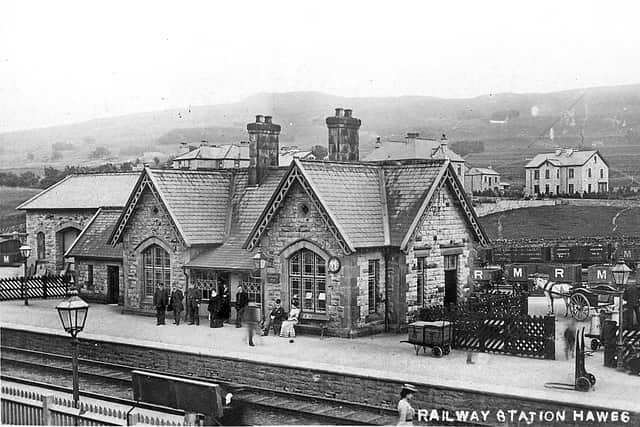
Part of the Settle-Carlisle project was a branch from Garsdale to Hawes and the NER resolved to connect from Leyburn.
The 16 miles to Hawes featured few engineering challenges, whereas at the Midland Railway’s end, there was a substantial viaduct and tunnel.
After an inspector found some deficiencies in the NER line from Leyburn to Askrigg, further work was necessary which delayed the public opening to February 1st, 1877.
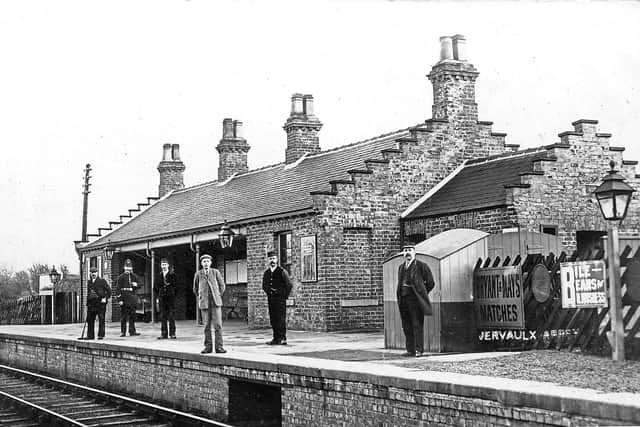
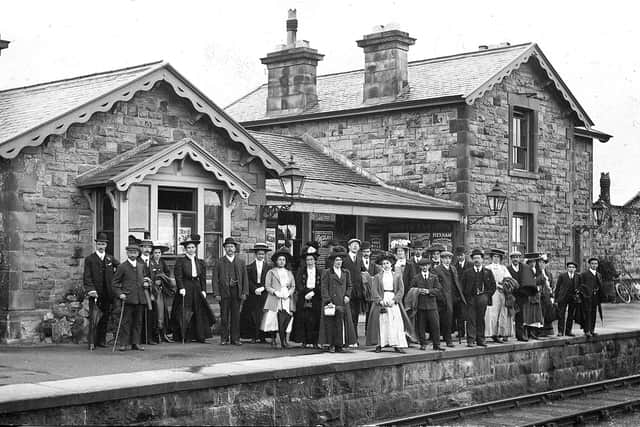
There was a great celebration on the day and several newspapers reported on the event, but particularly highlighted a number of the natural attractions that people could now view.
The York Herald carried several interesting pieces of information.
‘…the opening of the line has been looked forward to as an unmixed blessing, and in order to commemorate the day, which it is universally agreed will inaugurate better times to come, business was almost entirely suspended at the different villages along the route.’
The Askrigg Market, which had been dormant for 20 years, was to be restarted, with the charter dating from 1587.
Three trains were scheduled and on the first was only one passenger, an elderly gentleman of 70 who had never seen a railway.
Also, a woman, who had never left her village, was surprised the steam engine could smoke so much when moving. Many people had never seen a locomotive.
By the final train, several thousand locals had travelled on the new railway.
Work continued on the remainder of the route until late 1878 and opening throughout occurred on October 1st.
Though in a different form, the proposed connections of 1846 were now possible. Yet, the services provided for the public consisted of only four or five local trains between Northallerton and Garsdale.
Before the First World War, the line reached a peak of seven services each way and there were also some that went just as far as Bedale or Leyburn.
Though the Midland Railway had some running powers over the NER line, the company only offered a daily Hellifield to Hawes service.
A freight train ran every day and there was a special one on Sunday to collect milk from places in the dale.
The route had 14 stations and the places served, not already mentioned, were Ainderby, Scruton, Crakehall, Jervaulx (originally Newton-le-Willows), Finghall, Constable Burton, Spennithorne, Wensley, Redmire and Aysgarth.
As there was just a single track, some improvements occurred over time, with the addition of passing loops and second platforms at stations.
The London & North Eastern Railway took over the Wensleydale line after Grouping in 1923 but there were no significant changes made.
The company did offer special excursions to stations on the route, particularly for the total eclipse of the sun in 1927 when Leyburn and Richmond offered good vantage points.
However, overcast conditions spoiled a good view on the day.
The LNER installed camping coaches at three stations during the 1930s.
These were placed at Askrigg, Aysgarth and Wensley and were old Great Northern Railway six-wheel carriages, modified for open spaces and retaining compartments for sleeping.
Ablutions had to be performed at the stations and the price per coach was £2 10s a week, or around £230 in present currency.
After Nationalisation in 1948, British Railways scrutinised the network owing to falling receipts and rising costs.
The Wensleydale line was targeted early, as BR claimed less than 3% of the population in the area used the railway.
The company could save nearly £15,000 by ending passenger services; goods trains would remain.
As the community had fought to acquire the railway, they strongly challenged the withdrawal of passenger trains.
In spite of these efforts, BR moved quickly and the closure was confirmed for the last full day being Saturday April 24, 1954, with the basic final Sunday service following.
A report said hundreds of local people witnessed the passage of the last train, which had a wreath attached to the front of the locomotive bearing an inscription: ‘Goodbye, Old Faithfull’.
Some of the intermediate stations were gradually closed to goods as the years progressed.
In 1964, the Hawes to Redmire section was taken out of use but limestone trains from Redmire continued for many years.
Goods services were finally withdrawn from Bedale and Leyburn in 1982 and the decision to mothball the line occurred a decade later.
Local residents and railway enthusiasts were still determined the line should remain active and they formed the Wensleydale Railway Association in 1990.
Thanks to the Ministry of Defence, funding was made available to maintain and upgrade the line around 1996.
The MOD decided to use the railway rather than road to transport armour and military vehicles for Catterick Garrison which is to the north of Leeming.
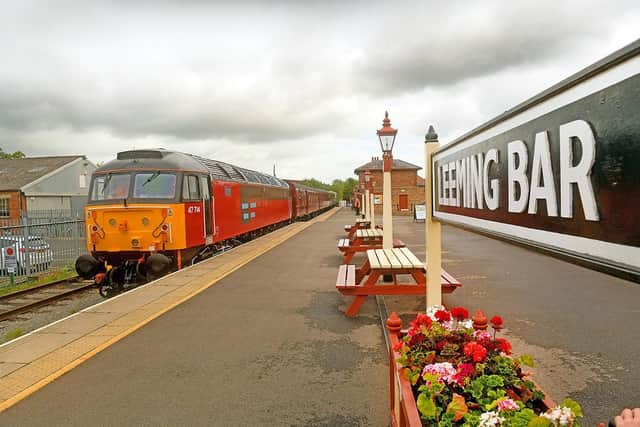
The WRA became Wensleydale Railway plc in 2000 to raise funds for reopening and this was achieved in 2003 with Leeming Bar and Leyburn stations welcoming passengers and several more have followed subsequently.
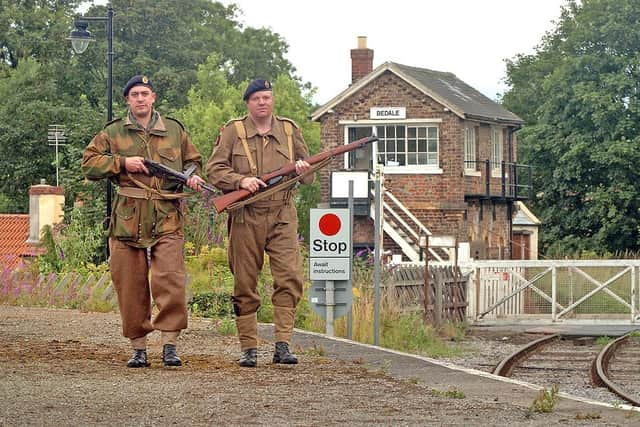
Yorkshire Post photographers have been on the WR to capture such scenes as those at the Wensley Ale festival, restorations of locomotives, buildings and permanent way, staff/volunteers at work, 1940s weekends, Galas, special trains, Christmas celebrations, etc.
The ultimate aim of the WR is to restore the route to Garsdale and connect with the Settle and Carlisle line.
Nearly 200 years on, the idea for a railway through Wensleydale is still alive and the focus for a group of determined people.
Further reading: The Wensleydale Branch – A New History (1993), by Stanley C. Jenkins.