
The 300-yard-long ancient thoroughfare which is one of the most important streets in Yorkshire
York’s ancient throughfare, Blossom Street – the Royal entrance to the city – is the subject of the Clements Hall Local History Group’s latest book. It is the seventh and last in their series.
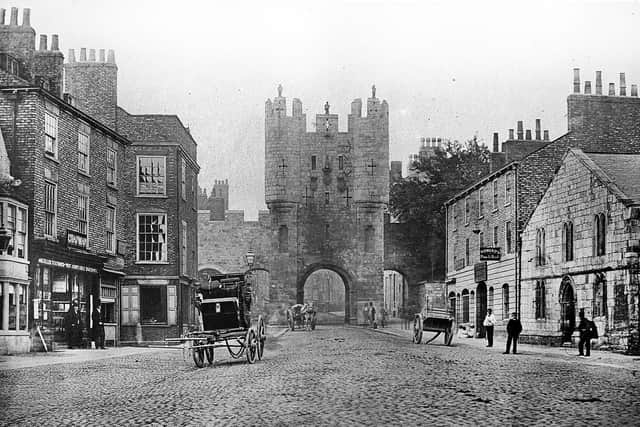
The street, a short stretch of 300 yards, is one of York’s most significant, and leads from Micklegate Bar to Holgate Road. The Blossom Street book recalls an abundance of fascinating facts.
A Roman road from Tadcaster (Calcaria) ran parallel to the present Blossom Street, on its north-west side.
During Roman occupation, this area outside the fortress was used for burying the dead and Roman cemeteries have been discovered there on both sides of the current Blossom Street.

From around the 5th century, the area would have been used as agricultural land, and the name Blossom Street reflects this.
It seems to have arisen from the Scandinavian word Ploxwangate in the medieval period, referring to ploughmen.
St Thomas’s Hospital was first recorded in 1391, with the twin purposes of supporting the poor and providing shelter for travellers from the south-west. Lepers however, were not welcome.
There have been occasions when Blossom Street was threatened by military action.
During the English Civil War in 1644, Royalist York was surrounded by Parliamentary forces at the Siege of York. But Blossom Street was protected by the Great Sconce, a huge gun emplacement on the Mount.
The thoroughfare was a spectacular setting in 1639, when Charles I was conducted along there into York from London, for a month’s stay.
He was escorted by the Sheriff of Yorkshire, with the trained bands of the City and Ainsty drawn up outside the Bar. As he passed through, they gave him ‘a handsome volley’.
Following the eventual defeat of the Royalists by the Parliamentarians at Marston Moor on July 2, 1644, wounded and exhausted men fled back to York, lining Blossom Street up to the Bar.
It was described as ‘a harrowing sight’, with men making ‘a pitiful outcry for help or some relief to their suffering’.
Catholicism has featured in the area’s past, with nuns a regular sight on the stretch. The Bar Convent was established on the north east corner of what became Nunnery Lane in 1686.
This was by the sisters of a congregation founded by Mary Ward earlier in the 17th century, for the education of Roman Catholic girls.
It was the first Roman Catholic institution for teaching girls in the country.
Many of the former medieval buildings in the street were redeveloped in the 17th and 18th centuries, to provide houses for wealthy families and merchants.
It fulfilled a desire for those who wanted to move away from the noise and smells of the river and the city.
Early travel to and from York involved wagons and carriers or horses, but stage coaches were launched in the city during 1653.
The first York coach was described as taking 14 passengers, later six-seater coaches drawn by two or four horses (or maybe six in winter) were employed.
An 1835 parliamentary report recorded 24 coaches a week from London to York, taking four days, plus seven mail coaches from the capital, all passing through Blossom Street.
The stage coach trade came to a halt around 1840 when a railway was established from York to London. By the 1850s, there were 13 trains a day between the two cities, carrying 341,000 passengers a year.
For several centuries Blossom Street has featured an intriguing mixture of residential houses for the gentry alongside workshops for small scale crafts and manufacturing, together with retail businesses.
Local architect, George Townsend Andrews, played a significant role in creating and remodelling some of the Blossom Street buildings from the mid-19th century.
They included the Bar Convent, and the adjacent mid- and late 18th century houses. On the opposite side of the street, Andrews designed three impressive houses in the newly created Crescent.
The Blossom Street book reveals the area once housed a number of noted individuals. Celebrated naturalist, physician and antiquary Martin Lister lived in ‘Micklegate Without’ for around 12 years in the 17th century.
Members of the Rowntree family were living there briefly, with Joseph Rowntree in the 1840s, Henry Isaac Rowntree in the 1870s and the Terry family in the 1890s.
There were noted railway figures, such as George Leeman MP, William Bell, North Eastern Railway architect, contractor Joseph Crawshaw, and Thomas Cabry.
Traditionally, during the 19th and 20th centuries, Blossom Street served the retail needs of the population residing in the surrounding streets.
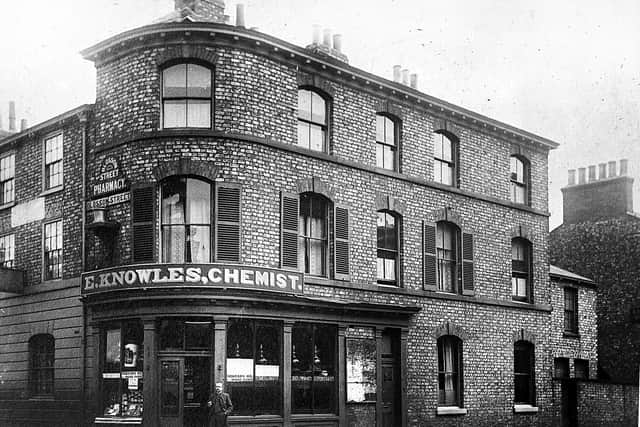
The traders have included grocers, chemists, newsagents, confectioners and butchers. One chemist was on a prime site on the corner of Queen Street for over 100 years between the 1860s and 1970s.
Another was the pharmacy on the corner of Shaw’s Terrace, still present today after 120 years.
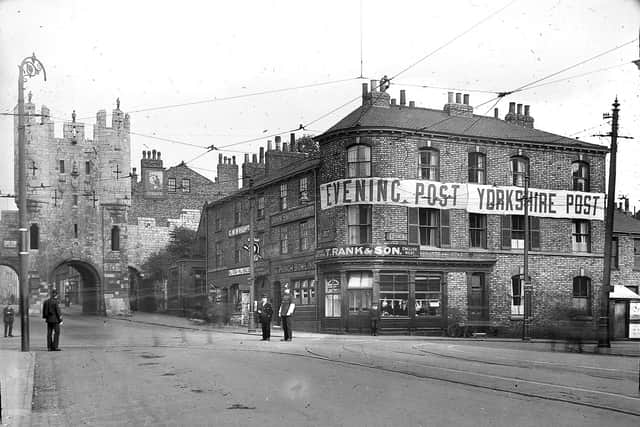
Two pictures in the Blossom Street book illustrate tramway developments in York. The first shows a horse-drawn tram, the second an electric vehicle.
The York Tramway Company’s system was opened on October 27, 1880 and horse trams were eventually preferred over steam.
York’s first electric car, no. 1, ran fully decorated, at noon on January 20, 1910. The tramway system closed on November 16, 1935.
In the 20th century Blossom Street began to cater for the motorist, the wide cobbled areas in front of premises providing convenient areas for parking and supply of petrol.
The Forsselius garage sold and repaired motorcars from around 1908 until the 1980s with premises on both sides of the street.
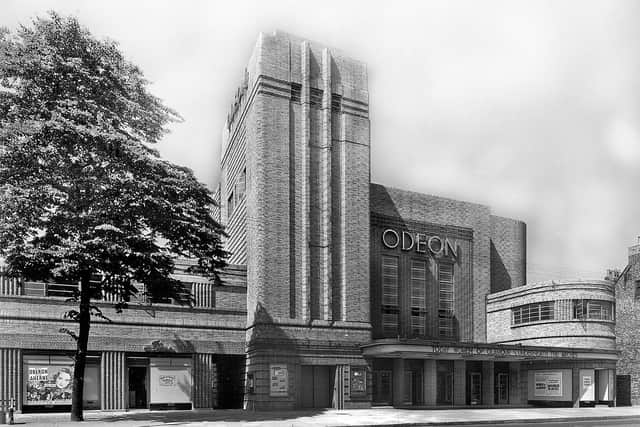
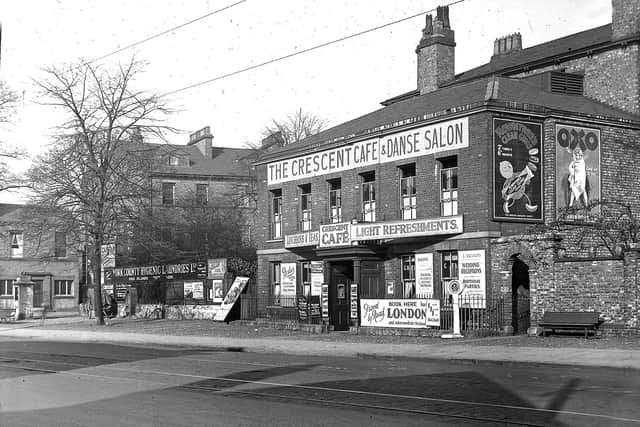
A major 20th century Blossom Street development was the opening on February 1, 1937 of the Odeon cinema, built on the former site of the Crescent Café and Danse Salon. Both the café and the cinema, are seen in pin-sharp illustrations.
The Crescent Café was the creation of Leslie Shaw, caterer and restaurant-keeper. Shaw had previously lived in Wakefield and was a business partner in the local Central Dancing Academy.
He moved from Wakefield to York in 1905 and bought or leased a house to set up the Crescent Café and Danse Salon in 1921. The earliest newspaper reference of an event there was in 1922.
The Oscar Deutsch-owned Odeon was erected on the café site in a distinctive Art Deco-style at a cost of over £40,000.
The design was by architect Harry Weedon with the assistance of Robert Bullivant. The Odeon was Listed Grade II in 1981.
This was a useful protection, as Ring Road proposals in the early 1970s had suggested its demolition for a major traffic route.
The building closed in 2006, was reopened three years later by the Reel Cinemas chain then shut once more in 2017. It is presently operated by Everyman Cinemas.
Amongst York’s many watering holes is the Blossom Street Punch Bowl. Noted between 1822 and 1825 as the Fox and Hounds it is recorded as an inn as early as 1783.
There are records of the building being used in the 19th century for inquests.
The Punch Bowl expanded first in 1895, into a cab office next door, then during 1974 southwards round the corner into the butcher’s premises on Nunnery Lane.
This increased the number of bedrooms to 13 and replaced a line of long-standing traders at this position. The premises had stopped operating as a hotel by 2002, when it was bought by J.D. Wetherspoon.
Presently, the Bar Convent is still home to religious sisters of Mary Ward’s Institute, now known as the Congregation of Jesus, and the house is open to everyone of all faiths and none.
Visits can be made at any time Monday to Saturday, 10am to 4pm, and callers may explore the exhibition, chapel, café, garden, gift shop, and even stay overnight in the guest house.
The Bar Convent houses the relic of the York martyr St Margaret Clitherow, which can be seen in the Georgian Chapel.
It is part of the convent’s internationally significant collections, which include a crucifix with links to the story of the Gunpowder Plot and the spectacular Arma Christi medieval scroll.
Thanks to Susan Major at the Clements Hall Local History Group for help with this piece.