
The Black Prince, Leeds: Why Leeds has a prominent statue of a prince with no connections to the city
The most famous statue in Leeds is this figure on horseback in City Square, situated between Queens Hotel and the former Post Office.
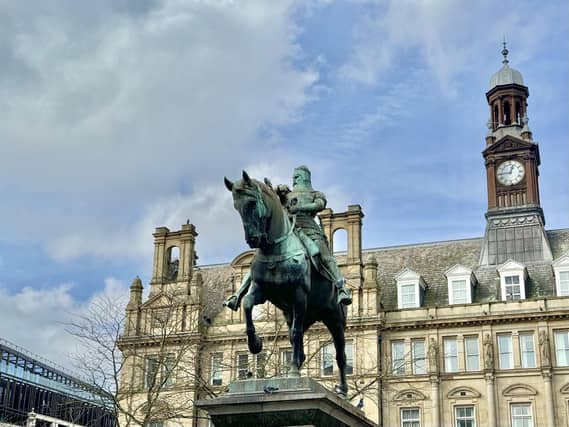

Its prominence has long been controversial given that the character it represents - the eldest son of Edward III known as the Black Prince - had no connection with Leeds.
The original idea was a statue of the Norman baron Henry de Lacy, Lord of the Manor of Pontefract, whose estates extended westwards into the Yorkshire Dales and in 1152 had provided land to Cistercian monks to establish Kirkstall Abbey, credited with aiding the growth of the village which later became Leeds.
If anyone deserved the title of Leeds’ founder it was de Lacy yet he was rejected.

When the discussion took place in the 1890s, the city fathers wanted someone with wider appeal to put on top of a pedestal that would be placed in the centre of the city’s smart new square.
De Lacy was dismissed as lacking in heroism and chivalry.
The Black Prince suggestion came from the then-mayor, Col. Thomas Harding, owner of a large pin-making factory, Tower Works, south of the River Aire.
Harding funded the statue, and it was unveiled on 16th September 1903.
Edward the Black Prince was, he said, “the upholder of the liberties of the English people and would remain an emblem of manly and unselfish virtues”.
The commission went to the sculptor Sir Thomas Brock, whose most famous work is the Victoria Memorial in front of Buckingham Palace.
It was cast in Belgium and arrived in Leeds on a canal boat towed up the Aire & Calder Navigation.
The statue was questioned most recently by Leeds-born comedian Vic Reeves, who said: “I’ve always been intrigued by the story of the Black Prince and wondered what he was actually doing in Leeds.”