
The canny 19th century nobleman who pulled off a betting coup at the St Leger
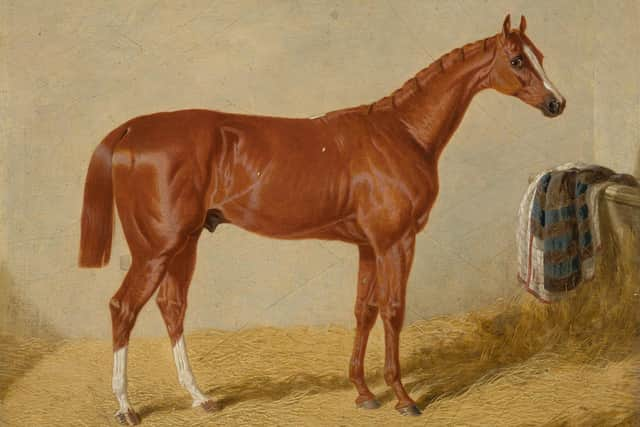
This sleek, alert chestnut colt, with an expressive look in his eye, is the work of John Frederick Herring Snr, the Doncaster-based former coachman who is regarded as one of the finest animal painters of the 19th century.
But it is not the highly skilled artwork that draws me to feature the oil, one of hundreds of horses he painted during his career, including portraits of 33 winners of the St. Leger and 21 winners of the Derby.
The reason for highlighting it lies in the extraordinarily devious methods his owner used to achieve victory and pull off a betting coup in the 1836 St Leger.
The picture, entitled Lord Lichfield's chestnut colt Ellis in his stable, and dated the same year as the victory, fetched £8,890 at Christie's in London. But even the title is misleading.

Whig politician and one-time Postmaster General Thomas William Anson, 1st Earl of Lichfield (1795-1854), is listed as the owner of Ellis.
But his gambling and lavish entertaining landed him heavily in debt and he had to sell off the entire contents of his Shugborough Hall estate in Staffordshire.
Ellis rang under his colours but actually the horse had been purchased as a yearling by diarist Charles Greville (1794-1865) on behalf of Conservative politician Lord George Bentinck, third son of the 4th Duke of Portland, who was attempting to conceal the depth of his involvement in horseracing from his family.
So far, so devious. But there's more...Ellis, bred in 1833, won 11 eleven of his fifteen races between 1835 and 1837, with four seconds.
So he was obviously well fancied for the 1836 Doncaster classic. At that time racehorses were typically walked to race meetings, often covering vast distances.
This both tired them and alerted bookmakers of their race entries so they could adjust the odds accordingly.
Assuming that Elis would enter the St. Leger, the bookmakers set short odds.
But with the horse stabled at Goodwood, more than 200 miles away, the cunning Lord Bentinck (1802-1848), a notorious and often unsuccessful gambler, showed no signs of making the journey, leading bookies to conclude that Elis was a non-runner, pushing his odds out to 12-1.
Five days before the off, Bentinck placed a substantial wager at 12s.
What nobody knew was that Elis was covertly conveyed to Doncaster in under three days in a huge, newly-designed carriage drawn by six horses - essentially the first horsebox.
The odds tumbled to 7/2 when his presence was noted and a fresh Ellis, ridden by John Barham Day, romped to victory by two lengths.
The crafty aristocrat joyously pocketed his winnings and the victory ensured his new "horsebox" was soon widely used.
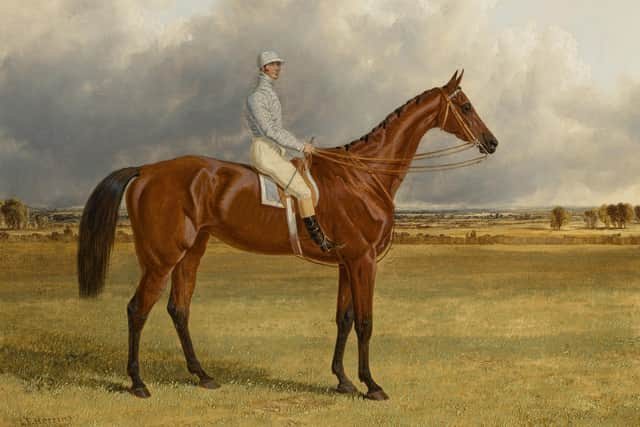
At the same Christie's sale, another of Herring Snr's racehorse oils, Lord Bentinck's Crucifix, with John Barham Day Up, dated 1840, sold for £17,780.
In that year, Crucifix won the 1000 Guineas and the 2000 Guineas (possible in those days), followed by the Oaks, before being retired to stud undefeated in her twelve races, making her one of the most dominant two and three-year-old fillies in 19th-century racing.
Although he often lost heavily, Lord Bentinck was estimated to have won more than £100,000 during the 1845 season.
Bentinck, despite his trickery, served as a dominant Steward of the Jockey Club, exercising immense rule-making power over British racing.
In 1844, having exposed the winner of the Derby as a fraud, he proposed a set of rules to cover horse racing.
He limited the corruption involved in making and settling bets is also credited with inventing the flag start at race meetings.
An aristocratic dandy who sported a new silk scarf every day, he had a volatile temper and nearly lost his life in a duel over an unpaid debt.
He fired his pistol in the air as his opponent, Squire Osbaldeston, an expert marksman, was flustered and missed, shooting Bentinck cleanly through the hat.
In 1846, Lord William George Frederick Cavendish-Scott-Bentinck (1802 -1848), to give him his full title, sold his horses for a bargain £10,000.
The string included Surplice, winner of the Derby and the St Leger in 1848. He was now free to focus entirely on his political career alongside future prime minister Benjamin Disraeli and helped to unseat Sir Robert Peel over the Corn Laws.
Bentinck's father, the Duke, was delighted when his son returned to "the more elevated occupations of political society".
*At Woolley & Wallis of Salisbury, Wiltshire, an early 17th century Moghul School painting, A Farrier Shoeing a Horse, fetched £88,400 and at Tennants, "Fazzoletto" with jockey up, by Harry Hall (1814-1882) made £7,190. Lord Derby's Fazzoletto won the 2000 Guineas in 1856,.