
The famous visitors to Doncaster Races - from Charles Dickens to Queen Elizabeth II
Horse racing in Doncaster has been a major part of the town’s history for years and it is no surprise there are many stories, and people, as well as events associated with the sport.
During the 18th century there were a good many alterations in the times and conditions of racing in Doncaster.
John Orton, in his Turf Annals of York and Doncaster (York, 1844), first mentions race meetings at Doncaster in 1728, when plates of twenty and forty guineas each were run on July 22 and 23.
The meeting of 1729 was held in August, of 1730 in May, and of 1731 in June. In the last-named year it was resolved that June should be the recognised month.

By the middle of the century, however, September appears to have been definitely fixed upon for celebrating what has since become regarded as an annual event of great importance. There were five days’ racing at the September meetings of 1757 and 1758 and four in the following year.
After that the races were sometimes on three, sometimes on four days. In 1768, sport was particularly poor on several days, for the good and sufficient reason that there were no horses.
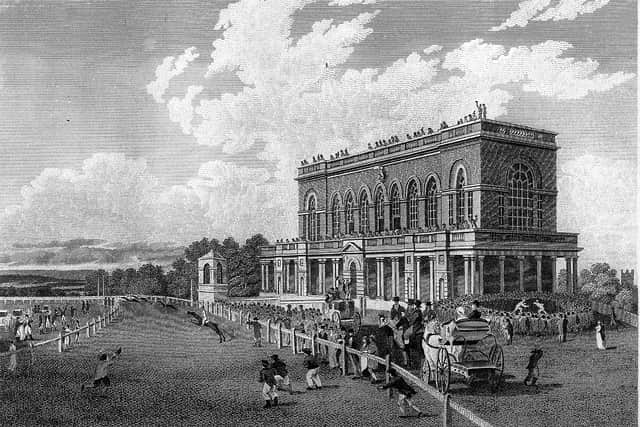
The Doncaster Grand Stand was built by a Mr Theakston and Mr Beardshaw from the designs by John Carr of York, at a cost of £2,637.
A minute of the Corporation, dated March 2, 1781, gives an order that John Carr shall be paid the apparently very modest sum of one hundred guineas ‘for his trouble in architecting and directing’ the work.
The enterprise of the corporate body did not stop there, a new course was formed, the Tryer’s stand and the rubbing stables were built, for the benefit of the patrons of Doncaster races.
During the 19th century it was said that Doncaster was literally besieged and occupied for days before and after the September meeting.
There was such variety and colour in the High Street and the Market Place, to say nothing of the many strange sights to be seen on the way to the Town Moor and on the course itself.
Folk of all walks of life came from far and near to stay in the town until the last winner of the meeting had caught the judge’s eye, and often for some days later.
Inns and houses were filled to overflowing, all manner of sports and pastimes helped to amuse the anxious searchers after pleasure and excitement. There were plays at the Market Place theatre, assemblies and concerts in other places for public entertainment.
There were cock pits everywhere, and those who admired the noble art could see as much boxing as they cared for. In short, the September week at Doncaster was the great social event of the year, to be looked forward to.
Many noted jockeys have won races at Doncaster.
William Scott was one of them. Born at Chippenham in 1793, he was introduced to the saddle at a very early age, riding continually from 1814 to 1847; his last mount being his own horse Christopher in the Derby of that year.
Tykes and northerners believed that ‘Glorious Bill’ would go on winning as long as he liked to throw his leg across a horse.
From 1838 to 1841 he had a monopoly of Doncaster’s famous St Leger, riding nine winners: 1821, Jack Spigot; 1825, Memnon; 1828, The Colonel; 1829, Rowton; 1838, Don John; 1839, Charles XII; 1840, 1841, Launcelot; and 1846 Sir Tatton Sykes. He died at Highfield House, near Malton, in 1848.
Lester Keith Piggott, born November 5, 1935, is famously tall for a jockey (5 ft 8 in/1.73 m), hence his nickname of ‘The Long Fellow’.
He is considered to be the best of his generation and the greatest flat jockey of all time, with 4,493 career wins, including eight St Leger victories: 1960, St Paddy; 1961; Aurelius; 1967 Ribocco; 1968 Ribero; 1970, Nijinsky; 1971, Athens Wood; 1972 Boucher; 1984 Commanche Run.
Royalty has visited Doncaster Racecourse on a number of occasions.
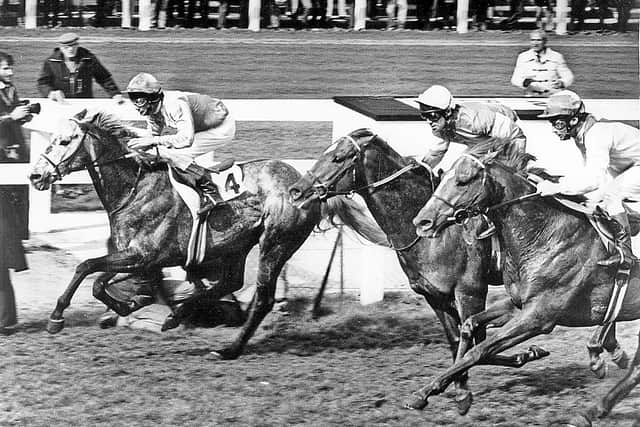
King Edward VII frequently attended meetings; his grandson King George VI and Queen Elizabeth went there in 1948.
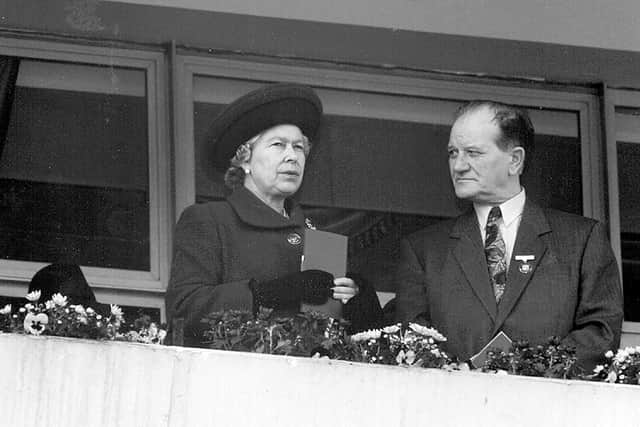
During a trip to South Yorkshire on Friday March 25, 1994, H. M. Queen Elizabeth II visited the Mansion House, Doncaster, and honoured the Mayor (Councillor John Quinn) with her presence at Luncheon. In the afternoon, the Queen attended Doncaster Races and was received at the Racecourse by the Chairman of the Racecourse Committee, Councillor Ronald Gillies
Well-known characters have been seen at Doncaster Races.
In 1857, Charles Dickens and Wilkie Collins arrived during race week. They stayed at the Angel Hotel, Dickens describing this in a letter as “very good, clean and quiet apartments on the second floor.’
He added: ‘Looking down into the main street, which is full of horse jockeys, bettors, drunkards, and other blackguards from morning to night-loud all night.’
Dickens had one great stroke of luck while he was in the town, describing it as a ‘wonderful paralysing coincidence.’
On St Leger day he bought a race card and wrote down three names for the winners of the three chief races. Never had he heard or thought of any of the horses. Strangely those three races were won one after the other by those three horses.
In Malcolm Macfarlane’s Bing Crosby Diary, 1960-69, the entry for 6/7/8 September 1966 reads: ‘At Doncaster in South Yorkshire where they attend the races including the St. Leger.’
Former Manchester United manager Sir Alex Ferguson was engulfed by autograph hunters when he appeared at Doncaster Racecourse on August 17, 2007.
Sir Alex was the co-owner of Rock of Gibraltar, which was beaten at Doncaster in the Champagne Stakes by Dubai Destination on 14 September 2001.
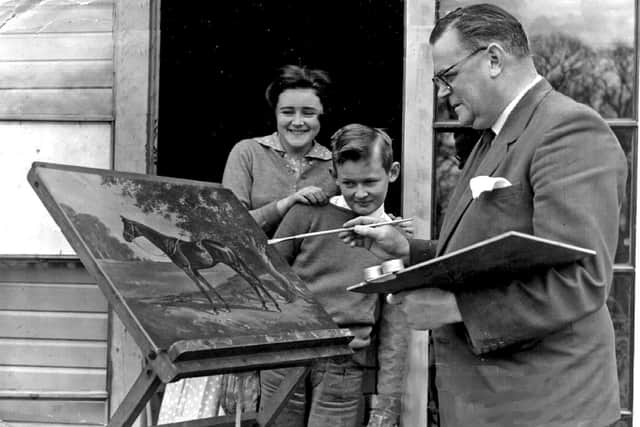
Joseph Appleyard was a prolific artist in watercolours and oils of landscape and sporting subjects from the mid 1930's to his untimely death in 1960.
Upon leaving school he attended local evening classes at Leeds School of Art gaining a job in window display and general advertising, limiting his painting to weekends and weekday evenings.
In time he struck up a friendship with Leeds artist Jacob Kramer, a forthright critic, whose kindness and comments encouraged Joe. During 1959 Joe painted ‘A Parde for the St Leger’ and the much larger picture ‘Finish of the St Leger, 1959’.
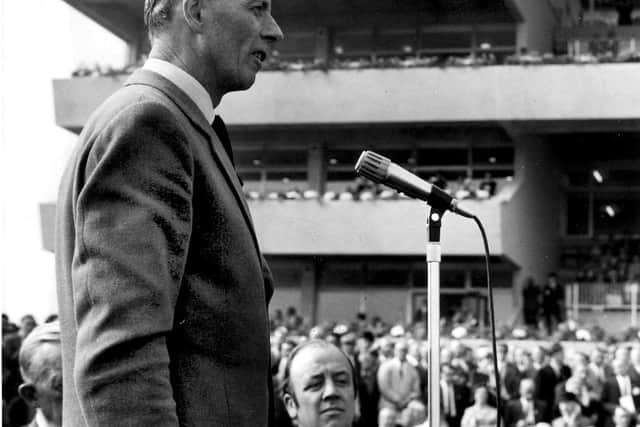
A new Doncaster race stand was opened by Lord Halifax in 1970. The building won an award for the record time in which it was erected.
One of the main features of the new stand was the internal Betting Hall, thus allowing the transference of the bookmakers from their customary area in front of the stands.
This facilitated the Parade Ring to be sited in front of the Grand Stand and a view of the horses parading was in sight to all race goers in all the enclosures.
The new Stand was well angled to the course and protection from the weather was provided by a cantilevered concrete roof and by armour-plate glass screens at each end of the balconies.
The Sheffield Morning Telegraph of 4 February 1970 said: ‘The new St Leger stand, paid for by a grant and loan from the Horserace Betterment Levy Board and funds provided from reserve and borrowing by the race committee, has already seen 12,000 people under its shadow at one time.
From it, they have seen and will see a standard of racing that has long put Doncaster in the international racing bracket.’
The building had a relatively short life span, being demolished and replaced by a new structure.
In 1975 the fifth annual award of the Race Goers Club was made to Doncaster Racecourse. It was in recognition of the efforts made by the Race Course Executive and Staff on behalf of the racing public.
More history was made at Doncaster in 1992 when it staged the first ever Sunday meeting on a British racecourse. A crowd of 23,000 turned up despite there being no betting.