
The fascinating history of Leeds' theatres and the famous old stars who performed there
Until the late 18th century theatrical performances in Leeds were staged by companies of strolling players in the local yards and inns.
Amongst the venues were the Talbot and the Rose and Crown in Briggate.
The town saw its first theatre – aptly named The Theatre – built in 1771. It was erected on Hunslet Lane and managed by Tate Wilkinson.
The Leeds Guide of 1806 was critical of the building’s size: ‘its form inconvenient, and utterly unworthy of the populous and flourishing town to which it belongs.’


Nonetheless, it could accommodate 600, though one newspaper informs that building was ‘elegantly illuminated by wax candles.’ Well-known actress, Mrs Siddons, performed there on several occasions.
The Theatre became the Theatre Royal in 1848. But it was demolished in 1867 by John Coleman and he built the New Theatre Royal. In 1875, this was destroyed by fire.
Considerable development took place in the Leeds’ theatre world during the 19th century. New theatres were erected whilst some were rebuilt and renamed.
In the 1840s the New Theatre was built in King Charles Croft. It was rebuilt in 1864 as the Princess Concert Hall.
This lasted until 1898 when it became the Tivoli. The final title between 1906 and 1933 was the Hippodrome. Then, the site was acquired by Schofields and used as a warehouse before demolition in 1967.
During June, 1865, Thornton’s New Music Hall and Fashionable Lounge opened as an extension to the singing room of the White Swan Inn, a former coaching inn dating from c. 1760.
Charles Thornton had been White Swan licensee since 1857. He rebuilt the singing room to a design by George Smith and opened the music hall under his name. It held around 2,000 people.
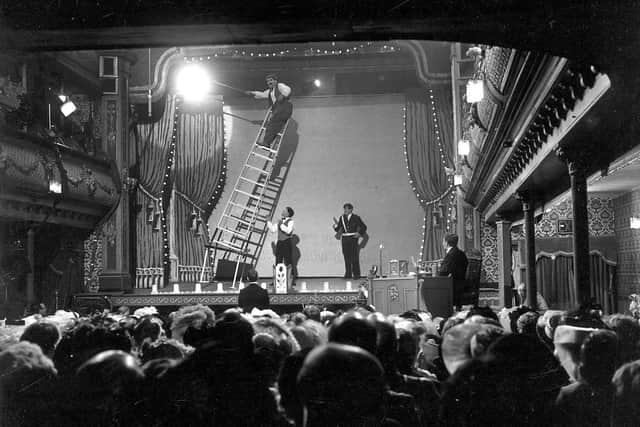
During 1880, the premises were known as Stansfield’s Varieties, whilst in 1894 the name was changed to the more well-known Leeds City Varieties Music Hall.

Amongst the famous acts to appear there were Charlie Chaplin, starring as one of The Eight Lancashire Lads in 1897.
Lily Langtry, the famous ‘Jersey Belle’ performed in 1898, George Formby senior, father of a famous son, in 1898, and Houdini in 1904.
Between 1953 and 1983, the City Varieties achieved national fame as the venue for the BBC television programme The Good Old Days, a recreation of an old-time music hall featuring Leonard Sachs as the alliterative Chairman.
The Theatre Royal in King Charles Croft (not to be confused with the Theatre Royal in Hunslet Lane) welcomed patrons from 1876. It was built by Joseph Hobson and replaced The Amphitheatre which had been destroyed by fire some months earlier.
When Francis Laidler took over in 1909, the theatre, in subsequent years, gained a reputation as one of the best in the north of England for staging pantomimes. Florrie Ford starred in Laidler’s first Christmas production, Babes in the Wood.
She was an Australian-born British vaudevillian performer and popular singer, notable in music hall and pantomime. In 1945 Humpty Dumpty was performed for a record 22 weeks.
When Laidler died in 1957, his wife carried on at the theatre for another two years. The site was acquired by Schofields and later absorbed into the Headrow Shopping Centre, renamed ‘The Core’.
Built at a cost of £62,000, the Grand Theatre in New Briggate began performances on November 18, 1878, with a performance of William Shakespeare’s Much Ado about Nothing.
The theatre was designed by George Corson (1829-1910), a Scottish architect active in Leeds, along with his assistant James Robinson Watson.
The exterior reflects a mixture of Romanesque and Scottish baronial styles, while the interior features Gothic motifs: fan-vaulting and clustered columns.
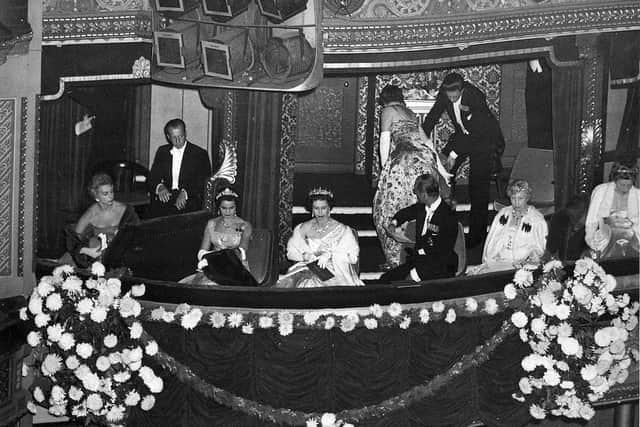
It could accommodate 2,600 people, with standing room for a further 200. Every precaution was taken to make the building safe.
The manager was even prompted to state: ‘If the stage were engulfed by fire, every gentleman would have time to light his cigar comfortably, give his arm to his lady love, and saunter pleasantly out of the building!’
Sarah Bernhardt appeared at the Grand in July 1881, Lily Langtry in 1882, and Ellen Terry acted in J M Barrie’s play Alice-sit-by-the–Fire in 1905.
The Prince and Princess of Wales opened The Coliseum, Cookridge Street, on July 15, 1885.
Designed in the Gothic style by William Blackwell, it included a dress circle and upper circle, with accommodation for 3,400. During 1938, it was converted to a cinema and renamed Gaumont. During the 21st century it became the O2 Academy.
The Empire Palace Theatre, Briggate, opened on August 29, 1898. It was designed by Frank Matcham for the Liverpool, Leeds & Hull Empire Palaces Limited. Seating was for 1,750 people, arranged on three tiers.
The opening night featured 17 acts, including Lydia Yeamans (the original ‘Sally in our Alley’), the French comedian O’Gust, Harry Tate impersonating Dan Leno and others, and John Higgins, the Human Kangaroo.
The theatre was altered in 1931, enabling it to show films as well as regular variety. Cliff Richard appeared there in the late 1950s but in the following decade, the site was redeveloped.
Emile Littler’s Babes in the Wood was the last show on February 25, 1961. The Empire Palace was demolished in 1962, and replaced by the Empire Arcade.
Several significant developments took place during the 20th century.
By 1925, the old Institute of Arts and Science on Cookridge Street was named the Civic Playhouse after being taken over by the British Drama League.
It opened with a performance of Overture. Admission was free, but a collection was taken at each performance, and patrons could support the theatre by becoming subscribers. Alterations took place in 1949 and the building was officially opened as the Civic Theatre on October 7 of that year.
The Civic Theatre provided a good base for local amateur dramatic companies belonging to the Leeds Civic Arts Guild. Closure came in 2005, and through Heritage Lottery funding the building reopened as the City Museum three years later.
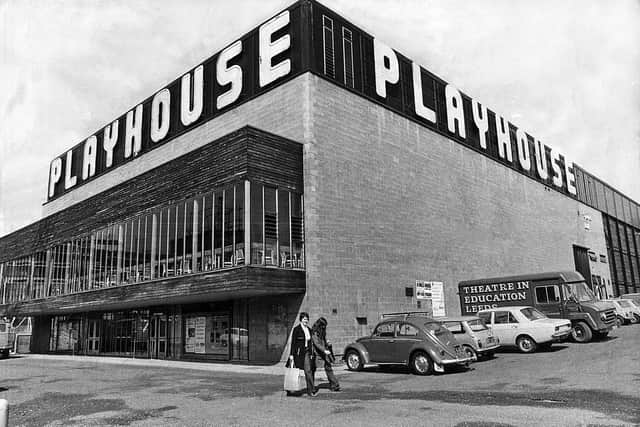
An exciting development evolved in 1964. The Leeds Playhouse website states that a new committee in Leeds, comprising over a dozen people, began a campaign for promoting a professional theatre in the city.
It was an attempt to address the absence of a professional producing theatre in the West Yorkshire area. It adds: ‘In 1968 the Leeds Theatre Trust was incorporated and a public appeal for funds of £150,000 was launched at a meeting in Leeds Town Hall on 5 May 1968.’
The gathering was addressed by Peter O’Toole and Keith Waterhouse. The architect for the building was Bill Houghton-Evans, the foundation stone was laid on September 25, 1969 by the Lord Mayor of Leeds, Alderman A.R. Bretherick.
The construction work was carried out by Robert R. Roberts of Leeds at a cost of around be £141,500.
The first performance at Leeds Playhouse occurred on September 16, 1970 with Sir Tony Robinson in Alan Plater’s play Simon Says.
Leeds Playhouse was replaced by the West Yorkshire Playhouse. Designed by The Appleton Partnership architects of Edinburgh, it was built on Quarry Hill, formerly occupied by the Quarry Hill flats.
Donald Sinden turned the first sod in November 1987; Judi Dench laid the foundation stone in March 1989, and Albert Finney performed the topping out ceremony in September 1989.
The West Yorkshire Playhouse opened its doors in March 1990, being rebranded Leeds Playhouse in 2018.
Thanks to Susan Stepan and Helen Skilbeck at Leeds Libraries for help with this piece.