
The historic Yorkshire buildings which survived the dissolution of the monasteries
Following the Norman Conquest in the late 11th century, many abbeys and priories were founded as a place for employment, service or worship for local communities.
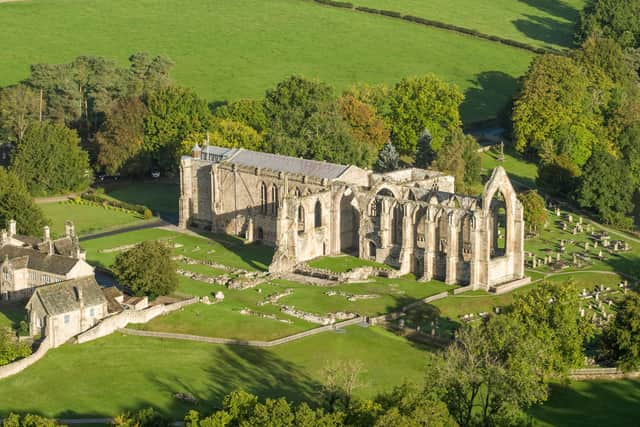
This role lasted for around 500 years to the Dissolution of the Monasteries. Yet, a number of places of worship within the areas managed to survive afterwards, including Bolton Priory Church, near Skipton.
There were several reasons why abbeys and priories became so numerous. Many of the abbots and priors were people from France and they were loyal to the Normans, allowing their laws to be enforced.
With these figures in place, the Normans were able to control large tracts of land which were held by the abbeys and priories.

There was also a charitable element to building places of worship and this partially appeased the Pope, who demanded penance for the bloodshed caused by the invasion.
A number of religious orders formed monasteries in the 11th and 12th centuries.
The Benedictines were the earliest and in Yorkshire these included Selby Abbey, Whitby Abbey and St Mary’s Abbey, York.
The Cistercian order followed with Fountains Abbey, Rievaulx Abbey and Kirkstall Abbey amongst others.
A third group was the Augustinians, founding a number of priories following some Cistercian traditions, but instead of being somewhat reclusive, the Augustinians taught Christianity in the local community.
Bridlington, Gisborough and Kirkham Priories were established in Yorkshire during the early 12th century.
Another was Embsay Priory, built in 1121 by Alice de Romille and dedicated to St Mary and St Cuthbert.
Alice was the daughter of William de Meschines and Cecilia de Romille.
Her father was descended from the last Saxon owner of the lands, Edwin, and the estate was inherited on Alice’s mother’s side of the family.
During a period of conflict with the Scottish, Alice was able to subdue their leader William Fitz-Duncan and the two were subsequently married.
Bolton Priory of Canons Regular of the Order of St Augustine was founded in 1154 and endowed with three villages, several churches, a fair at Embsay, free warren in 14 townships (hunting and breeding rights for small animals, such as hares or rabbits) and a tithe on all wild beasts killed in Craven.
The priory also operated a lead mine. By the turn of the 13th to 14th centuries, Bolton Priory was most productive and generated a revenue over £850 annually.
This can be roughly converted to around £850,000 in present currency.
As a result, large amounts of produce were consumed annually, including 64 oxen, 35 cows, 140 sheep and 69 pigs.
Also, 113 stones of butter, 147 stones of cheese and 8,000 bottles of wine, as well as liberal amounts of ale.
Shortly after this period of prosperity, Northern England became an unsafe place owing to the First War of Scottish Independence (1296-1328).
The wealth of the religious establishments became the focus of the raiders and on several occasions the prior and cannons at Bolton were obliged to flee, taking refuge in Skipton Castle.
In demonstration of the priory’s influence, during the conflict, wagons were requestioned by the King’s forces, yet a bribe was paid to his representatives for their return.
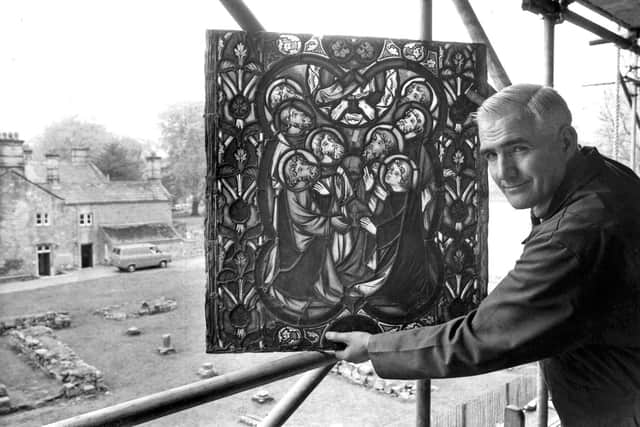
Bolton Priory was subsequently rebuilt and restored, whilst the last prior began building the Western Tower, which was only partially complete by the reign of Henry VIII.
When he suppressed the monasteries, Bolton was signed over to his agents by prior Moone and 14 cannons on January 29, 1540.
Everything of value was taken from the priory and sold. The lead was stripped from the roof and melted down into ‘pigs and fodders’. Most of the building was damaged in the process.
The lands held by the priory were sold by Henry VIII in April 1542 to Henry Clifford, 1st Earl of Cumberland, realising nearly £2,500.
The 5th Earl left the estates to his daughter Elizabeth, wife of Richard Boyle, 1st Earl of Burlington.
The 3rd Earl’s daughter Charlotte married William Cavendish, Marquess of Hartington, later 4th Duke of Devonshire, and received Bolton on her father’s death in 1753.
She died of smallpox just a year later and the estate went to William and has been held by the Cavendish family to the present time.
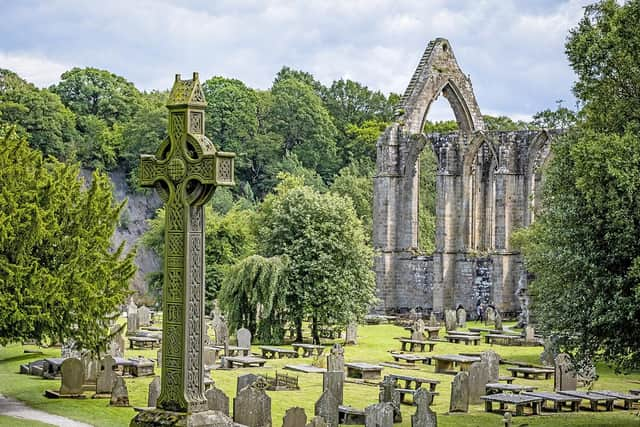
Whilst a number of monasteries were left in ruins, local communities were keen to continue their worship of Christ and God which led to the formation of churches within the old structures.
At Bolton Priory there appears to have been a gathering of parishioners in the nave and west tower under the administration of the Holy Trinity Church, Skipton, for around two centuries.
The 3rd Earl of Burlington started renovation works in the late 1720s and at the end of the century, the 5th Duke of Devonshire oversaw the reorganisation of the interior of Bolton Priory Church.
In the mid-19th century, the 6th and 7th Dukes of Devonshire further enhanced the church, with stained glass windows designed by Augustus Pugin, and a major restoration was started under the guidance of G.E. Street, who also designed the Royal Courts of Justice.
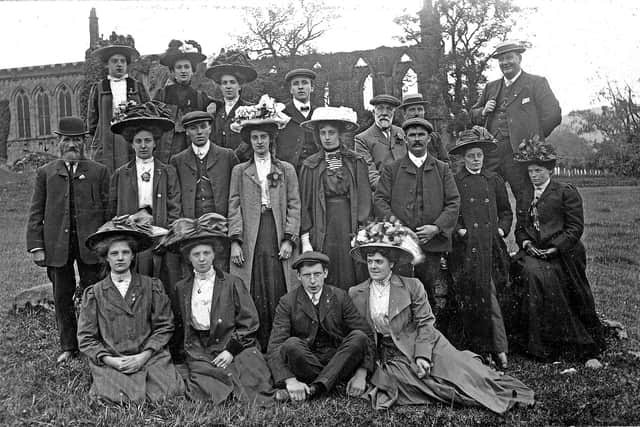
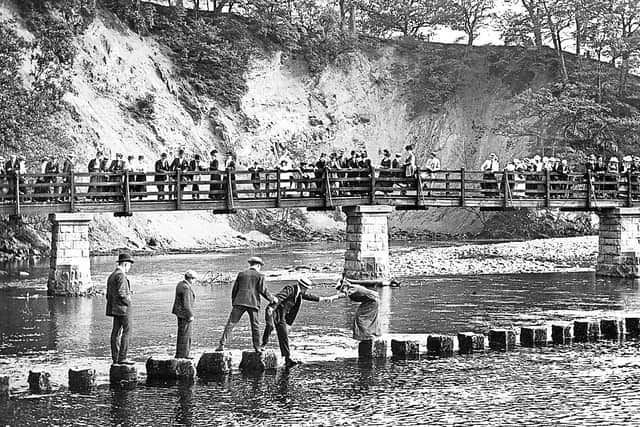
Around this time, the railways reached Skipton from Bradford and Bolton Priory became a popular destination for tourists, who admired the ruins and crossed the Strid using the stepping stones.
A coach service from Skipton was advertised in the 1870s, costing 2s there and back.
By the late 1880s, a railway branch had been built from Skipton to Ilkley, with a station provided at Bolton Abbey.
In use to 1965, the section of line between Embsay and Bolton Abbey is now home to a heritage railway.
The freedom of the public to enter the grounds of the priory was in jeopardy during the early 20th century as there were several reports of vandalism.
An article from 1906 announced that six pieces of moulding had been forcibly removed, whilst an ancient carved head was also missing.
Furthermore, damage had been caused to the trees from people cutting their initials into them.
The gatehouse for the priory, which had served as a hunting lodge from the mid-17th century, was converted into a house, Bolton Abbey Hall, during the 1840s.
Sir Joseph Paxton, of Crystal Palace fame, was involved in extensions made around the gatehouse.
Several Dukes of Devonshire spent time at the hall, particularly at the start of the hunting season.
The Prince of Wales, later King Edward VII, visited a number of times for the shooting, as did George V, who brought Queen Mary on occasion.
She is noted visiting the priory ruins in the 1920s, whilst the King and Queen attended services at the church while in residence.
Queen Elizabeth II and Prince Philip were guests of the Duke and Duchess of Devonshire in 2005.
Despite seeing falling congregations in the late 20th century, Bolton Priory Church was revitalised under canon Maurice Slaughter, who led another refurbishment of the building and sought to draw in worshippers from further afield in Yorkshire and the North West.
Recently, as a result of the pandemic, services have been streamed online and have helped draw visitors from several continents.