
The history of transport in Yorkshire from Iron Age roads to electrified railways
In the history of the British mainland, national roads and transport links have only been important within the last few centuries, particularly with the advent of railways in the early 1800s. Yorkshire witnessed several rail developments due to mineral deposits and industry, whilst there was also the major trunk route – the East Coast Main Line – running through the county.
In Iron Age Britain, roads were mainly natural pathways made by people travelling between local settlements and for moving livestock.
During the Roman occupation (AD43-AD410), sturdy routes of communication were necessary for military movement and trading.
The Romans built a number of roads to a general design, with ditches either side of a raised central portion that had gravel or stone toppings.

These generally ran in a straight line on higher ground (for good drainage), connecting settlements and fortresses across the country.
After the Romans, the roads were often stripped by locals for building materials and a return was made to the trackways used previously.
The Normans devolved the responsibility of road upkeep to manorial lords and their serfs, whilst the clergy also played a role as roads were seen as charitable.
Three original Roman roads – and an ancient pathway – were enshrined in Norman law as Royal Routes and protection was offered against highwaymen.
Towards the end of the Tudor period, an attempt was made to assign responsibility of roadways to parishes, yet this was unpopular.
During 1663, the Turnpike Act was passed and placed the obligation with private companies.
Part of the Great North Road in the south was gated for the collection of tolls as a trial before the practice spread out across Britain.
In Yorkshire, the first turnpike opened between Rochdale, Halifax and Elland during 1735.
This influenced subsequent ventures, such as a connection to Leeds in 1740 and from there to Selby during the same year, allowing access to the River Ouse.
In the next decade, turnpikes had been established between Doncaster and Tadcaster, Hull and Beverley, York and Scarborough and Boroughbridge and Durham.
Yet, the turnpikes were disliked by ordinary people as the tolls were seen as a financial burden when historically travel had been free for all.
In 1753, protesters in Leeds assembled and rioted by burning several toll bars. When the marchers reached the turnpike headquarters in the city, the army was called and a number of people were shot.
Just as stage coaches were being established, the first wagonway to receive an Act of Parliament started at Middleton, Leeds.
Used principally for coal traffic, the line later hosted the first commercially successful steam locomotive in the early 19th century.
With the development of the Stockton & Darlington and Liverpool & Manchester Railways, confidence was gained for other projects.
In Yorkshire, the Leeds & Selby Railway was an early line, then from this the Selby & Hull Railway was developed.
As a result, a cross-country journey between the Irish and North Seas was possible, which promoted industrial growth and exports.
Additionally, Hull became the premier East Coast port, just as competition was experienced from places such as Goole.
By 1840, Yorkshire was in communication with London, albeit through travelling on several companies’ lines.
The North Midland Railway and York & North Midland Railway made this possible, with the former completing a section from Derby to Leeds, whilst the latter connected with the NMR at Normanton.
This reduced the journey time from Yorkshire to the capital from a day on a stage coach to approx. 10 hours by rail.
Though the Great North of England Railway was authorised to reach Newcastle from York, the company only managed to build a line from the latter to Darlington and several other undertakings were necessary to reach the Tyne.
There had been plans to connect London with York since the 1830s. Yet this project did not come to fruition until the late 1840s.
The Great Northern Railway built the line from King’s Cross to just north of Doncaster where the GNER was met and used to reach York.
The GNR went on to establish a presence across Yorkshire, particularly West Yorkshire.
By the mid-1850s, the companies between York and Newcastle had joined together forming the North Eastern Railway.
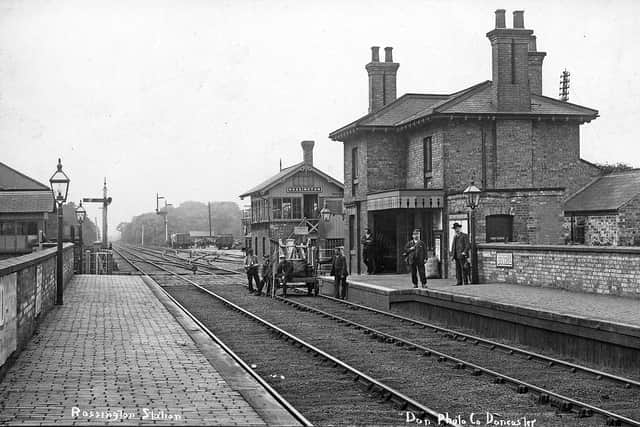
The GNR and NER ran the ECML in Yorkshire to the Grouping of 1923 and also developed much of the infrastructure.
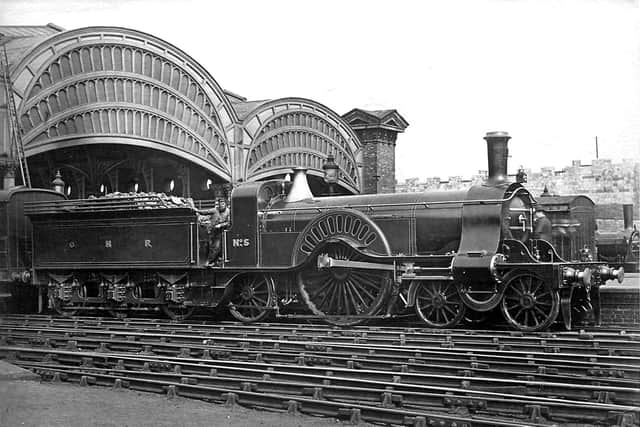
The NER was based at York and in 1877 built a new station which was for a time the largest in the world.
The company’s carriage works were also in the city and extensive sidings were present for freight traffic.
The GNR founded workshops at Doncaster in the 1850s and many famous ECML locomotives were built there, as well as coaching stock.
The original junction between the GNR and NER was inconvenient and in the 1870s a major upgrade was undertaken to straighten the route between Doncaster and York via Selby.
This later became a bottleneck and was a cause of concern for subsidence in the 1970s. As a result, the ECML was diverted from south of Selby to just south of York, with the project completed in 1983.
Also, during the 1980s the ECML electrification scheme was mainly carried out in Yorkshire at the end of the decade.
Whilst freight traffic was historically the main revenue source for railway companies, passenger services were widely publicised and brought prestige, particularly those on the trunk routes.
The ‘Flying Scotsman’ service’s origins date back to the early 1860s and daily services between King’s Cross and Edinburgh Waverley took 10.5 hours, with a stop at York for lunch.
By the end of the 19th century, the time had reduced to eight hours.
After Grouping in 1923, the London & North Eastern Railway decided to introduce a Pullman service to Harrogate, then later in 1927 the ‘Scarborough Flyer’ started as a non-stop to York before continuing to the coast.
In 1935, the ‘Harrogate Pullman’ was rebranded the ‘Yorkshire Pullman’ as a portion was offered to Hull.
Both trains were withdrawn during the war, but returned and operated to the late 1970s and early 1960s respectively.
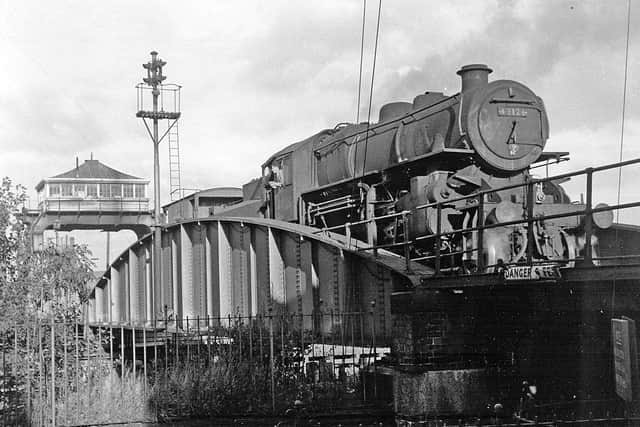
Before dieselisation in the 1960s, steam engines experienced a final golden period on the ECML and several named trains ran through Yorkshire daily.
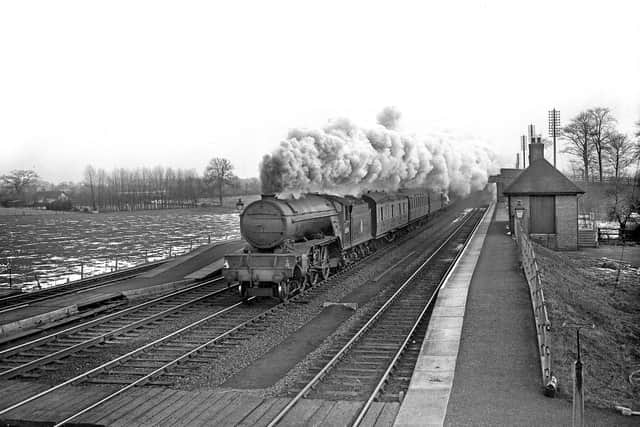
These included: ‘The Flying Scotsman’; ‘The Queen of Scots’; ‘The Tees-Tyne Pullman’; ‘The Talisman’; etc. These were hauled by Gresley and Peppercorn Pacifics – many of which were built at Doncaster.
With the electrification of the ECML in the 1980s, the new Intercity 225s were able to seriously improve timings and a London-Edinburgh journey could be completed in just over four hours.
Recently, the ‘Azuma’ sets have entered service and are operating on the main line and to Leeds.
Whilst many might bemoan the standard of the railways or being stuck in traffic on the A1, the Romans would likely marvel at such a robust national communication network.