
The history of Whitby's railways which brought thousands of holidaymakers to the Yorkshire coast
Whitby’s early transport links are detailed by G.W.J. Potter (1906). The first turnpike road leading out of Whitby ‘presumably to Pickering’, according to the author, was made in 1759.
In 1788 communication with York was established and stage coaches ran from 1795.
A little earlier, in 1793, considerations for a canal between Whitby and Pickering were put forward but was found to be impracticable.
The Whitby & Pickering Railway Act of 1833 authorised the construction of a horse-drawn railway between the two towns.

Details in the Act said it would be of much advantage to the commercial, agricultural and other interests of the two areas, the neighbourhood and to the general public.
Whitby’s shipbuilding and whaling industries had been experiencing a decline and there was hope new transport links would rejuvenate its fortunes.
In a notice to earthworkers, quarrymen and carpenters, the Leeds Intelligencer of September 14, 1833 made an announcement.
The directors of the Whitby & Pickering Railway Company (W&PR) were ready to receive tenders for the execution of the earthwork (including the ballasting), bridges, and other works required along the first seven miles, at the Pickering end of the route.
Another notice in the same newspaper said the company was ready to receive tenders for larch sleepers, and posts and rails.
Building the railway was not without incident.
On Monday June 9, 1834 two men were seriously hurt while employed about two miles from Whitby in some excavations on the line. A large quantity of earth and stones fell on them.
One man had his thigh broken whilst another “was so severely bruised, that considerable doubts are entertained of his recovery”.
By October 8, 1834, the W&PR engineer George Stephenson said the company was ready to contract for the execution of the whole of the works on the remaining eight-and-a-half miles of the railway.
Three days later one of the labourers employed in excavating the Grosmont tunnel was accidentally killed, crushed by a falling rock. He left a wife and four children.
On Friday May 22, 1835 the W&PR directors travelled in a coach to inspect the line – so far completed – and were pleased with the progress made.
The W&PR was opened to the public on Monday July 13, 1835 for the distance six-and-a-half miles from Whitby to Grosmont Bridge.
A reference from September 1835 notes the directors ordered from George Vasey of Whitby “two coaches of good seasoned timber for £42 each”.
The railway opened completely on Thursday May 26, 1836.
One account asked: “Who is there except those who delight in the dreary solitude and chilly blasts of the moors that does not rejoice in the coming of the railway?”
It continued that “the railroad wound through a succession of valleys of extraordinary beauty possessing a combination of scenery, in wood, rock, water and highly cultivated land that renders it one of the most beautiful and picturesque rides in the kingdom”.
The W&PR was intended to carry passengers as well as goods and three first class horse-drawn carriages, named Premier, Transit and Lady Hilda were used.
These vehicles were no more than stage coaches adapted for railway use; also provided were a number of cheaper open carriages.
Fares were 3s 6d inside, 2s 6d outside. There was room for six passengers inside.
By July 1836, an account of the W&PR, with 13 engraved illustrations of the adjacent scenery drawn by G. Dodgson, was published.
Descriptions of the district and undertaking were by Henry Belcher.
An Act of 1845 authorised the sale of the W&PR to the York & North Midland Railway Company (Y&NM) owned by self-styled “railway king” George Hudson.
The W&PR line was converted from horse to steam power between late 1846 and mid-1847.
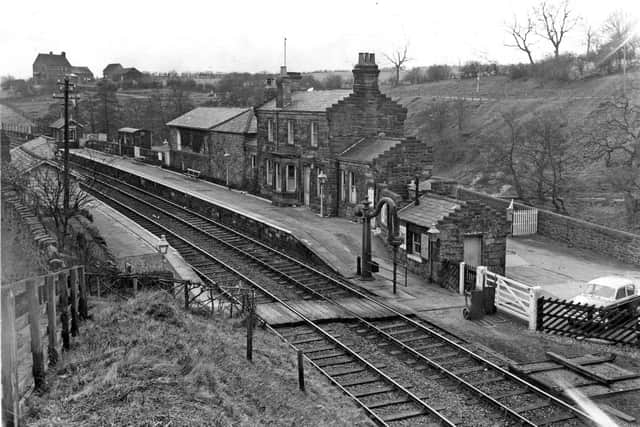
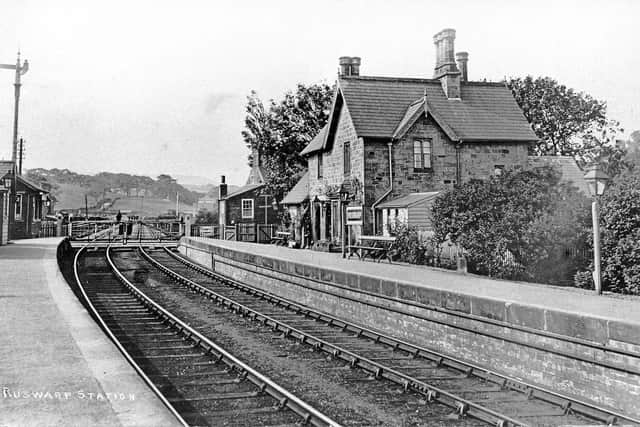
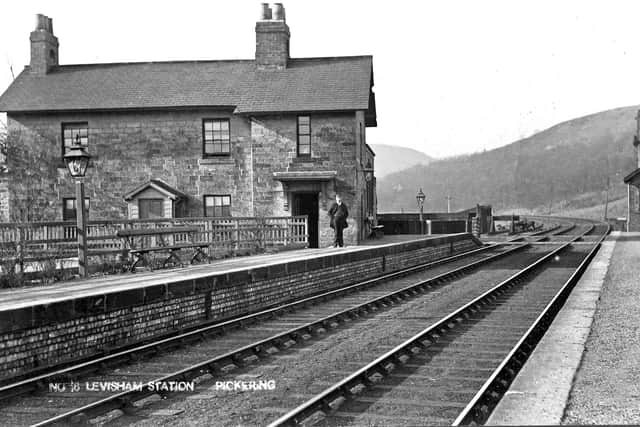
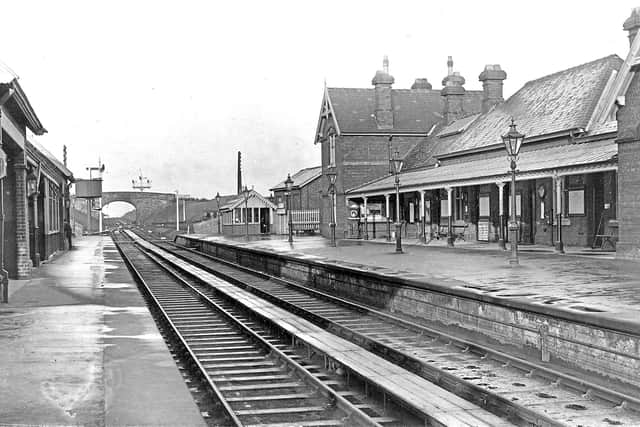
The work involved rebuilding the line to a double-track railway, erecting railway stations, engine sheds, goods sheds, crossing keepers and labourer’s cottages, wider bridges and a tunnel at Grosmont.
Design work for the new Y&NM structures was mainly carried out by noted York railway architect GT Andrews. Steam-hauled public services began in 1847.
A new station at Whitby was opened on June 4 of that year. With the intention of encouraging traffic on the railway, a subsidiary company of Hudson’s – the West Cliff Building Company founded in 1843 – developed the West Cliff in Whitby, creating roads and building hotels.
The Y&NM was absorbed by the North Eastern Railway (NER) in 1854 and work undertaken during their ownership included the construction of a new Deviation Line due to the problems caused by the Beckhole incline.
The new line opened in 1865 and saw the completion of four new over bridges, seven under bridges and a new station at Goathland.
Whitby West Cliff railway station opened on December 3, 1883.
At the Grouping of Railways in 1923 the Whitby to Pickering route transferred to the London & North Eastern Railway, existing with this latter company for 24 years before absorption into British Railways.
The mid-1950s saw the introduction of the far-reaching plan for the modernisation of the rail network. Diesel multiple units were introduced on many services including the Whitby branch in 1959.
When the Beeching Report was published in 1963 countless UK branch lines were axed and the Pickering to Grosmont stretch was completely closed amid many redundancies in 1965.
The Esk Valley line was reprieved, saving six miles of the original W&PR route between Grosmont and Whitby. This was to be very convenient in the years ahead.
Devastated by the closure of the old W&PR line, a group of ten ardent railway enthusiasts was pioneering enough to plan a preservation scheme.
Their intention was to seek permission to carry out maintenance work on the Grosmont to Pickering line and organise members only steam galas. Thereafter, a number of important milestones were passed.
The inaugural meeting of the North Yorkshire Moors Railway Preservation Society took place in Goathland village hall; the first membership magazine appeared in February 1968; the first rail vehicle arrived a few months later; and the first rail movement between Pickering and Grosmont was celebrated on February 2, 1969.
Events moved apace during the early 1970s: the North York Moors Historical Railway Trust was incorporated as a successor to the Preservation Society by December 1971 and registered as a charity a year later.
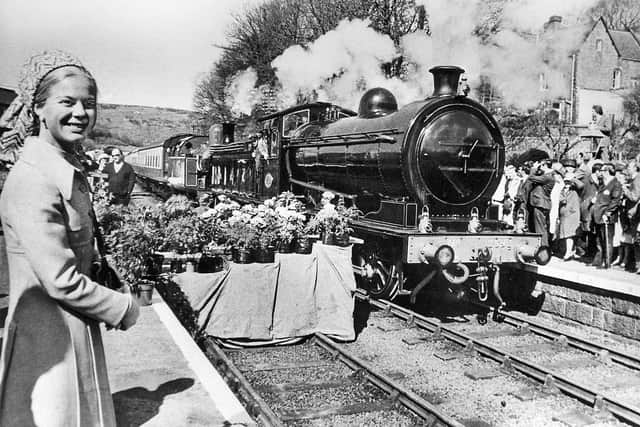
Public services commenced on the NYMR between Grosmont and Pickering on April 22, 1973 and on May 1 of the same year, HRH Duchess of Kent officially opened the railway.
She did so by operating a signal at Grosmont, where she also unveiled one of three plaques.
Special events at the North Yorkshire Moor Railway, usually revolving around a particular theme, are staged through the operating year and the Yorkshire Post has regularly been on hand to record the details.
The NYMR has featured in both television and film, including Heartbeat, Harry Potter, Casualty, Brideshead Revisited and All Creatures Great and Small.