
'The Horsforth Horror: The chilling murder of my great aunt Barbara Waterhouse'
David Tasker tells Laura Reid about the book he is writing 135 years after the murder of his great aunt Barbara Waterhouse in Leeds.

David Tasker’s interest was piqued. The box of belongings had ended up with his mum and dad in Horsforth, Leeds after the passing of his aunt. His folks didn’t know much but they knew that Barbara – David’s great aunt – had been the victim of a murder.
“That raised a lot of questions and it took me on a little bit of a journey,” says David, who formerly worked in policing. “I was interested in what had happened.”
It was back in the mid-1980s that he stumbled across the story, one that he says his family “never spoke about”. Four decades on, he’s writing about it, hoping to publish a book next year, around the 135th anniversary of his relative’s death.
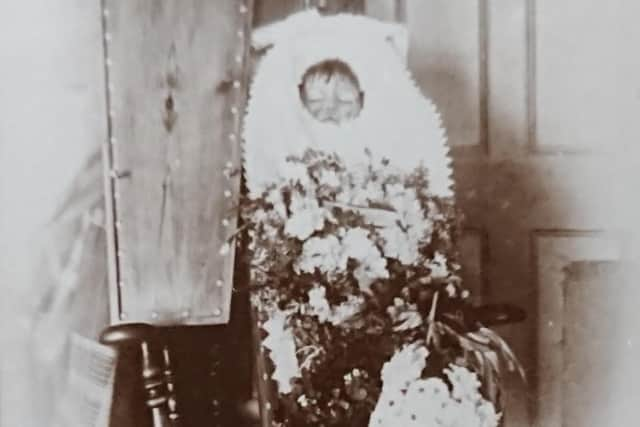

“I’ve written it as a family record I suppose,” the 67-year-old reflects. “Barbara was one of seven children, so there’s probably quite a big family network in Horsforth, though I don’t really know anybody….from a family of seven, that's probably expanded exponentially.”
David’s grandmother Jane was Barbara’s sister, though born in the years after she was murdered. After seeing Barbara’s photograph, he set about researching what had happened to her all those years ago.
His interest took him to Leeds, where he collected newspaper cuttings of articles about when Barbara went missing and the trial of her killer that later followed. In national archives, he found judge’s notes and comments about the case. “There’s a lot of verbatim recording of what happened at the time,” he says.
It is thought that Barbara had been playing out with a friend around Alma Yard in Horsforth when she went missing, after the pair nipped into a local shop. "Barbara used to collect boxes. She liked building things out of boxes,” David says. “The (shopkeepers) gave her a box and I think she stayed playing with that outside the shop for a while which is then when she went missing.”

It wasn’t until several days later that what happened to Barbara began to come to light, when a police officer found her body, covered by a shawl in Alexander Street in Leeds City Centre, just a stone’s throw away from the town hall.
Walter Lewis Turner, a 32-year-old weaver, who lived close to where Barbara went missing, was charged with her murder. He is said to have stored her body in a cellar-of-sorts in the home that he shared with his mother. “He moved the sofa so nobody could get into the under-stairs coal area,” David says. “He’d got enough coal out to fuel the fire for a few days, as that’s where the body was.
"On the Sunday (the day after the murder), he spent the whole day on the sofa so nobody could move it, saying he felt as though he had got the flu. On the Monday morning, his mum got up before him and curiously had a look in the (cellar) and just saw this bundle in the corner wrapped in her shawl.”
Turner’s mother helped her son to dispose of the body, with the pair taking it in a trunk to Leeds city centre. It is thought that she then confided in a friend and was persuaded to speak to police. Turner was found guilty of Barbara’s murder and was sentenced to death for what locals dubbed the Horsforth Horror. He was hanged at Armley Gaol in August 1891.
Whilst researching the crime, David, who was born in Horsforth, also came across reports of the unsolved murder of Johnny Gill, a seven-year-old boy who was killed in Manningham, Bradford a few years earlier in 1888. A local milkman, William Barrett, became a suspect in the case but there was a lack of solid evidence and no one was ever prosecuted for the murder.
David, who worked for Suffolk Police for more than 30 years before moving into teaching, believes there are similarities between the murder of Johnny and that of his great aunt Barbara. "When you look at the autopsy report, it looks as though Barbara was probably enticed away with an orange – quite a luxury in the Victorian times...When you look at the Bradford murder, it seems the young boy there was enticed with a fruit cake...
“When you look at these two cases and the injuries that were caused, they’re very similar...The police did look at a (potential) link between the two. I think the difficulty for the police at the time was the different forces - you had Bradford police, Leeds city police and Horsforth used to work more towards Guiseley and York so the exchange of information was very limited.”
David is appealing for information to help him with his book. He is particularly keen to hear details about the lives of Ellen Turner – Walter’s estranged wife, William Barrett, and the descendants of Johnny Gill, as well as information about members of his extended family related to the children of Elizabeth and David Waterhouse.
"Barbara’s mother was terribly affected by the murder,” David says. “I think she used to just sort of drift off in conversations and start talking about how her daughter was murdered. I think it probably took her a long time to get over that. Fortunately for me, they still had my grandmother later on...
“I think it's one of those things that families don't talk about. It's one of those skeletons in the cupboard really - I don't know why as it was nobody's fault was but people don't like to talk about (what happened) or didn't in those days. But the story has definitely got a certain fascination.”
Anyone with information can get in touch with David via email at [email protected]