
The Rarity Garden by Yorkshire Coast Nature's Richard Baines shares how he attracted mirgating birds to his Flamborough Head home
Richard Baines’s book shares his lifelong passion for wildlife and explains how his unique Flamborough garden attracted rare species. John Blow finds out more.


Gorging goldfinches and a healthy stipend of marbles – that’s all it took for a young Richard Baines to fall in love with wildlife.
He casts his mind back to his days as a schoolboy of eight years old in Middlesbrough.
"We were asked to come back the next day with something to draw. So when I was walking home, I remember very clearly - it's a very strong memory – I met a flock of goldfinches. These goldfinches just appeared next to me, flew in and were feeding on thistles, as they do.
“I just couldn't believe how close they were,” he says. “It felt like that first magical moment with birds when you find something yourself, or something appears in front of you. It could be any form of wildlife – it could be a fox, a badger or a flock of goldfinches.”
Sure enough, he knew what to draw when he got to class and his teacher was very impressed.
“That encouragement from that teacher was the start of it really and the funniest thing about that experience, and I describe it in the book, was my friends then wanted me to teach them how to draw birds. So I asked them to pay me in marbles because that was the most valuable currency for an eight year old in the 1970s.”
Now 59, his passion for wildlife has endured the half a century which has since passed and, happily, he has kept journals of his discoveries since 1979.
Richard’s notes and annotated drawings proved indispensable during his decade and more tucked away on the Flamborough Headlands, where he set about creating ideal conditions for migrating wildlife to land right on the family patch.
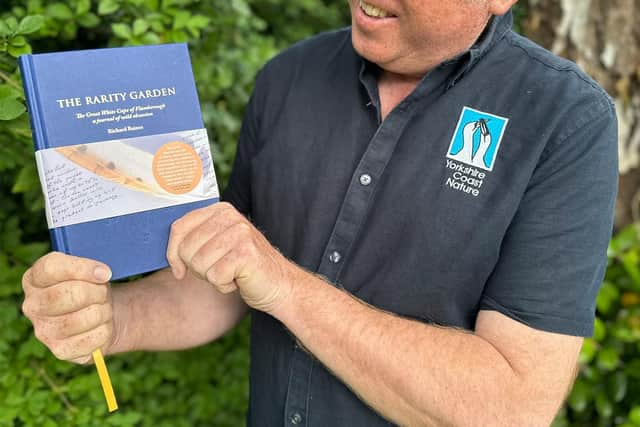
The Rarity Garden, his first book, shares that journey – a personal and beautifully illustrated account of his time observing one small garden perched on the cliffs. It is packed with tips for birders and anyone who is interested, and the hardback book contains photographs, drawings, paintings, and maps. Five per cent of all proceeds from the book will also be donated to the North Yorkshire Turtle Dove Project.
Ever since those early school days, Richard has been trying to spot rarities.
“Birding was very different then, when we didn't have the internet, and we had to just get to know people in different parts of the country and make friends. And then every week, you would ring your friends and say, ‘What have you got nearby?’”
When he was 18 to 19, he got a job at a country park in Sedgefield, County Durham, where he took bird surveys and led walks.
He was off to college to study nature conservation and is now a professional ecologist with Wold Ecology, who has conducted surveys across the UK for more than 30 years, including extensive work with the North York Moors National Park Authority. In 2011, Richard co-founded Yorkshire Coast Nature – one of the UK’s first locally-based nature tourism enterprises – with his business partner, Steve Race.
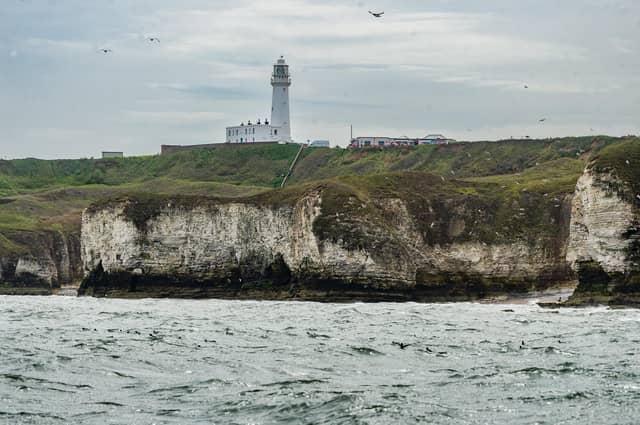
But it was in the autumn 22 years ago when he moved to his special spot, a coastguard cottage near Flamborough Lighthouse on the Outer Headland, having first moved to the village itself in 1999 to become a countryside officer for East Riding Council.
“I had grown up as a birder and would dream of seeing unusual birds and living very close to the sea in Yorkshire, and having a garden next to the sea was always a big dream of mine, and it was something that I never thought I would achieve. Then we got an opportunity to buy the house in October 2003 and it just started there really.
“It was a fantastic place. We could smell the guano from the bottom of the garden from the nesting seabirds, the guillemots and razorbills and puffins. It was a real dream come true.”
Richard wanted to attract not only the most interesting local birds as residents but also migrating wildlife – and habitat was the byword of his efforts.
Food, water and shelter are three things birds need. But he also had a pond and stream – courtesy of the home’s industrious former inhabitants – which complemented a wildflower meadow, a thicket of bramble bushes and willow trees, which provided a feast of insects and invertebrate food for visitors such as warblers and flycatchers land from across the North Sea. "They would stop and refuel on feed on their long journeys to Africa,” he says. “By building better habitat in your garden, you create a refuelling station, effectively,” adds Richard, who is partner to artist Jo Ruth and father to Dylan.
Over time, things got really interesting. "I went into the back garden one day, luckily with my camera, and suddenly realised there was a Long-eared Owl staring at me from the bottom of the garden. We were both as shocked as each other,” he says.
"For an owl to come 400 miles across the North Sea and then land in your garden is a pretty special experience, really.”
The Pallas's Warbler was another species that Richard could hardly believe was in his little patch. It is, he says, “a tiny little bird which breeds in the forests of Siberia, and it's quite a scarce bird in this country, but to actually get one in (the) garden was my personal dream”.
This part of the UK, in particular, is a brilliant place for seeing all kinds of birds from around the globe meeting in one spot because it gets what is called a “fall of migrants” when the conditions are right. "When they get to the North Sea coast and there's a little bit of rain, then they have to stop, and that's when we see huge numbers, thousands and thousands of thrushes like blackbirds and redwings and fieldfares, and it's really impressive. The east coast of the British Isles is one of the best places in the world to experience that because we receive huge numbers of birds from continental Europe. So a blackbird from Germany will be mixing with a Pallas's Warbler from Siberia, which will be mixing with a Long-eared Owl from Scandinavia. It's this mixing of birds from different parts of the world that is really impressive.”
For those wanting to develop their own rarity garden, Richard reinforces the message that habitat is key. Streams, even man-made, are an “amazing magnet” for birds.
Another tip is simply “making part of your garden a wild jungle, like your mini nature reserve”, even if the rest of your outdoor space is formal. For example, leave an area for nettles to grow – insects love them, so the birds will too.
Richard now lives in York after moving from the Flamborough house seven years ago. Writing his first book has allowed him to reflect on his amazing time there while creating something that is beautifully designed, with original artwork by Ben Green.
He has ideas for other books but loves the garden focus because most people can relate to it.
“If something unusual lands in your garden - a rare butterfly that you've not seen before - you've got a rarity garden.”
The Rarity Garden – The Great White Cape of Flamborough: a journal of wild obsession by Richard Baines (£30) can be ordered from www.yorkshirecoastnature.co.uk. Richard will also be giving a talk at the Living Seas Events Centre in Flamborough on February 15, 2026, at 2pm. The event includes an auction of all the paintings in the book with all money going to Flamborough Bird Observatory for conservation.