
The UK's youngest clog maker: We meet Simon Brock to find out why he is passionate about the endangered craft
There is nothing fanciful about the narrow single-storey building in Sheffield until you step inside the workshop of one of the UK’s most endangered artisan crafts. Glancing at the range of colourful leathers, the brass adornments and beautiful pieces of sycamore being transformed into soles, I feel I have landed in shoe heaven.
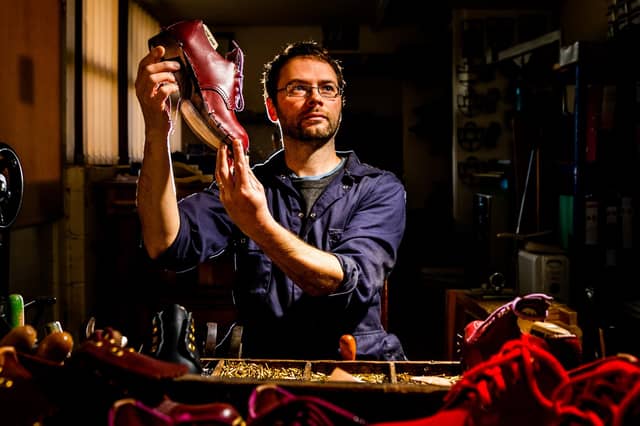

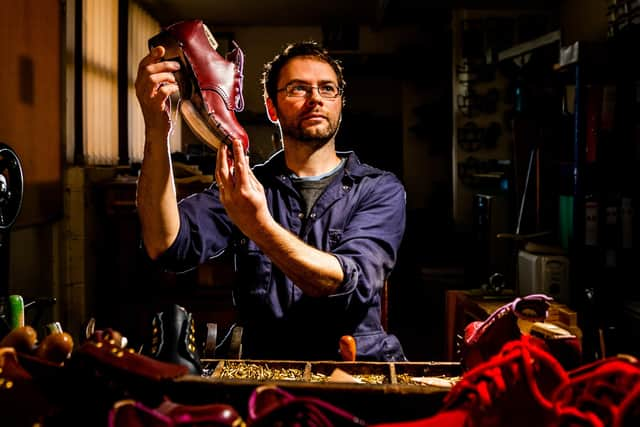
Away from the glamour and gloss of the modern shoe shop, this is a traditional workshop where the artisan is busily fashioning beautiful footwear – well, more specifically clogs – from scratch.
Scanning the shelves, there are plastic boxes filled with brass nails. Metal press knives used to cut out the leather occupy one wall; the vintage Singer sewing machine, its thread dangling ready to stitch the cut pieces of leather together, and the wooden lasts, over which the dampened leather is stretched and tacked into place around the sole ready for the two-to-three-day drying process before the lasts and tacks are removed and replaced with brass nails, occupy another wall in this visibly hands-on production.
The band saw, on which the soles are cut out to a template, and sanding machines, to buff out any rough edges, speed up the process and reduce what would be a lengthier wait to produce what is no ordinary footwear.
Perhaps that is what makes clog wearing more appealing. Yet, despite the apparent demand both from wearers of the wooden-soled footwear for traditional dance or just to be different, this craft finds itself among other ‘critically endangered’ crafts on the Heritage Crafts Red List of Endangered Crafts. First published in 2017, it is believed to be the first report of its kind to rank traditional crafts by the likelihood they would survive to the next generation, based on intangible cultural heritage safeguarding principles, led by Heritage Crafts, the only UNESCO-accredited NGO working primarily in the domain of traditional craftsmanship.
The reasons for crafts becoming ‘critically endangered’ – at serious risk of no longer being practised in the UK – are varied. Limited training opportunities and, basically, the skills and knowledge not being passed on are among the many.
For Simon Brock, the artisan occupying this organised workspace, carrying on the craft isn’t the sole incentive, but who takes on the baton when he retires is something he, along with the few remaining clog makers in the UK, must be conscious of.
Furniture making led Simon into clog making. Having that basic knowledge of woodworking, he believes, is essential for those wanting to come into the craft – yet he has seen many of those courses diminishing, which doesn’t give it a firm footing when attracting clog makers of the future.

“I have always enjoyed making things. My favourite stuff when I was little was Lego, and it was building it that always interested me. I did A-level art at Barnsley College. I enjoy painting, but I was more interested in 3D workshops and making things out of metal and wood. When I was 16 or 17, it was obvious I wanted a career in making, but I couldn’t see it at the time.
“I did a furniture-making HND, originally at Leeds College of Art as it was then, and that is how I learnt woodworking. Then I worked as a furniture restorer in Knaresborough for two and a half years,” explains Simon.
It was a combination of his interest in a morris dancing group he saw performing and ended up joining and meeting a renowned clog maker who was showcasing his footwear in Whitby that led him into a pastime that has become important to his profession.
“In 2010 I met a guy called Trefor Owen. I had heard of him because he was a clog maker of great renown,” says Simon. Watching Trefor at work in North Wales, Simon learnt the skills during what became a long-distance apprenticeship. He also credits Jeremy Atkinson, another expert clog maker, for teaching him how to hand-carve the footbed on the soles.

“It was encouragement from Trefor that prompted Simon to refocus from the leatherworking business he had built up in his garden shed.
“I got quite adept at leatherworking and found a gap in the market for things. Morris dancers wanted bell pads, straps for musical instruments and cases for musical instruments. It took on a life of its own,” he recalls. “Trefor said, ‘your leatherworking is nice but why aren’t you making clogs?’”
Since setting up in 2018, Simon, 39, is believed to be the youngest professional clog maker in the UK.
Of course, clog making was also a natural step for someone involved in the traditional dance network to take.

Interestingly though, the team Simon dances with – the Handsworth Longsword Dancers in Sheffield, where he lives and works – don’t dance in clogs, but having contacts in the network and the knowledge has brought him plenty of custom.
Demand is evident in the stylish clogs standing on the workbench. From the functional to the funky and fashionable, there are clogs in every colour. Gold brings a bit of bling but doesn’t eclipse the beautiful cobalt Mary Jane-style clogs I have my eye on.
Each pair features brass buckles and toetins – a fancy toe fitment to protect the leather when kneeling down – and all are numbered so Simon can keep track of how many he makes – nearly 1,000 since he started. Customers can request customisations too – stars embossed around a pair of black dancing clogs and personalised patterns are among the examples. Practical for the purpose of dancing, different soles suit the style of dance.
“Different styles of dancing require a different approach when making a clog. It can be the shape of the sole that goes on the bottom. For step dancing it is bare wood; rubbers for morris dancing; and some teams insist on traditional irons for the sole,” says Simon, taking a horseshoe shape from a nearby rack. “That is what people would have worn back in the day, and that is what makes the sparks.”
Such memories, particularly for those who wore clogs in childhood, have brought clog wearing back into fashion. Tyre treads are used for the soles of the general wearers Simon refers to as ‘civilians’. It is for the ‘civilians’ who don’t have to sport a specific colour and style for dancing that the choice of pink patent and Jaguar print brings a fashionable dimension to the traditional footwear he is producing.
“It is about 50 per cent for step dancers with the bare wooden soles, 30 per cent for morris dancers, and 20 per cent is what I call ‘civilians’ – people who want them for general or Sunday best or to get married in or as a birthday present to themselves – some people like the story and the craft – the romance of it.”

Eighty per cent of Simon’s customers are dancers, and many of his clogs are destined for global destinations – America, Australia and New Zealand are among the many.
Watching him at work, it is easy to see why he jokingly says it takes 15 years to make a pair of clogs – based on learning and mastering the skills. In reality it takes about a week; customisations lengthen the process.
For more information on Simon Brock, visit his website at www.simonbrock.co.uk or email him at [email protected].