
The Yorkshire workshops that helped power a nation
The York & North Midland Railway was founded in the mid-1830s to connect York with the Leeds & Selby Railway.
From this point the company would have access to several industries, such as textiles and coal mining, as well as new areas for distribution of the products of York and the surrounding area.
Locomotives used by the Y&NMR in these early years mainly consisted of types that had been built by Robert Stephenson & Co.
The L&SR was taken over in 1840 and the engines used by the company also became the responsibility of the Y&NMR.
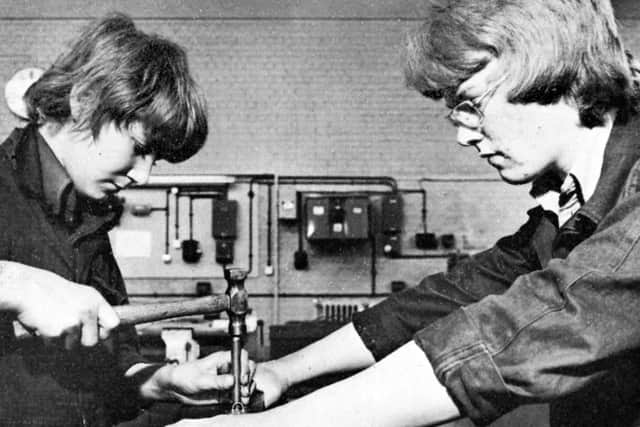

This led to the formation of locomotive repair shops a short distance away from the York temporary station of 1839 and these were overseen by the line's resident engineer Thomas Cabry.
Over the next few decades, the site grew to a respectable size and catered not only for locomotives but wagons as well. The shops reached their height in the mid-1860s.
Taking control of the Y&NMR in 1854, the North Eastern Railway soon decided that the wagons could no longer be accommodated on the relatively small site and were transferred to a 10-acre site to the west of the station on the north side of the line.
The new shops were completed in 1867. The space vacated at the Locomotive Repair Shops was turned into a new Erecting Shop and this was later extended.
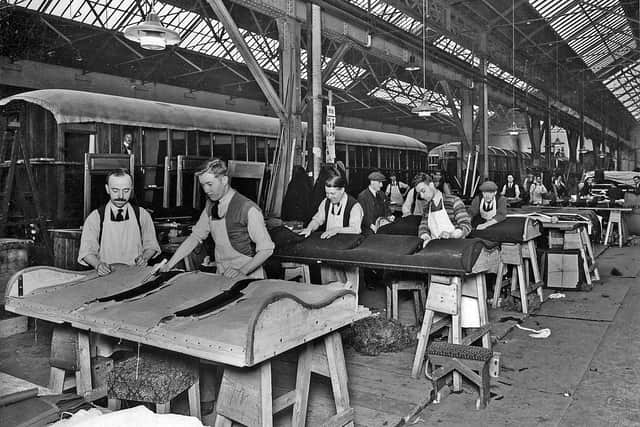
As wagons had been inherited from several different companies, which in turn had bought them from a number of outlets, there was little standardisation between the many types in use. With the arrival of T.W. Worsdell a start was made rectifying this situation.
York Wagon Works' role was producing and repairing the standard wagon types, but also building many of the more specialised wagon designs including plate, bogie bolster, boiler, trolley and propeller wagons through to Grouping of the Railways in 1923.
Consideration was given to the provision of carriage workshops at the end of the 1870s and land was bought directly to the south of the wagon works; communication between the two was later affected by means of a footbridge across the running lines.
The construction process was carried out in stages spanning the years 1880 to 1884 and in all, the work cost around £90,000.
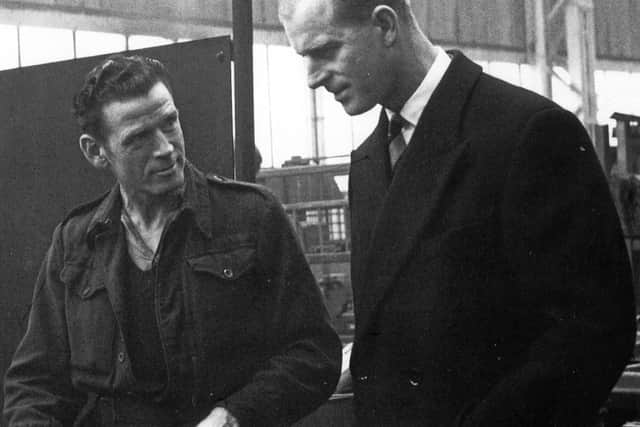
When the opening of the Carriage Works occurred, the NER was in the midst of discontinuing the construction of four-wheel carriages and adopting six wheels as the standard, this type being in production since the late 1860s.
Ten years after the opening of the workshops a change was made to clerestory roof carriages and these were fitted with four-wheel bogies.
Approximately 100 were built every year until 1906 when elliptical roofs became the mainstay of the design for passenger vehicles.
The majority of the NER coaching stock featured compartments and there was only a small number of corridor carriages built for the company's services.
During 1903, York Carriage Works constructed new carriages for the electrified lines from Newcastle to Tynemouth which were opened in 1904. These had clerestory roofs, matchboard sides, gate partitions and seating for 64.
While the Carriage and Wagon Works were being developed to meet the traffic requirements of the time, the Locomotive Shops were left behind and eclipsed by the expansions at Darlington Works.
As a result, the Locomotive Shops were closed in 1905, but the buildings subsequently found several other uses.
The newest Erecting Shop was taken over by York Railway Institute, while the original Repair Shops were made into a railway museum by the LNER in 1928, bringing together a large number of historical items from the collections of the 'big four' railway companies.
The First World War saw a battalion of men raised from NER employees in Hull as well as some from York.
Those left behind in the York Carriage and Wagon Works made general service wagons, over 1,000 stretchers, 3,000 picketing posts and 17,000 picketing pegs.
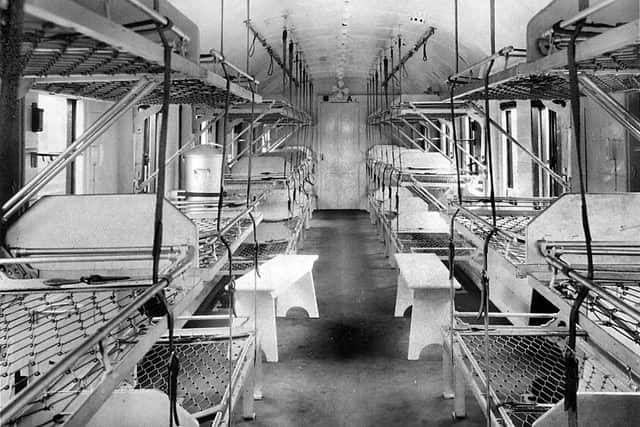
Covered wagons were converted to transport the sick and injured and before the end of the war a 17-carriage ambulance train was completed.
This was in addition to a set for the Director General of Transportation on the continent.
A large number of gun parts were produced and many of the copper bands used by Darlington in the 6-in. shell shop were made at York.
Of the 21,000 carriages inherited by the LNER at the 1923 Grouping approx. 4,000 belonged to the NER and as a result York Carriage Works was an important facility for keeping these in traffic.
The capacity for new construction was not overlooked and the shops were embraced as major contributors to the requirements of the company.
On the other hand, the Wagon Works were in the midst of a transition to a repair centre thanks to the erection of new wagon shops at Faverdale.
Immediately after Grouping, York Carriage Works continued to erect NER designs. These consisted of a number of first and third class carriages.
In 1924, York was employed building the new standard designs that were to be incorporated in the new 'Flying Scotsman' set.
In 1928, K.S. Robertson, Assistant Carriage Works Manager at York, recorded in the LNER Magazine that the workshops were capable of building 200 carriages a year as there had been a reorganisation and rationalisation of the processes taking place, in addition to new equipment and machinery being installed.
At Grouping, the LNER had very few Post Office sorting vans that were of recent design and throughout the 1920s pressure was put on the company to update the carriages.
Finally, in 1929, three vehicles were built at York.
There were around 3,000 people employed at York Carriage and Wagon Works by 1930 but, unfortunately for 400 workers, redundancies were subsequently carried out.
By 1936, the workshops were constructing one carriage a day and repairing as many as 16.
In 1935, York turned out buffet cars to be used as part of the ‘Tourist Stock’.
This had been formulated at the height of the depression years as a means to offer a cheap alternative to coach travel for weekend and holiday traffic.
During 1939, the outbreak of the Second World War made these glamorous trains fade into a different era and by the end of the year York was building ambulance trains for use at both home and abroad.
Construction of new carriages at York began again in 1946 and these were to a design featuring steel panels for the sides.
York Carriage and Wagon Works were indispensable from their respective functions for the newly formed British Railways.
From 1959, York Carriage Works concentrated on building Electric Multiple Units for BR's growing number of electrified lines.
The first of these was the stock for the former London, Tilbury & Southend Railway line.
York Carriage Works was fully modernised for the continuation of EMU work, beginning in 1965 and completed in 1967, at a cost of nearly £1,000,000, with repair work also remaining part of the remit.
Unfortunately, the Wagon Works was obsolete by this time and closed in the early 1960s as the work was transferred to Shildon, while some container repairs were carried out on the Carriage Works site.
Following the break-up of British Rail Engineering in 1987, York Carriage shops were sold to ASEA Brown Boveri, but under this new management high quality carriage construction and maintenance at York came to an end during the 1990s.
The US firm Thrall acquired the workshops and began construction of wagons for English, Welsh & Scottish Railways in 1997. This continued until 2002 when the site was finally shut down.
Since that time some of the buildings have been demolished, while the others remain standing and are occupied by Network Rail.
Parts of the former sidings are used for small business offices and sections have been reused for housing.