
The young Yorkshire engineer who left for Australia with one of England's first Ashes squads
John Vincent reports on a young Yorkshire engineer who left for Australia 140 years ago, leaving his mother distraught.
No loving mother likes to see her son leave home, particularly if he's sailing to the other side of the world, perhaps never to return.
Young Charles Walter Leighton's mum Margaret was no exception and she was in floods of tears as she and husband William waved him goodbye at Gravesend after making the long and arduous journey together from their home in Thornes, Wakefield, in September, 1884.
Leighton, according to my researches, was born in May, 1867, making him just 17 - extraordinarily young to be voyaging to Australia to work for the Melbourne engineering and shipbuilding firm of Campbell, Sloss and McCann.
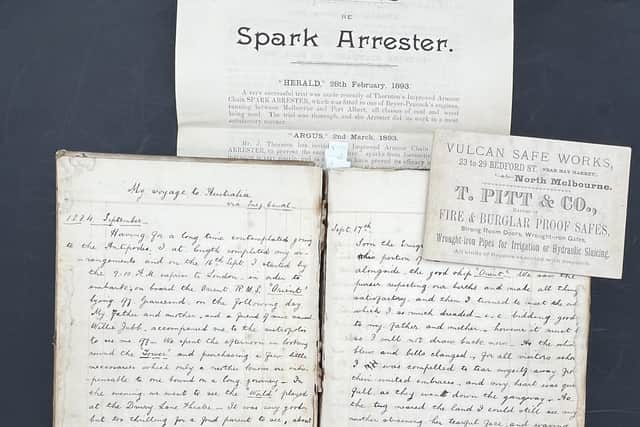

By coincidence, his travelling companions on the 40-odd day voyage via the Suez Canal aboard the Glasgow-built steam ship Orient were the English cricket touring team, who joined at Dover heading for the five-Test series against Australia.
The young engineer was actually away from home, in Australia and New Zealand, for 15 years, finally returning on the Blue Anchor Line's SS Yarrayonga via South Africa in 1899 to a joyous reunion with his parents.
While away, he kept a journal - more of a pictorial record than a diary - recalling his exploits.
The fascinating journal, packed with mementos, ended up in the collection of former Wakefield mayor and cricket umpire Norman Hazell, who died in 2022, aged 90, and is now offered by Ilkley-based Christian White Rare Books at £1,250.
In the journal, he recalls high jinks on board the Orient, the poor food and the "squalor and filthiness" of Port Said but is entranced as he approaches his destination.
He writes: "A bird's eye view of Melbourne is seen coming up Hobson's Bay forms a particularly magnificent panorama of beauty to the stranger, with the shipping at Sandridge and Williamstown and the city of Melbourne standing in the background."
He writes of the bustle of the pier and his first look around what was termed "the Queen City of the Southern Hemisphere".
"I found it all buisness (sic), everybody seeming to have but one object in view - buisness - and you will not wonder at Melbourne being such a flourishing place if you will see the business-like inhabitants who constitute its citizens."
Leighton writes (but goes into no detail) of enjoying himself after so long cooped up on ship and observed that if he ever returned home he would travel with the Orient Steam Navigation Company, on either the Orient or the Austral.
His work for Campbell, Sloss and McCann, of Footscray, Melbourne, which built the Lady Loch lighthouse tender and armed Customs cruiser during Leighton's early years there, apparently prevented him continuing his diary in such fulsome detail, with a word count words over 15 years of 2,500 (just over three times the length of this article).
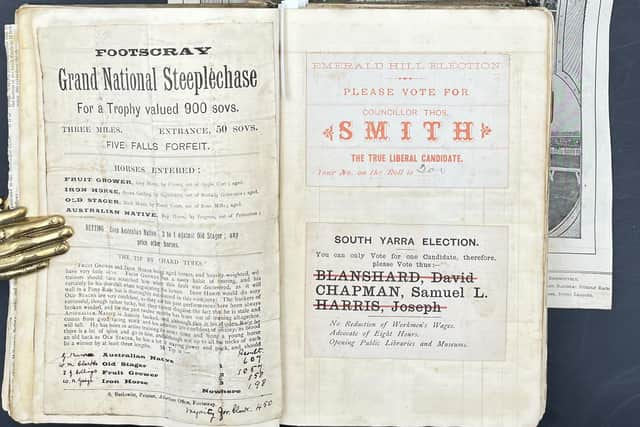
But he compensates by compiling ephemera which included a broadside for the "Footscray Grand National Steeplechase for a Trophy valued 900 sovs", his ballot cards for the Emerald Hill election in south Melbourne, invitations to an 1891 "Grand Social" in South Melbourne Town Hall and the embossed card from his employers for the "Trial Trip" on the aforementioned Lady Loch.
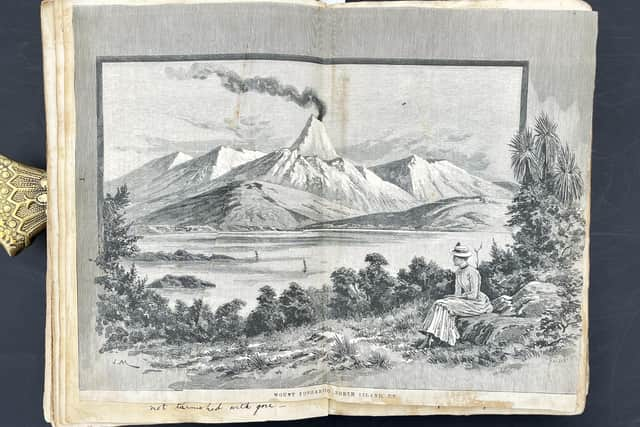
In the grey cloth-covered book, Leighton has also painstakingly kept 100 pages of cuttings, many illustrated, from Australian newspapers and journals, visiting and business cards, receipts, resident's documents, travel and admission tickets (including one to an event in Durban on his way home), all presumably for the amusement of his parents on his return, still a young man at 32.
Back for a moment to his outward voyage in 1894… apart from enduring "squalor and filthiness" while ashore in Port Said, at the northern end of the Suez Canal, he records that the ship collected up vast amounts of cargo, including "raisins for the Australian Christmas puddings".
He is impressed by Adelaide, especially "the principle street King William" which he believed "the finest one in the whole world".
It was in Adelaide that England's cricketers disembarked, winning the first Test there by eight wickets and proceeding to win the series, retrospectively known as the Ashes, 3-2, clinching victory in the last match in Melbourne by an innings and 98 runs.
That 13-man all-professional England touring team of 1884-85, under administrator and former cricketer and rugby player Alfred Shaw (1842-1907), was captained by Arthur Shrewsbury (1856-1903), one of the world's finest batsmen of the 1880s. The great WG Grace, incidentally, did not go on that tour because of injury.
*Also offered by Christian White Rare Books, at £250: an early copy of The Tenant of Wildfell Hall (1848) by Anne Bronte under the pseudonym Acton Bell