
Thrybergh: The Yorkshire village of three hills with centuries of fascinating history
Plenty of fascinating history is packed into Thrybergh’s past and it extends back many centuries.
Situated on the north eastern edge of Rotherham, the name Thrybergh (‘Triberga’) – according to A Dictionary of British Place Names – means ‘three hills’.
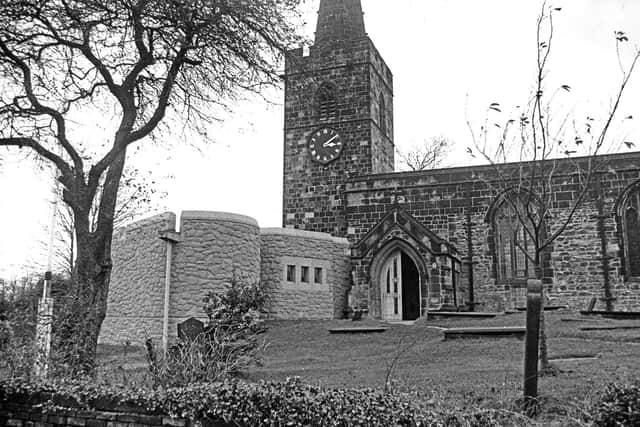
The area’s church is dedicated to St Leonard who was the patron saint of all prisoners, captives and slaves.
The structure was lengthened at the west end during the Norman period (1066-1154), whilst the lower storeys of the tower were added in the Early English years (c.1180 to 1275).

A chancel was built a little later.
The beginning of the 15th century saw the upper portion of the tower and the spire erected. Later, the roof of the nave was raised and four Perpendicular windows inserted.
Although the church once contained many monuments, a number have been lost. Some of those remaining include ones to members of the Reresby and Finch families.
By the 1890s, the tower and spire were taken down and rebuilt, with the foundation stone laid by Mrs Fullerton in December 1894.
Two other churches were established at Thrybergh. St Peter’s was opened in 1909 to serve a growing population.
St Gerard’s Catholic Church was erected in 1950 replacing a wooden hut. But, a Mass centre had been opened in 1910.
A number of families have owned the Thrybergh estate including the Reresbys from 1310 and Saviles from about 1705.
By the end of the 18th century, the estate was in the ownership of Judith Savile Finch (née Fullerton). According to Peter Hawkridge, writing for the Rotherham District Civic Society (2020), Judith left the whole of the Thrybergh estates following her death in 1809 to her brother Weston Fullerton.
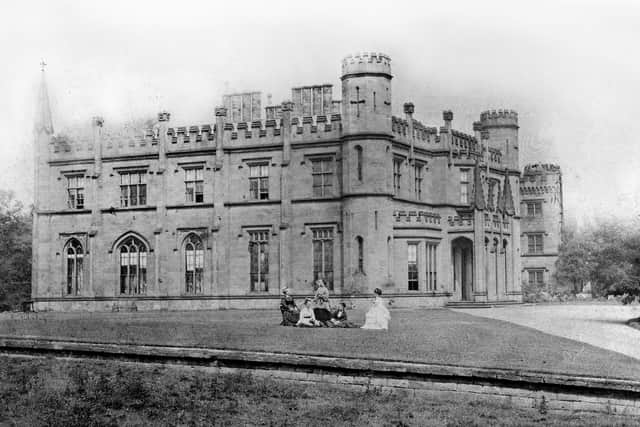
Fullerton and his wife Louisa moved from Bramley Hall to the old Thrybergh Hall in 1810.
Finding the property unfit they decided to build a new house which was designed in a Tudor Gothic Revival style by John Webb and completed in ashlar sandstone during 1813/14.
For the remainder of the 19th century, the Thrybergh estate was owned by several Fullertons. Colonel Fullerton died on January 19, 1847 aged 68.
An obituary noted that he was a senior magistrate, attached to the Conservative party and a keen promoter of archery meetings and cricket clubs in the local area.
For many years, he held the rank of Lieutenant-Colonel in the First West Yorkshire Yeomanry Cavalry after joining in 1809.
Colonel John Fullerton was succeeded by eldest son also called John (II). Several months after the colonel’s death an advertisement stated the mansion house at Thrybergh was available to let completely furnished for a term of seven or fourteen years with immediate possession. John Fullerton II died on March 6 1871 aged 68.
A piece from December 26, 1874, was headed: ‘The Mansion and Extensive Shooting,’ and announced: ‘To be Let (furnished) Thrybergh Hall with shooting over 200 acres.’
The mansion’s rooms included entrance hall, drawing room, dining room, library, morning room and 19 bed and dressing rooms.
The outbuildings comprised excellent stabling, coach houses and servants’ rooms. There were large walled and well stocked kitchen and fruit gardens, conservatories, greenhouses etc.
John Fullerton II was followed by Thomas Grey Fullerton MA and JP. During April 1880 the Thrybergh Hall was once more let furnished.
Thomas Grey Fullerton died in 1881 aged about 53 after a short illness at Brinsworth House, Twickenham. He left a widow but no family.
His estates descended to his brother the Rev. Charles Garth Fullerton who at the time held the living in Lincolnshire.
He was ordained in 1861 having been educated at Cambridge. He survived until February 4 1890, dying aged 51. He left a widow and three sons and two daughters.
The eldest son John Skipwith Herbert Fullerton succeeded his father in the Thrybergh, Denaby and Brinsworth estates. He was educated at Harrow and Downton Agricultural College.
During his lifetime, he became one of the best-known Masters of Foxhounds in the country and an authority on breeding hunters.
An announcement on Friday April 24, 1903 suggested the Fullerton’s influence in Thrybergh might be falling away.
On the previous day quite a large number of golfers and those who hoped to become golfers went out to the new course of Rotherham Golf Club situated in the heart of Thrybergh Park.
A South Yorkshire Times piece from January 4, 1929 said that Thrybergh Hall and Thrybergh Park, with the rest of the Thrybergh estate ‘have just been sold by Mr J.S.H. Fullerton to Mr Herbert Hey of Harrogate and the property will shortly be offered for resale.’
Details of early industry in Thrybergh are provided by the thryberghparishcouncil website. It revealed that two stone quarries were established in the 15th century but declined in the mid-18th century.
By 1870 there was only one remaining quarry.
W. White's History & Directory of Sheffield, Rotherham (1833) notes the Thrybergh village contained 320 inhabitants and amongst the miscellany of traders were a blacksmith, shoemaker, wheelwright and tailor.
By 1861 the Thrybergh Hall colliery was operational a short distance away in nearby Kilnhurst. This survived until 1988.
In 1879 amongst the traders were a quarry owner, shoemaker and post messenger, corn miller, school teachers, a number of farmers and a wheelwright. Another colliery was established nearby in 1903.
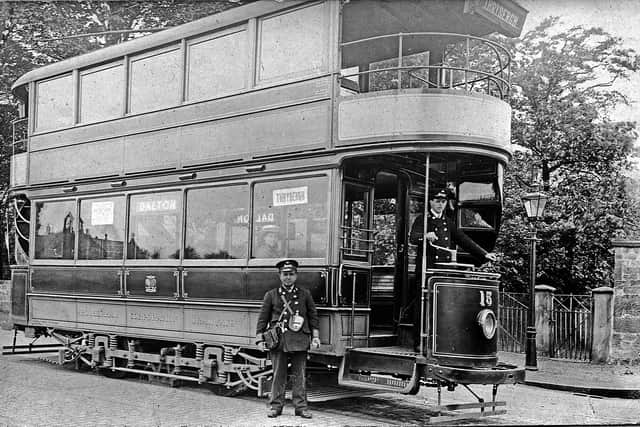
The Dalton Main Coal Company opened Silverwood colliery between Thrybergh and Ravenfield and it operated until the end of 1994.
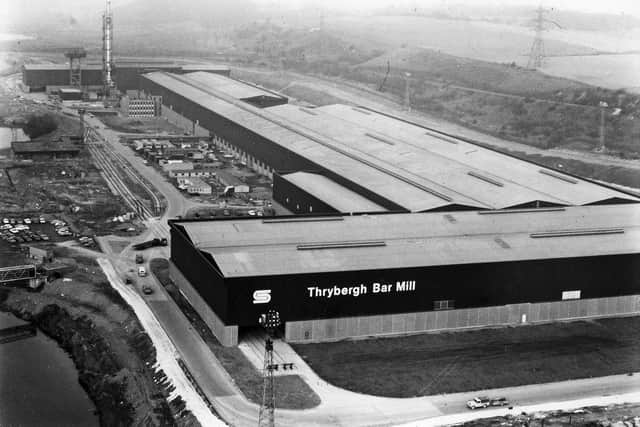
On Wednesday June 9, 1976 at the Thrybergh Bar Mill, situated south west of the Thrybergh village, hundreds of steelworkers stripped to the waist in the blistering heat, lined a route and dangled from scaffolding.
This was to greet Princess Anne as she opened this BSC £30m facility. An important feature in the Rotherham Steel industry, the mill was acquired by Liberty Speciality Steel in 2017.
A unique war memorial resembling a miner’s lamp was unveiled by the Lord Bishop of Sheffield adjacent to Silverwood on December 15, 1923.
This was to commemorated the 312 local miners who were killed in the First World War. The memorial was moved to a position outside the Thrybergh Parish Hall on Park Lane in time for Armistice Day in 1990.
Thrybergh country park and nature reserve was opened in 1983. The area was a former reservoir created in 1880 by Doncaster Corporation.
It was acquired by Rotherham Metropolitan Borough Council in in 1980. During 2006 it won a Green Flag award for its green spaces.
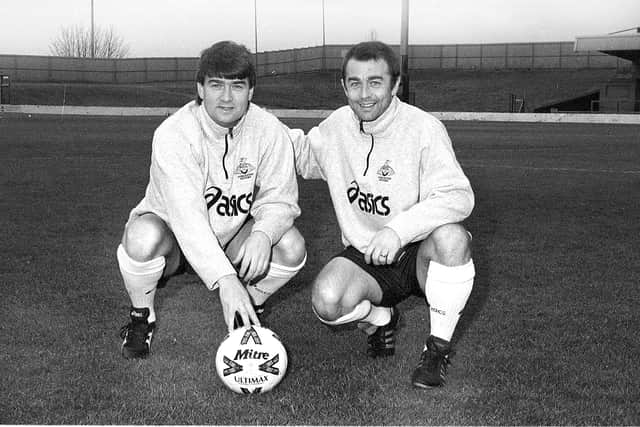
Two noted footballing brothers Ian and Glynn Snodin were born at Thrybergh in 1963 and 1960 respectively and had strong connections with Yorkshire clubs.
Ian played for Doncaster Rovers, Leeds United and Scarborough as well as Everton, Sunderland and Oldham Athletic. He has four England U21 caps.
Glyn played for Doncaster Rovers, Sheffield Wednesday, Leeds United and Barnsley, as well as Oldham Athletic and Hearts.
Since their playing days both brothers have been involved with managing and coaching roles.