
Thurnscoe: The small Yorkshire mining village built on the site of a Roman farmstead
Thurnscoe, near Barnsley, was another small Yorkshire village that was considerably developed following mining developments in the vicinity – namely the Goldthorpe and Hickleton collieries.
But there is evidence of a much earlier history in Thurnscoe.
The Yorkshire Archaeological Journal (Vol. 76, 2004) reported on excavations that took place between September and November 1999 prior to developments for housing on Billingley Drive, Thurnscoe.
This was found to be a Romano-British farmstead, with ditched enclosures linked to neighbouring fields and trackways.


Separate from the main site was a corn oven and several likely burials, with a late period cemetery possibly present in one of the enclosures.
Evidence of burnt coal was found, as well as growth-managed wood. There were signs of iron-smithing and metal objects were uncovered, such as the bit part of a horse’s bridle.
Other items included pottery (670 sherds) and coins (six) which suggested the site was in use between the mid-second and mid-fourth centuries before being abandoned.
The website, achurchnearyou, boldly states that Thurnscoe’s St Helen Church is historically significant, being the oldest structure in the area.
Originally built by the Saxons in 812, it was subsequently rebuilt by the Normans in 1087.
The website adds: ‘The outside tower was constructed in 1789 but the inside was built in 1329.’
An article from Monday November 8, 1889 mentions that several days earlier the St Helen Church was reopened after being closed for renovation.
The body of the building was entirely removed and reconstructed under the direction of a Mr Hubbard, architect Rotherham.

Historic England’s listing description for Thurnscoe Hall states that it was built in ashlar sandstone with a stone slate roof between 1670 and 1701 for Thomas Shirecliff. Later owners were British Coal and F. Sedgwick.
Baines’ West Riding Directory (1822) notes Thurnscoe’s population as 205.
A map published in 1854 shows Thurnscoe as a very small area, the main features being: the St Helen church, a Rectory, Pinfold and the Butchers’ Arms.
Hickleton Main Colliery was established in 1894 in an area to the east of the old Thurnscoe village.

Housing, becoming appropriately known as Thurnscoe East, was then built in the vicinity to house miners and their families along with other facilities.
Thurnscoe would also accommodate miners working at Goldthorpe colliery, south of the old village, after the first sod was cut for the pit on July 27, 1909.
Two railway companies connected Thurnscoe to the country’s rail network. The Hull & Barnsley Railway Company began services from Hickleton & Thurnscoe station from August 23, 1902.
The Dearne Valley Railway Company opened Goldthorpe and Thurnscoe Halt on June 3, 1912.
After some wrangling, a full licence was granted on February 9, 1903 for new licensed premises to be called the Thurnscoe Station Hotel.
Four years earlier the magistrates said there was not sufficient population to warrant them granting a licence but since then, it was argued, circumstances had materially changed.
There were 255 houses and 1,225 residents close to the proposed premises.
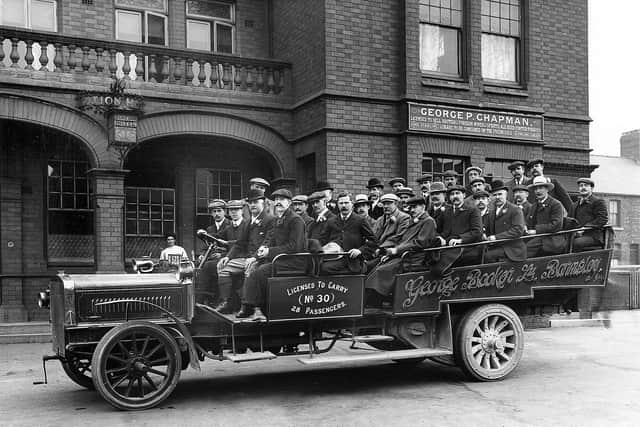
The Thurnscoe company Larratt Pepper & Sons began transport services in 1907 with horsedrawn vehicles. Their first motor vehicle, a Ford butchers’ meat van, was acquired in 1914.
According to a 1978 article the first fill-sized machine, was ‘a char-a-banc, a Daimler of 1921’. In the early years, the company’s buses often ran on market days and at other times when they were required.
Thurnscoe Park, which it was reported had been in public use ‘for several years’, was formally opened on Saturday October 2, 1920 by the Rev. T. Thornley Taylor of Dodworth Grange.
He was the donor of the site and of the adjoining recreation ground.
The work was carried out under the supervision, and from the designs of, the surveyor to the Thurnscoe Urban Council, Thomas Bull at a cost of £2,000.
Among the amenities of the park were an ornamental lake, a band stand, gravel walks, lawns, shrubs and trees all arranged planted and designed, it was stated, ‘with good taste.’
Immediately following the formal opening of the park, the ceremony of unveiling the war memorial which was erected in the park was carried out.
The memorial was about 20ft high comprising the figure of an infantryman standing on a tall slender pedestal. The pedestal included the names of the 82 Thurnscoe men who fell in the War.
The bulk of the memorial cost was met by the Hickleton Main Colliery company. The memorial was erected by Tyas & Guest, Swinton, from a design by Capt. M. Tyas of that firm.
The South Yorkshire Times on July 23, 1926 said the population of Thurnscoe was officially estimated at 9,000.
How Thurnscoe Council transformed a waterlogged area into a fine housing estate (on the area’s west side) was mentioned by M. Nokes chairman of Thurnscoe U.D.C in January 1928.
This was when he formally declared open the main and subsidiary roads of the new municipal housing estate in Houghton Road, Thurnscoe.
He said that the site of the roads and houses was under water a few years ago and was, apparently, unsuitable for houses.
The council had transformed the bog into a splendid housing estate which would be the pride of the district. T. Sparkey, chairman of the Housing Committee, said he believed that Thurnscoe was the first authority to have a housing scheme completed with concrete roads. They had cost about £10,000.
A journalist writing for The Express on June 16, 1934 was amazed at the activity which abounded in Thurnscoe: ‘There are two allotment societies east – and west – a choral society, three dramatic societies, a church lads brigade, two troops of scouts, a League of Youth, a swimming club, two cycling clubs, football and cricket clubs too numerous to mention and now a motoring club’.
Another church, St Hilda’s, was built in Thurnscoe at a cost of £6,000. It was consecrated on March 2, 1935 by the Bishop of Sheffield and designed by Charles Flockton of Sheffield.
The new church inaugurated a new era in the ecclesiastical life of Thurnscoe.
St Hilda’s became the parish church of an entirely new parish consisting almost of the Hickleton Main colliery and its housing estates, the old estate in the neighbourhood of the colliery and the more modern High Grange estate.
By the 21st century Thurnscoe had seen many changes. The Goldthorpe and Thurnscoe Halt closed on September 10, 1951 and the Hickleton and Thurnscoe station ceased operations on April 8, 1929.
A new Thurnscoe station was built by British Rail and opened on May 16, 1988. It comprises two wooden platforms and each have a shelter.
The Cinema House, originally intended to be called Cinedrome, had opened on May 8, 1922. Having gone through the common transformation to a bingo hall, it then housed a snooker club before the site was cleared.
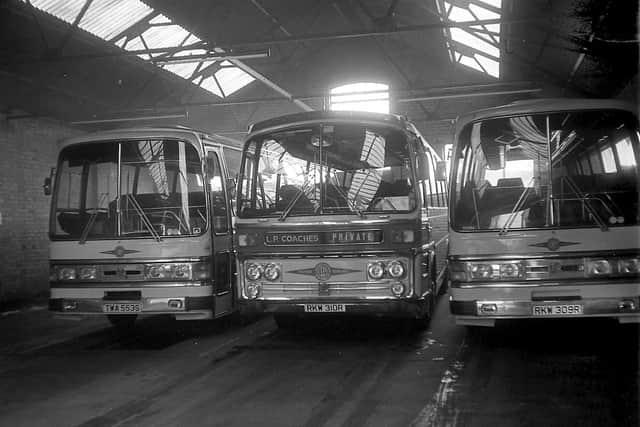
On May 13, 1978 the stage carriage service of Larratt Pepper & Sons Ltd, operated for the last time and on the following day the Yorkshire Traction Company took over the service.
But four coaches were retained and that side of the business was to continue for a time.
From January 1, 1986, Goldthorpe and Hickleton Collieries were merged and became one unit. Production ceased on February 4, 1994 and a year later all the surface buildings were cleared.
Dr Rajendra Prasad carried out extensive alterations at Thurnscoe Hall over an 18-month period and he opened the building as a nursing home in 1989.
Due to the Station Hotel having lain derelict for a number of years and set alight regularly, Darren Investments sought permission from Barnsley Council to clear the site and construct a petrol station on the area. Pictures show the Station Hotel being demolished in 2023.
St Hilda’s church which had closed for worship in 2017 was put up for sale in 2023 by White & Co. for ‘Community Use or Redevelopment Opportunity.’
Later plans were passed to convert the building into a storage unit for a local housebuilding business after Barnsley Council passed the submitted plans.
Overall, Thurnscoe, like many other Yorkshire communities, once reliant on the mining industry, is finding regeneration challenging, with economic growth, wages, and employment opportunities.
Thanks to Professor Dr Paul Buckland for help with this piece.