
Veteran Yorkshire hairdresser Russell Eaton: ‘You were expected to work in the mines or in steel. But I went into the salon and there was a buzz I loved.’
Veteran Yorkshire hairdresser Russell Eaton has a career spanning seven decades. As his team celebrates another prestigious award, he tells Yorkshire Post Fashion Editor Stephanie Smith why the hair salon remains at the heart of the local community. Main images by Simon Hulme.


Russell Eaton was a teenager when his aunt told him about her visits to the Andre Bernard hairdressing salon in Doncaster. “There are one or two young men who work there,” she said. Before long, he too was working there, as a Saturday boy. “I never wanted to do anything else,” he says.
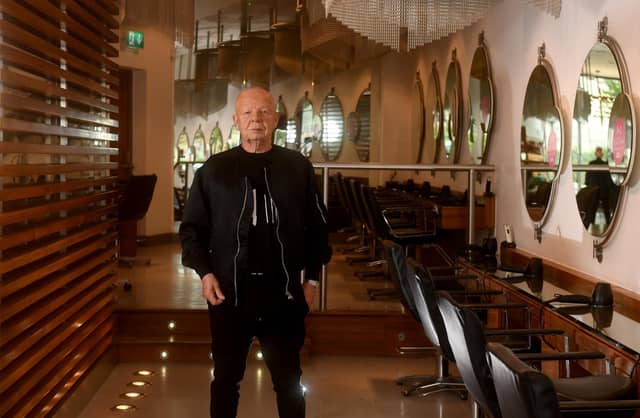
Sitting in his top-floor office at the Russell Eaton salon in Barnsley, overlooking the Town Hall, Russell, now 73, is clearly a man who loves fashion. “There are three types of clothes I buy,” he says. “Rick Owens is my favourite. Comme des Garcons, and sometimes I buy a bit of Yohji Yamamoto. Now it's great because there's a shop in Leeds called The Allotment. Prior to that, you’d got to go to London.
“I've always been interested in fashion. That’s developed from my teenage years.”
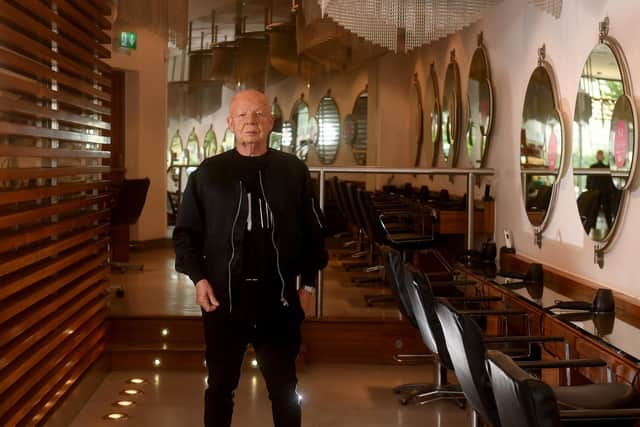
Back in the mid-1960s, hairdressing was an unusual career choice for a lad who grew up in the mining village of Goldthorpe, between Doncaster and Barnsley.
“Mum was fine. But my father, a miner, his son going to be a ladies’ hairdresser wasn't at all on his radar, and he wasn't very keen on the idea at first,” says Russell. “But as time went on, and he could see I was very enthusiastic and I loved my job, he warmed to it.
“In those days, you left school and, particularly in this area, you were expected to go into heavy industry - mines, steel works. I wouldn't say I got my leg pulled, but it was not looked upon as a proper man's job. That was the attitude in those days.
“As a Saturday boy, I had never experienced anything like it. I went into the salon and there was a buzz and an atmosphere which somehow resonated with me. I loved this, and I've never felt any different about it.”
In those days, women would come in weekly for a shampoo and set. “People expected their set to last the best part of a week,” he says. “And they’d come in and say, ‘Peter, it didn't last very well.’ So then you put extra setting lotion on.
“Perming was a very popular service as well. The perm helped the set stay in.
“The salon had two full-time manicurists, and while they were under the dryer, they would have their nails done. It was just normal. Every week.
“People had the head bleached and then we used to put a rinse through afterwards, blue or rose, and then the hair was set.”
Hairdressing apprenticeships took three years, with technical training at night classes. “Very much like today and yes, you've got all the technical skills, but you've got to then spend a further year or two years developing them, and your own stamp, and your own style. So I believe that it still takes five years to become super-confident and proficient.”
Russell shows me some of the photographs and memorabilia he has gathered over a pioneering, globe-trotting, award-winning career that now spans seven decades. It includes a hairdryer he has had since he was 14.
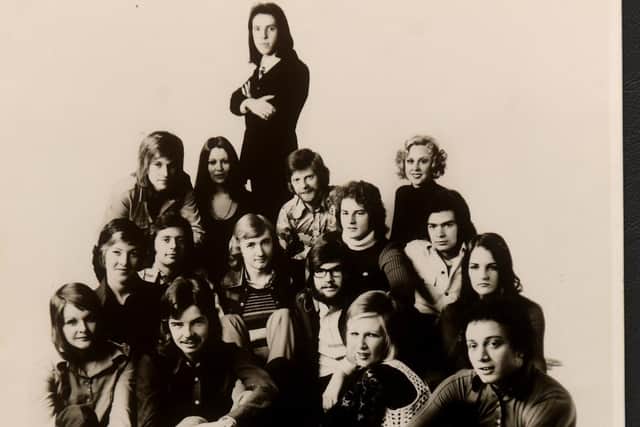
The 1960s and ‘70s saw a revolution in fashion and in hairdressing. A job with Vidal Sassoon in London propelled Russell’s career. “I was working for them in the early ‘70s. It was a very, very exciting time, a very special time, which I don't think you can replicate again,” he says.
“You've got to look back to a period where ladies had their hair dressed. Vidal felt hair should hang and be cut like a material, and this was tremendously exciting, because nobody else was doing it. The Sassoon way was an absolute revolution. We all accept it today, but at the time it was so apart from anything else that was happening in the industry.”
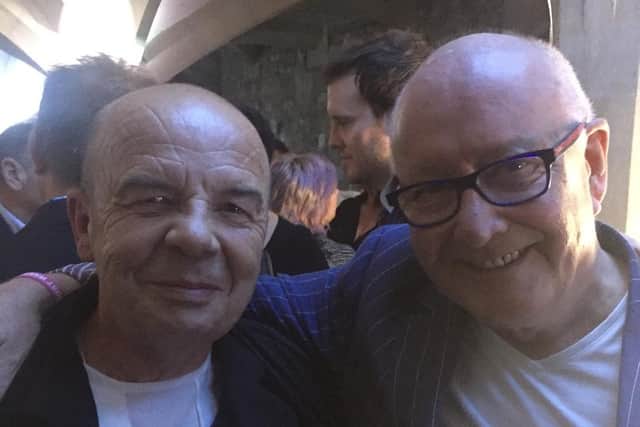
One day, Vidal called Russell into his office to tell him that they were opening a salon in Manchester on King Street, and might he be interested in moving back North?
Russell was interested, and became part of a team headed by art director Trevor Sorbie. “He developed me. He could see I had the potential and the enthusiasm to become an art director, so Trevor took me under his wing,” he says.
“It was hard to start with, because people weren't used to the Sassoon way in the North, but eventually it became a tremendous success, and we decided to open a salon in Leeds.”
It was while Russell was working in the Leeds Sassoon salon on Albion Street that he met his wife, Karen. “We were doing a show. Karen came in and I cut her hair, and Trevor said she would be a good model for the show.”
After the show, Russell gave Karen a lift back home to Barnsley and asked her out for a drink. They married in 1976, and had their children, Robert and Isobel.
In 1978, Russell decided to go it alone and start his own salon. “I loved Sassoon and I still do. But I was young and I felt the time was right to do that,” he says.

The first Russell Eaton salon opened in Barnsley in Rita Britton’s legendary Pollyanna fashion store. “Rita was a client. When she used to come over to Manchester to Vidal Sassoon, I used to cut her hair. So it goes back a long way”
He credits Rita, who stocked Comme des Garcons and Jill Sanders Men at Pollyanna, with developing his fashion sense. “She gave me the taste for those. You've got to be educated into those types of designers to understand them.”
After a couple of years the salon moved to Wellington Street in Barnsley, and Russell won the Wella Vogue Award in 1982. In 1996, it moved to its current premises on Shambles Street in Barnsley, in what had been Armstrong's restaurant. “We used to come to eat at Armstrong's. I remember sitting having dinner one night and I said to my wife, this would make an amazing hairdressing salon.”
They acquired the lease and later bought the building. In 2003 the salon won the L’Oreal Colour Trophy, one of many awards across the years, but it is the clients who matter most.
“In Barnsley, in particular, the salon is an important institution, and has been since 1978,” says Russell. “I have some customers who have been with me all that time. I don't do a great deal of hairdressing anymore, but I'm quite happy to look after those clients.
“A hairdressing salon is very important to the High Street. We've offered lots of employment opportunities to young people over the years, and opportunities they would never have had, to work on shows in London. I feel we've brought something to the community.”
In 2009 a second Russell Eaton salon opened in Leeds on Boar Lane. Robert and Isobel have both followed their father into hairdressing. Robert began as an apprentice at 16, and Isobel joined the family firm later, following a degree from Nottingham University in Fashion and Textile Management, after which she trained with Tony and Guy.
Their success has been impressive. Isobel is creative director and master colourist at the Barnsley salon and won the North Eastern British Hairdresser of the Year award in 2017 and 2018. Robert is one of the UK’s most respected and awarded hairdressers, a colour expert and a trichologist. He won British Hairdresser of the Year in 2019 and 2021, and is nominated again for 2025. He was President of the Fellowship for British Hairdressing from 2022-2024.
“I'm immensely proud and pleased,” says Russell. “It was never part of any plan. It happened organically, you know, when they were 14,15, and I used to say, ‘come on, Saturday job in the salon’, and it went from there.”
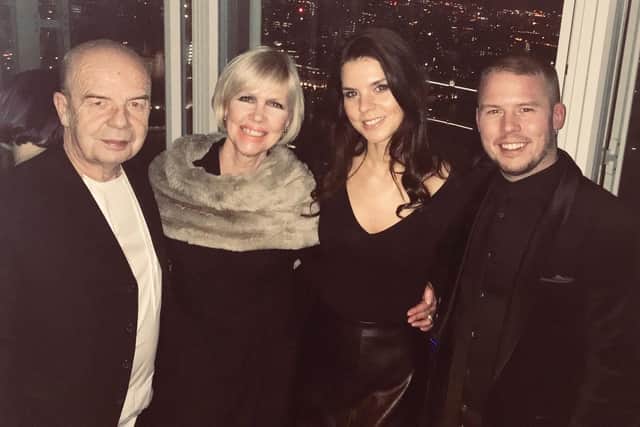
In 2024 the Leeds salon relocated to Albion Street, the very salon where Russell first met Karen, who has been at his side throughout. “In the background, she has contributed enormously,” he says. “They say ‘behind every good man is a good woman’, and I think that's the case.
“She does VAT, she does the accounts. There is so much more to running a business than actually doing it. You need someone who does all the other stuff.
“And I think that's why it's worked for us. Each member of the family is good at different things. Living together, growing up together, working together.
“It's not a downside, but whenever they come to see us at home, it's inevitable we start talking about hairdressing. It really does become a way of life. As a family, we've all always got on pretty well. Very well, really. We've never had any major disagreements.
“I'm probably the one that is like, ‘look, we should be doing this, we should be doing that’. Although Robert now he's older, he has ideas of his own. He’s been president of the Fellowship, which is a great honour because you can't just become president; you've got to be nominated. For two years, he was up and down to London most weeks for meetings, organising things. The Fellowship runs a lot of projects for young people. Like Project X - you can apply and they take 12 people and they are mentored for a year.”
In this way, he says, Robert has added to the legacy not just of Russell Eaton the business, but the hairdressing industry as a whole. As have other award-winning salon members, with Angela Thomson at the Barnsley salon last month winning the prestigious L'Oreal Colour Trophy 2025.
In 2019 Russell was granted the Fellowship for British Hairdressing Lifetime Achievement Award, presented to him at the Dorchester.
He still works at least four days a week across Barnsley and Leeds, and always on a Saturday. “My clients generally come every six weeks. It's not the industry norm, people stretch it out longer these days.
“When you've been doing someone’s hair for 40 years, they become friends. They say to me things like, ‘Oh, don't retire us all.’
“It's not just about their hair. It's a social thing. I've seen their families grow up. In fact, the families come into the salon.”
He has no immediate plans to retire. “I suppose there will come a time. But I think I'll be one of those that will always have an interest in the industry, and what Robert and Isobel and the team are doing.
Russell Eaton is at Shambles Street in Barnsley and at Albion Street in Leeds. Visit russelleatonhair.com
“I love the industry events. It's a much younger industry now, but there are still a few people like me who own salons that are still about.”
Sadly, Trevor Sorbie died in November last year. “I've known Trevor most of my hairdressing career,” says Russell. “Several times a year we'd see each other. Trevor was a great inspiration to me and someone I greatly admire as a hairdresser, not just for his hairdressing, but his foresight and his ideas were amazing.”
There are and have always been challenges in running your own business, especially one that employs more than 40 staff across two locations. Russell says: “There has been a massive rise in self-employment within our industry. There are only about 30 per cent of salons in the UK that employ people as we do. A lot have gone to the rent-a-chair model, which puts us at a slight disadvantage because we are obviously paying VAT on everything.”
But he believes that stability is important for staff. “People that work here, particularly Barnsley, have come up from school leavers, and I think they like being employed, and we offer good packages to them, and that's the way we keep them. I personally feel that when we're all employed, we work much better as a team.
“The challenges change. Post-budget with the rise in employees’ NI. And to be in a town or a city centre, you've got huge overheads, so that there are financial challenges all the time.”
But hairdressing is a profession he would still recommend to young people, including his three granddaughters. “You get out what you put into it,” he says. “If you've got that passion, there are so many opportunities within hairdressing, whether you want to be a session hairdresser, a salon stylist, work on shows for one of the manufacturers, which can take you anywhere in the world, really.
“It’s taken me all over Europe and I’ve done so many things I would just never have thought that could have ever, ever happened.
“There are times when you feel like just throwing everything out the window. You've just got to keep going. And absorb everything around you, learn from your colleagues, and if you see an idea while you're out, remember that idea.
“We sometimes say to Robert’s eldest, when you're old enough, you can have a Saturday job. Let's see what happens in the future.”