
Wakefield: Postcards tell story of historic Yorkshire city from over 100 years ago
Thousands of postcard views appeared when the Post Office allowed them to be sent in the UK from 1894.
They were taken by an army of photographers, with varying talents, who sprang into action to capture scenes in villages, towns, and cities.
Arguably, most of them favoured depicting special events – some quite extraordinary – and this was seen in pictures taken at Wakefield, particularly during the first two decades of the 20th century.
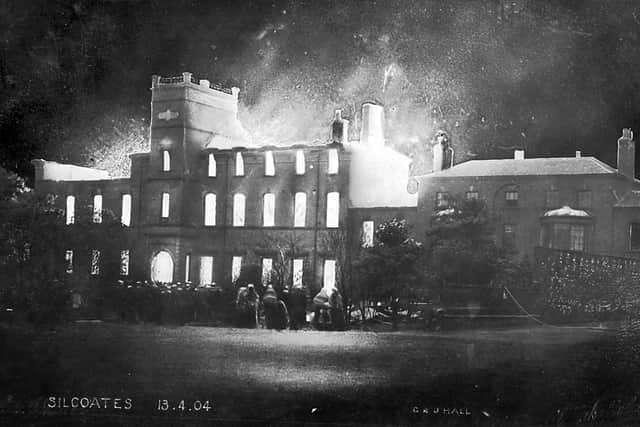
The Northern Congregational School, Silcoates, Wakefield was completely destroyed by fire on April 13, 1904. One dramatic night time view shows how the photographer skilfully captured the school ablaze.

The outbreak was discovered on the third story of the old portion of the school about 10.30pm by the housekeeper. Fortunately, the scholars (about 100) and masters were away on their Easter holiday break.
An alarm was sent to Wakefield, with a request for the fire brigade’s help.
Unfortunately, a year or two earlier, the City Council passed a resolution that the brigade should not attend fires outside the city boundary.
As Silcoates was just beyond the limit, Captain Harris refused to allow the brigade to go. He did depart from the regulations, however, and sent a number of firemen.
Yet, they found that no water was available within a quarter of a mile of the place.
A little later, a telephone message was sent to the Dewsbury brigade, who promised to attend, their journey taking about three quarters of an hour.
They too were frustrated by lack of water available. The only supply they were able to obtain was from a 3 in. main near the school, and the force was not strong enough to reach the topmost part of the building.
All efforts to subdue the outbreak proved futile, and the flames rapidly enveloped the whole of the premises, including the residential portion.
The damage, fully covered by insurance, was roughly estimated at £12,000. The school was established in 1820 as the Yorkshire Dissenters’ Grammar School, but became regarded as one of the leading Nonconformist educational establishments.
A new school was formally opened by the Rt. Hon. Walter Runciman, MP, President of the Board of Education on October 1, 1908.
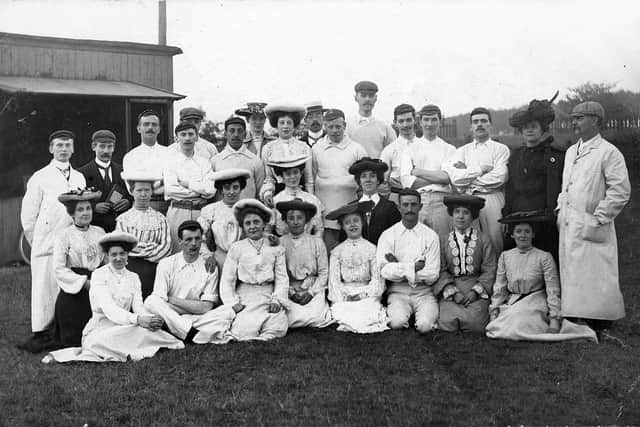
An interesting match took place at Bradford Road, Wakefield on Saturday September 24, 1904, between the Wakefield St John’s Cricket Club and the Wakefield St John’s Ladies’ Cricket Club.
At some point, both sets of players posed for a postcard view. The Ladies scored 24, the men 27. After the match, the teams adjourned to the St John’s School, where tea was waiting, being provided by the gentlemen players.
Following tea, Miss Armstrong Lamb proposed a vote of thanks to the gentlemen for providing refreshments. It was reported the ‘remainder of the evening was spent in an enjoyable way’ and the party broke up at nine o’clock.
Following the death of Queen Victoria in 1901, many statues of her were erected across the UK and abroad in memory of her long reign.
A genuine holiday spirit was said to prevail in Wakefield on Wednesday February 15, 1905 when the city’s Queen Victoria statue was unveiled in the Bull Ring by the Mayoress of Wakefield (Mrs H.S. Childe).
The statue standing 10 ft high on a stone pedestal, was a bronze replica of a figure from the studio of F.J. Williamson of Esher, Surrey, sculptor to the late Queen.
The replica costing £1,000 was produced at the foundry of Hollingshead and Burton. The site was given by the Corporation, who also put in the foundation, partially on the site of the old Boy and Barrel public house which had been cleared some seven years earlier.
Both, the foundation and the erection of the statue were carried out by Kitson & Sons, Wakefield. Several mayors from other areas of Yorkshire attended the unveiling ceremony.
The tradesmen of the city and others had decided, some four years earlier, to perpetuate the memory of the late Queen.
A statue was decided upon and although its erection had been delayed owing to the construction of tramways, it was agreed it would be a welcome adornment to the city.
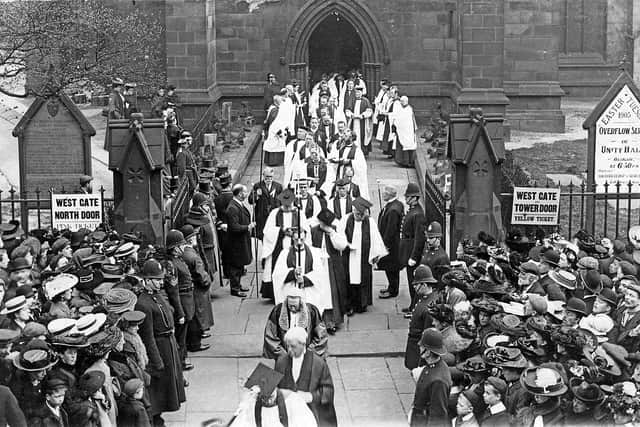
A new chapter in the history of the Wakefield diocese was inaugurated during late April 1905.
This occurred when the newly-extended east end of the cathedral in the city, erected as a memorial of the life and work of the first Bishop, Dr William Walsham How, was consecrated by the current Bishop, Dr George Rodney Eden.
The memorial scheme, commenced in 1897, embraced the enlargement of the cathedral, a recumbent effigy of the Bishop, and a children’s memorial stained-glass window.
All these projects were carried out at a total cost of about £45,000. Altogether it was announced that a fine old parish church was turned into a handsome, if small, cathedral.
The structural additions were carried out by Armitage & Hodgson of Leeds from plans prepared by J.L. Pearson of London. The effigy was executed by F.N. Forsyth of London.
Members of a large crowd were immortalised on a postcard as they watched those who officiated at the ceremony exiting the church.
Several views show Scottish-American industrialist Andrew Carnegie at the Wakefield Library opening on Saturday June 2, 1906.
With a massive personal fortune, he gave a large amount away for the establishment of 660 libraries in the UK. Wakefield’s Mayor, Henry S. Childe, successfully secured £8,000 from the philanthropic Carnegie for the building of a library in the city.
This was on condition that the Public Library Act (1850) was activated, allowing the levying of a penny rate. Wakefield’s Carnegie Library was designed by Trimmell, Cox and Davison and built by Bagnall Bros.
Local man Charles Skidmore, a Bradford Stipendiary magistrate, donated 2,000 books to the library.
Paying a flying visit to Wakefield, Andrew Carnegie, standing on a temporary platform and amidst a heavy shower formally, opened the new building.
He also received from the Mayor and Corporation the honorary freedom of the city.
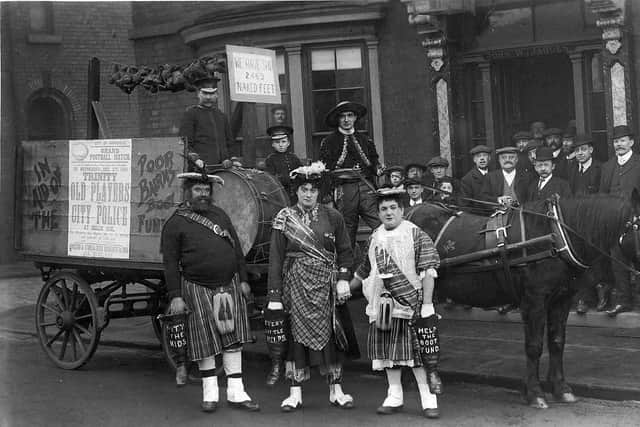
Those involved in collecting funds for Wakefield’s Poor Children’s Boot fund, found their way on to a postcard in December 1911. The fund was established around 1904 by the Chief Constable T.M. Harris.
By means of the fund no fewer than 2,350 pairs of boots had been given away in the city. The sum realised since the inauguration of the initiative being over £500.
The annual football match between members of the Wakefield City Force and Old Wakefield Trinity players for the benefit of the boot fund and other local charities took place on the Wakefield Trinity ground at Belle Vue on Wednesday afternoon December 27 and there was a large attendance.
An advertisement for the match may be seen in the postcard. The proceeds amounted to over £60.
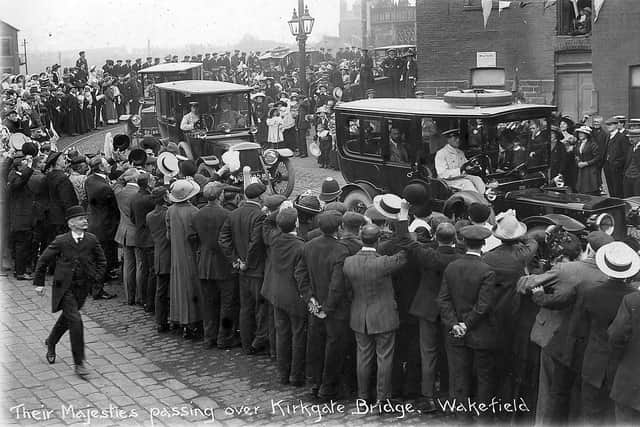
Postcard photographers were out in force on Wednesday July 10, 1912 to capture scenes from the visit to Wakefield of George V and Queen Mary.
It was part of a four-day visit to Yorkshire to acquaint themselves with industrial areas. The photographers caught the Royal Couple from various vantage points, one of the best showed them passing in a motor vehicle over Kirkgate Bridge.
Amongst the industries visited in Wakefield were the firms of George Craddock, wire rope manufacturers; the Seamless Boat Co; and E. Green & Sons Ltd.
At least two postcards illustrate the scene after a fire broke out at the Parkhill colliery Wakefield on Monday night October 17, 1919. About 100 men were working down the Haigh Moor seam at the time and there was much concern for their safety.
The Wakefield Rescue Party, however, went down one of the shafts, and the men were eventually rescued safely.
The fire broke out in the large screens, and owing to a strong wind, it soon had a firm hold. The Wakefield City and Stanley Urban Council Fire Brigades were soon in attendance, and with a good supply of water available, the fire was checked.
But, the whole screens were soon reduced to ruins, whilst the efforts of the two brigades were successful in preventing the shafting from becoming ignited.