
Womersley Hall: The colourful life and times of a stunning Yorkshire country mansion
My first job when starting as Keeper of Art at Doncaster Museum and Art Gallery in May 1975 was to help Curator Terry Manby stage an exhibition titled the ‘Destruction of English Country House’.
We gathered items from surviving local country houses with the intention of augmenting a Victoria & Albert touring exhibition of the same title.
When collecting several Sèvres vases from Womersley Hall near Pontefract, we met 93-year-old Frances Lois, Countess de Vesci.
I was a little cautious when stretching over a hearth to take the items from a mantlepiece.

Turning to the Countess, I said coyly: ‘What happens if I drop one?’
She replied without hesitation, but with humour: ‘Well, if you drop one, you drop one and that will be the end of it.’ Thankfully I didn’t drop any of them.
Frances Lois was the second daughter of Cecil and Lady Beatrice Lister-Kaye of Denby Grange, Wakefield.
She married William Edward Parsons, 5th Earl of Rosse on October 19, 1905 in the private chapel at Clumber House, the Duke of Newcastle’s Nottinghamshire seat. They had three children.

After her husband died in 1918, she remarried, to Ivo Richard Vesey, 5th Viscount de Vesci, on May 15 1920.
The eldest son from her first marriage, Michael Parsons, born September 1906, was known as Lord Oxmantown from 1908 until 1918 when, aged 12, he succeeded his father, becoming the 6th Earl of Rosse.
He was educated at Eton and Oxford. Whilst at Oxford, he was a member of the Railway Club. This was formed to popularise the pleasures of drinking on trains at night.
Graña, C., & Graña, M. (1990) in, On Bohemia: The code of the self-exiled (1990), mention: ‘A party of a dozen young men in full evening dress would board the Penzance-Aberdeen express at Oxford and travel on it as far as Leicester, they would return on the outward journey they would dine, and on the way back make speeches.’
In 1935, he married Mrs Anne Armstrong-Jones and she became Countess of Rosse.
Later, I learned that the 6th Earl and his wife Anne, who were not present on our 1975 visit, had links not only with Doncaster Museum and Art Gallery but heritage projects and institutions at a national level.
Besides Womersley, the Earl also had Birr Castle. His father-in-law, Lt Colonel Leonard Messel, owned Nymans until the grounds were made over to the National Trust in 1954.
Prior to that, the Earl had made the place his home and through him the beauty of it was said to have increased.
The 6th Earl of Rosse was made vice president of the Royal Horticultural Society and later became chairman of the International Dendrology Society, spending a great deal of time working to protect gardens in England and Ireland.
He was one of the founder members of the Georgian group and was chairman from 1946 until 1969.
He served with the Irish Guards in World War II.
Whilst on the main committees of the National Trust from 1944, he was chairman of the historic buildings committee, later properties committee, from 1955 to 1976.
On Tuesday April 10, 1962, the 6th Earl of Rosse laid the foundation stone for Doncaster’s new Museum and Art Gallery in Chequer Road.
From 1969 to 1975, he was deputy chairman of the National Trust and from 1956 to 1978 was chairman of the standing commission on museums and galleries. He died in July 1979.
Anne, Countess of Rosse was born Anne Messel in 1902, the only daughter of Lt Col. Leonard Messel and his wife Maud. She was brought up at Nymans and in 1925 she married Ronald Armstrong-Jones.
They had a son, Antony, and a daughter Susan. Mrs Armstrong Jones – much photographed by Cecil Beaton, Mme Yevonde and others – threw herself enthusiastically into the elaborate English social life of the time.
Her marriage to Armstrong-Jones was dissolved in 1934. The next year, she married the 6th Earl of Rosse. She was an inspiring influence in National Trust committees.
In 1960, Lady Rosse became a household name when her son, Tony Armstrong-Jones, by now a well-known photographer, married Princess Margaret.
At the ceremony at Westminster Abbey Lady Rosse cut a memorably elegant figure.
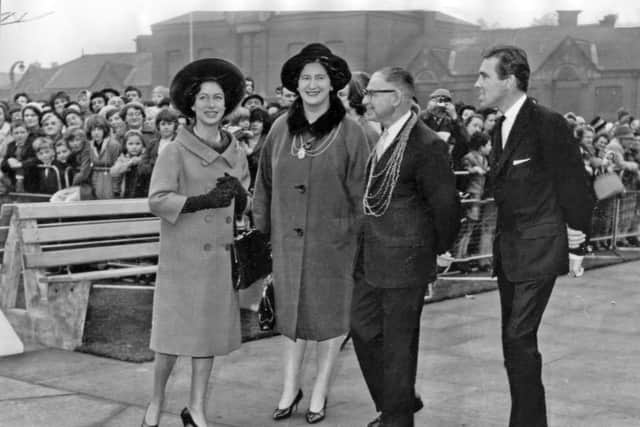
Princess Margaret and Lord Snowden landed at Church Fenton airfield on Thursday October 29, 1964 before staying several days at Womersley Hall.
On the following day they opened the new Doncaster Museum and Art Gallery. Lady Rosse died in 1992.
An outcrop of limestone exists from Nottinghamshire through Yorkshire to County Durham and this provided a base for settlements in the late Iron Age and Roman periods.
At Womersley, the discovery of a beehive quern – a stone used for grinding grain into flour – and some pottery pieces in the late 1960s led to the excavation of a site dated to at least the third or fourth century.
This was around a mile north west of the village centre and resulted in the uncovering of a T-shaped corn-drying oven or kiln. Unfortunately, part of the site was destroyed by earlier quarrying.
An account of events is recalled by P.C. Buckland and M.J. Dolby in A Roman Site at Womersley, North Yorkshire (1987).
Womersley parish was recorded as Wilmeresleia in the Domesday book of 1086. It notes the presence of a church and a priest at Womersley. With 19 households, woodlands and meadows, the village was assessed at the value of £5.
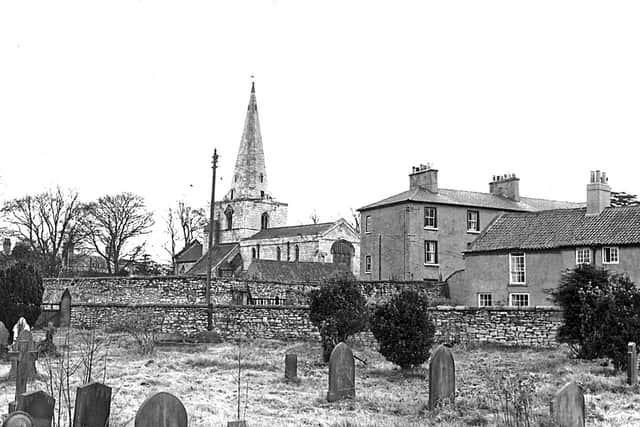
Womersley’s St Martin’s Church of white magnesian limestone is cruciform in design and according to Pevsner (1959) ‘has a beautiful strong broach spire on the crossing tower’.
But he argues ‘the evidence for a Norman church here is no more than the w respond of the N arcade’.
Significant alterations were carried out in 14th century.
An account from January 19, 1894 said that the church of St Martin had just been renovated internally at a cost of over £5,000 by the Countess of Rosse (Frances Cassandra Harvey Hawk, wife of the 4th Earl of Rosse), who had also erected two new vestries for choir and clergy.
Beautiful candelabra had been introduced on the communion table, and new Florentine lamps in the chancel, and a reredos of alabaster erected in the Lady chapel.
With the object of clearing an additional item of £300 for repairing the spire and providing heating apparatus, a bazaar was held in Womersley Park.
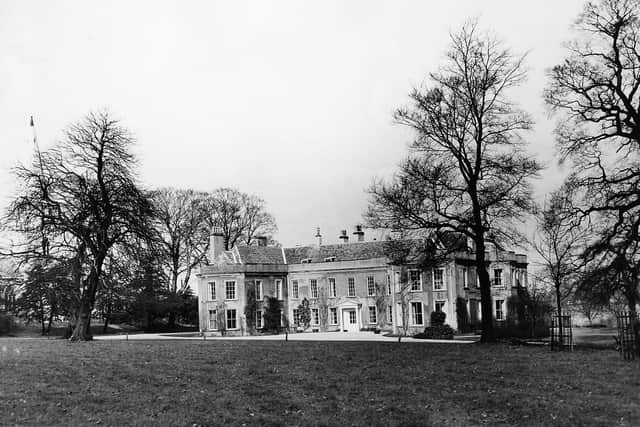
Country Life journalist Penny Church wrote on June 11, 2025 that once part of the 4,688-acre Womersley Park estate, the Hall dates from 1680.
This was when Tobiah Harvey, a London barrister, purchased the manor and began to build the house that would become the centre of a grand family estate.
She continued: ‘In the 18th century, three generations of Harveys significantly shaped Womersley Hall and its parkland. In the 1760s, Tobiah’s grandson, Stanhope Harvey, added a southern wing…’
Nikolaus Pevsner (1959) mentions mullioned windows are evident in the basement. He praises the late 18th century interior especially the drawing room with plaster ceiling.
Whilst compiling the book he was made aware by the Countess of Rosse that the staircase dates from the early 19th century.
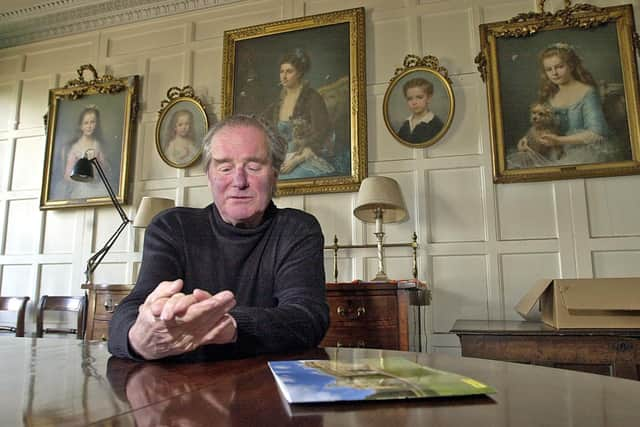
The last member of the Rosse family to reside at Womersley hall was Martin Parsons, the youngest son of the 6th Earl and his wife Anne.
The yorkshiregardentrust website says that in 1976, he and his family moved to Womersley, where his grandmother (Countess de Vesci), still lived up to the ripe old age of 101.
Martin Parsons was described as a flamboyant larger-than-life character.
Along with his wife, he established Womersley Foods in 1979, when they first began to create their famous range of fruit and herb vinegars and jellies.
He sold Womersley Hall in 2004 and died aged 71 in July 2010. At his funeral at St Martin’s Church Womersley, his family requested a splash of colour in keeping with Martin.
Thanks to Professor Dr Paul Buckland for help with this piece.