
Worsbrough Mill: The historic Yorkshire flour mill turning 400 years old this year
When the sunlight drifts on sifts of flour at a working mill near Barnsley, it can be easy to imagine that little has changed over 400 years.

There's the rush of water and a turn of the wheel against the crush of grain from an old millstone, then the creak and groan of the machine.
This year, to mark Worsbrough Mill’s 400th anniversary, there is a flurry of celebrations to honour its rich past.
The building is a place where time can stand still, say millers who work there. Now new ways are being introduced to engage with the mill’s history as volunteers bring old stories to life.
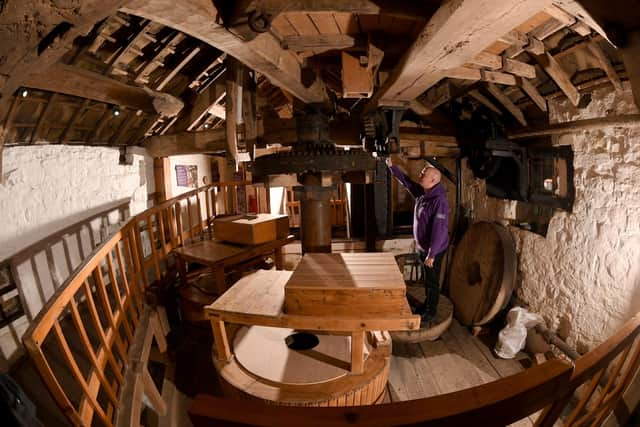

Charlotte Addams, assistant miller, said: “Once there would have been a mill in every village across the country. That history is part of us, part of our future. It’s so important to keep these amazing working buildings alive, doing what they were built to do.”
Not much is known about the earliest days of the mill, although the Worsbrough area is known to have one recorded nearly 1,000 years ago at the time of the Domesday Book.
What is known is that the oldest parts of the building date back 400 years to 1625, when the mill might have been used for nearby estates but certainly by villagers bringing their grain.
With the original beams remaining and with a large ‘T’ shaped key to unlock the old penstock as a control of the water's flow, Ms Addams says you can “feel the history”.
“If you look deeper, you can feel the old timber lines from different times in its history,” she said.
“It does set the imagination running, about what it was like in the 17th century.”
The mill was modernised in the early 1820s, and in 1972 it was taken on by the council as a working museum. It is now owned and operated by Barnsley Council, with its own cafe and many acres of parkland and walks surrounding it.
At present, the mill cannot operate as an upright shaft has skewed, which could damage its fabric.
But some £40,000 has been raised in donations and from Barnsley Council with the Museums and Heritage Trust, and with specialists due to replace it in the next few weeks.
It is hoped the mill can reopen in time for National Mills Weekend, from May 10. Until then, a series of projects are underway for this 400th anniversary year, with new artist commissions and events. Funding from The National Lottery Heritage Fund has been secured to support engagement and volunteer opportunities.
The team are seeking people's memories of the mill for online projects. A full programme will be released in coming weeks.
Vsitors and guardians hope to see the mill in action once more and with its history and heritage to be preserved for future generations.
Ben Marsh is programme development manager.
When the mill is in movement, he said, it comes “alive” with its own rhythmic pulse.
“Everything we are doing is encouraging people to connect with the mill,” he said. “That's what this year is all about.
“If we don't preserve that heritage we lose the ability for people to do that.”