
'Yorkshire should be so very proud of Amy Johnson' says actress in one-woman show
Actor Jenny Lockyer had never heard of the intrepid Amy Johnson until a chance discovery and she was so inspired by her that Jenny is now doing a one-woman tribute show. Phil Penfold reports.

It was an intriguing black and white post-card-sized portrait of a young woman.
“I was in the National Portrait Gallery in London,” remembers actor Jenny Lockyer, “and I wondered who on earth it could be. I was very interested in Art Deco and the time, and this lady just stood out – was it a hat she was wearing, or something else?”
It turned out to a flying helmet. And the person? The flying ace of the thirties, Yorkshire’s intrepid Amy Johnson.
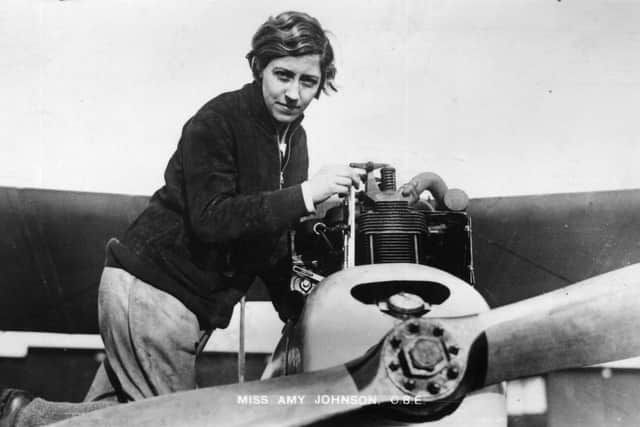

Amy was once the toast of the nation. She had schools, hospital wards, streets, and avenues named after her. There were plaques and trophies galore, civic and national recognition.
She broke world aviation records, but she was also a competitor in what was, back then, very much a man’s occupation.
On her return from her solo flight to Australia in 1930, she was laden with honours, including a CBE from King George V and gold medals from both the Royal Aero Club and the Society of Engineers.
In 1931 the public could buy a copy of a biography of Amy, Lone Girl Flier (by Charles Dixon) and she was instantly one of the most famous females in the world, up there with Garbo, and with film star status.
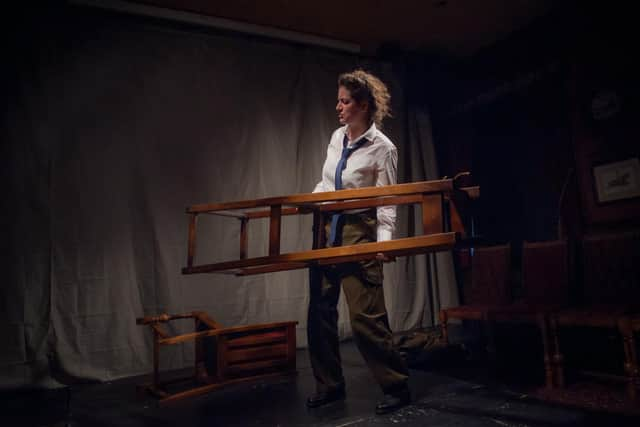
And now, Amy is back, in a new one-woman production devised and performed by Lockyer.
“When I bought that postcard, I hadn’t a clue who she was. But I made it my business to find out – and what I discovered fascinated me. I did a little research, and I thought ‘This is a must – I have to make a show about her’.”
She was born in Hull on July 1, 1903 to a well-off family, bright, but without a definite career in mind.
She left school aged almost 19, and Amy furthered her education by going to Sheffield University, graduating after three years with a BA in Economics.
Bizarrely, with that specialist subject under her belt, she then took a secretarial course, and that led her to a job with a Hull-based firm of accountants. But, with itchy feet, she wanted to put home comforts behind her.
She headed for Hull Paragon station, bought her tickets, and got on the first train to London. It was 1927, and the Depression was on the horizon. Her initial job down south was as a salesgirl in Peter Jones department store, which she detested.
Then, through family friends, she became a secretary in Crocker’s, a respected firm of solicitors.
“More significantly,” says Jenny, “Amy discovered the London Aeroplane Club in Edgware, a small airstrip owned by the prestigious de Havilland plane-makers. Suddenly, she knew her purpose in life was to be, and she threw herself into flying with a passion.
"She wrote to her father in Hull: ‘Dad, I’ve found what I really want to do!’ Amy paid for every lesson out of her own pocket."
In July, 1928, she was awarded her pilot’s licence, one of the very first women to have achieved the vital document.
She wrote to her parents, telling them that she had a belief in the future of global aeronautics, and then she handed in her notice to the solicitor’s firm.
Joining the ground team at Stag Lane to work as a mechanic, and by the December of the same year, she had achieved her Ground Engineer’s Licence, granted by the Air Ministry.
She was the first female in the world to be given this coveted qualification. Amy was now a fully-fledged “aviatrix”, a new word coined for female fliers.
In the May of 1930, she set off on her epic flight from Croydon Aerodrome (then the principal UK’s main airport) flying her aircraft, which she called ‘Jason’.
“He’s now a character in the play, and also an exhibit in the de Havilland Museum, hanging above all the visitors”, says Jenny, 43, “there, he looks wonderful – but then you start thinking ‘How on earth did this flimsy machine, held together with not much more than cables and balsa wood, achieve all her arduous journeys?
"After all, her first destination was to be Darwin, in Northern Australia, and after remarkable trip, she landed on May 24. Just incredible!”
The welcoming crowds were ecstatic, and Australia marked Amy’s success by awarding her their own pilot’s licence – she was the first woman in that country to get one. That record down, she started thinking about other flights and routes to explore.
Finally back home she found more cheering crowds where-ever she went, something she found uncomfortable – she was far happier in a plane than she was in the glare of the spotlight.
So off she went with a co-pilot Jack Humphreys (this time in a Puss Moth called Jason II), to see if they could get to Moscow in a day. They could – and did. It took just 21 hours to cover the distance. Another first. They flew on, over Siberia, to Tokyo, setting even more records.
“Amy mania” thrilled the nation. Then in 1932, she met and married a fellow pilot, Jim Mollison. It was a whirlwind romance – he proposed while they were both flying, only eight hours after they had been introduced.
Amy’s next record-breaking solo flight was to Cape Town. In fact, she shattered the standing record, which had been set earlier by her new husband.
She and Jim then flew off together from Pendine Sands in South Wales, in an attempt to make an Atlantic crossing in a de Havilland Dragon. After a near-fatal crash-landing in the States, the Mollisons were given a triumphant ticker-tape parade down Wall Street.
Amy and Jim then returned to London, and planned their next flight, to India. Another record time smashed. That was 1934.
In 1936, Amy made another solo flight to South Africa, and more records tumbled. Sadly, there were stresses in the marriage, and the pair divorced in 1938, and she reverted to her maiden name.
With the outbreak of war. Amy applied for combat duties. To her fury, the RAF turned her down flat, so she joined the Air Transport Auxiliary, who used many talented female pilots to fly planes to bases all over Britain, wherever they were required.
Amy was made a First Officer, and went on mission after mission. Tragically, her phenomenal luck ran out on January 5, 1941. She was flying an Airspeed Oxford from Blackpool to RAF Kiddlington (near Oxford), and the compass was playing up.
Then the winter conditions deteriorated so badly that she went way off course, and (it is assumed) ran out of fuel over the Thames estuary.
The plane went into the freezing water just off Herne Bay in Kent but her body was never recovered. It was, and is, an unsolved mystery, although, many years later, some bones were discovered, and taken into care by the Ministry of Defence.
That was the last that anyone has seen of them. There never was a proper funeral, and an inquest only offered the terse verdict: “Missing, presumed drowned ”. Amy was only 37.
“What could she have achieved?” says Jenny. “Just about anything that she could set her mind to. She might well have become a fighter pilot. She was indomitable. She was fascinated by the growth in rocket technology.
"She knew that the space race was going to be a huge part of a post war world. And Amy would have been at the forefront. She had confidence in what she did, she was focused, and superbly skilled. Yorkshire should be so very proud of Amy Johnson”.
Amy Johnson: Last flight out. The Ropewalk, Barton upon Humber, February 13. Doncaster Little Theatre, February 14. Helmsley Arts Centre, February 22. The Lantern, Sheffield, February 27. Guiseley Theatre, February 28.
www.flyinghightour.co.uk
www.lastflightout.co.uk