
Conisbrough Castle: Yorkshire's proud castle that has risen from the ruins
History has come alive at Conisbrough Castle.
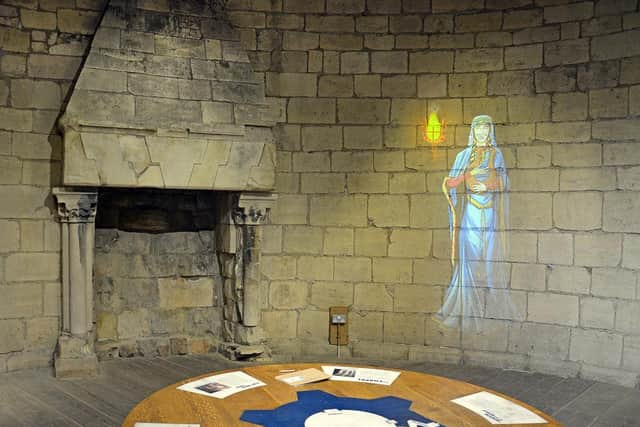
Via audio visual aids, figures in period costume are projected on to walls and give details of events from the building’s history and how it once functioned. This is of great help for children and adults alike to fire their imagination.
In the 11th century a motte and bailey castle was the centre of a great lordship. It was given by William the Conqueror to one of his most trusted followers, William de Warenne. During the mid-12th century, the castle was inherited by William’s great-great granddaughter, Isabel de Warenne.
She married Hamelin of Anjou, Henry II’s illegitimate half-brother and it was likely that Hamelin – now de Warenne – built the great tower in the 1170s or 1180s. This was a statement of his power and royal connections. The rubble stone curtain wall was built in about 1200, cutting into the earthen banks.

According to Sharon Bennett Connolly in Defenders of the Norman Crown (2021): ‘Henry II and King John are both known to have visited Conisbrough during Hamelin’s tenure…’
The English Heritage Conisbrough Castle guidebook states that the architectural details in the great tower closely resemble features at York Minster.
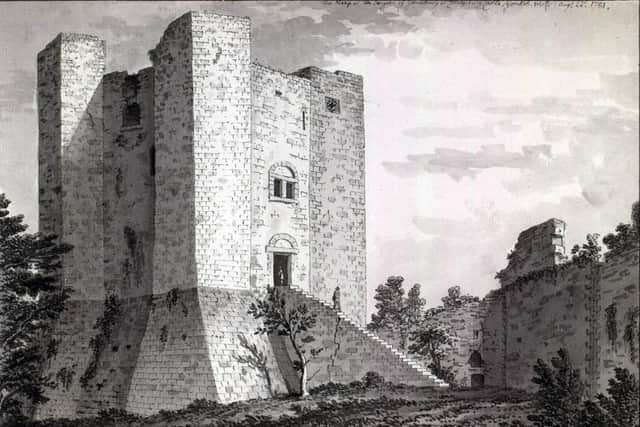
The publication adds that in the 12th century, English great towers were typically square or rectangular in plan, with an external staircase sometimes encased in a forebuilding. Conisbrough’s tower has a circular core with wedge-shaped buttresses.
It was entered via an exposed external staircase. Hamelin de Warenne was the only English baron to adopt this new style, building circular towers at Conisbrough, Thorne in South Yorkshire, and at his Normandy estate of Mortemer.
Conisbrough Castle remained in the hands of the de Warenne, Earls of Surrey, until the death of John, the last earl in 1347. Then it passed to King Edward II’s son, Edmund of Langley, and his descendants of the House of York.
The castle became Crown property in the late 15th century. The last recorded repairs to the structure were carried out in 1482-3 under Richard III. Thereafter, it appears to have been virtually abandoned.
Through grants and sales, the castle fell into the hands of a number of individuals. In 1559, Elizabeth I (r.1558-1603) granted the castle and manor of Conisbrough to her cousin Henry Carey, Lord Hunsdon.
The castle was not touched in the Civil War and Commonwealth period, doubtless because it was already an indefensible ruin. In 1737, the manor of Conisbrough was sold to Thomas Osborne, 4th Duke of Leeds.
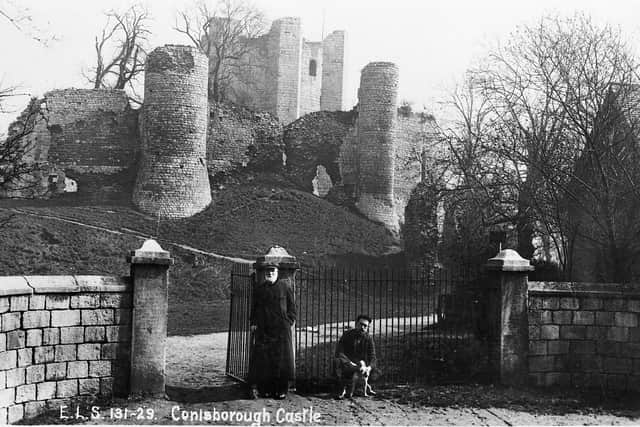
One of the earliest views of the castle in ruins was seen in Samuel Buck’s engraving of 1725. It is depicted in almost exactly the same state as it is today.
Later, English watercolour artists found the castle a good subject to depict. Amongst these were Peter De Wint (1784-1849) and Samuel Hieronymus Grimm (1733-1794).
Sir Walter Scott gave much publicity to Conisbrough Castle (but calling it Coningburgh) in his novel, Ivanhoe (1819). In 1811, he wrote to a friend: ‘Do you know anything of a striking, ancient castle belonging I think to the Duke of Leeds, called Coningburgh Castle? I once flew past it in the mail coach, when its round tower and flying buttresses had a most romantic effect in the morning dawn.’
The opening of a railway line through Conisbrough in 1849 started to bring many visitors to the ruined castle. One example was a missionary gathering on June 5, 1856.
A report said that considerable preparations had been made for the occasion. Two large tents were erected in the castle grounds and were decorated with evergreens and flags.
A flag also floated from the top of the castle. The weather on the day was good and no less than 400 went by special train from Sheffield.
The total number present during the afternoon and evening was estimated at nearly 5,000. The meeting was held in the castle yard where a platform had been erected. It was addressed by Rev. Punshon and other ministers.
From 1859, the castle was owned by Sackville Lane Fox and in time the grounds became an important park.
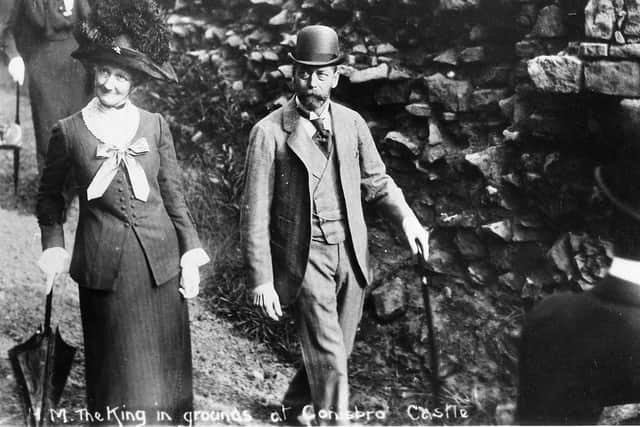
King George visited Conisbrough Castle on Monday July 8, 1912. It was estimated that some 10,000 people lined the slopes of the castle grounds to welcome the arrival of the King and Queen Mary.
Vendors of souvenirs in the shape of portraits of the Royal couple and ‘gold sovereign medals’ enjoyed a brisk trade. Inside the castle gates were about 3,600 children of the Conisbrough and Denaby schools and the Denaby Main troop of Scouts.
There was a staff of around 40 West Riding policemen on duty. At the castle gates, W. Lowry Cole, agent to the Countess of Yarborough, owner of Conisbrough castle, was presented by Earl Fitzwilliam to the King and Queen, and acted as host on behalf of the absent countess.
The King spent some time examining the remarkable ovens and fireplaces at the top of the tower. He also stood for a few moments enjoying the magnificent view. After walking round the top of the castle, the King descended and took tea with the Queen and others in a Royal pavilion.
This had been sent from Wentworth Woodhouse with a small party of butlers and footmen, and tea was served at five tables.
During 1946, the 5th Earl of Yarborough sold the Castle to Conisbrough Urban District Council for £25. Five years later, it was taken into guardianship by the Ministry of Works.
A report from October 13, 1956 said that repair work on the castle walls had been going on for the past eight years and was nearing completion. Involved with the work was a three-man party which included two masons and a labourer.
Between 1967-1969, the Ministry undertook major archaeological investigations. During the 1970s, a stone staircase to the great tower was replaced by concrete steps, much to the indignation of locals and conservationists.
A management partnership was formed in the 1990s between English Heritage, who took control in 1984, Doncaster Council and a local charitable trust. This resulted in the great tower being re-roofed and floored in 1993-5, while a new exhibition centre was erected.
But, the design of the latter courted controversy, some arguing that it clashed against the backdrop of the historic castle.
In 2007, the castle reverted to management by English Heritage. On heritage.org.uk, a report states that following a £1.1m renovation project funded by the Heritage Lottery Fund, English Heritage and Doncaster Council, Conisbrough Castle, re-opened its doors to the public on May 10, 2014.
This was with a brand new visitor centre, state of the art interpretation and enhanced education facilities.
The old controversial exhibition centre was cleared and the new visitor centre was built on to the existing Victorian lodge. It features a ‘digital dolls house – a 1.5m high model of the great tower with a cutaway section.
This reveals an animated interior, with furniture, fixings, roaring fires and people going about their daily activities. It may be viewed up close and enables visitors to envisage more clearly life in former times at Conisbrough Castle.
The report mentions the display in the great tower tells a story of its own. The walls are brought to life by new digital characters as they prepare for a Royal visit from Henry II himself.
It adds: ‘Members of the South Yorkshire community were used to inspire the faces of seven character in the information panels around the site and the ‘talking walls’ AV in the [great tower]. They include ladies’ maid Alice, based on local schoolgirl, Chloe Hanley, to Hamelin himself, Earl of Surrey, with the face of Mitch Norton.’
During the season, stretching from April 1, 2023 to March 31, 2024, there were 31,461 visitors to Conisbrough Castle.
Thanks to Kate Maughan-Brown at English Heritage and Sharon Bennett Connolly for their help with this piece.