
Doncaster Market Place: How Yorkshire market place has been the place to be since Roman times
Whilst new shopping malls, precincts and parks have sprung up around Doncaster over the last 60 years, the Market Place continues to thrive and be a popular place to shop.
It’s difficult to imagine that the area was formerly dominated by the Church of St Mary Magdalen. This latter was built around 1130 and is thought to have been the original parish church.
Another, consideration is that the market developed around the church, but William Sheardown writing in 1872 stated: ‘There cannot be much doubt that the Romans set apart the area of the present Corn Exchange [on the south-eastern side] for the use of a market; for, as it has been observed “the institution of fairs and markets followed wherever the Roman conquests extended”.’
St Mary Magdalen’s Church was superseded by St George’s Church, built around 1190-1200. The former subsequently declined in importance, becoming a chapel, and then a chantry.


Gradually, a series of lanes extended from St Mary Magdalen’s including Ratten Row, Meal Lane, Roper Row and Boot-and-Shoe Lane.
By the mid-16th century, St Mary Magdalen’s, with its cemetery, was owned by the Doncaster Corporation. From around 1561, part of the building was used as a school and a little later, the market extended over the cemetery.
Then, from the increase of the market, more room was required than the old area would accommodate. Thus, in 1575, the burial ground of the chapel of St Mary Magdalen was set apart for the purpose. Three years after this event, the main body of the church (the nave) became part of a Town Hall.
The various areas of the Market Place gradually acquired names, as mentioned by Eric Braim in his article The Market Place Conservation Area from the Doncaster Civic Trust Newsletter (1986). The Fish Shambles, at the Magdalen Church yard area, were mentioned as early as 1582.
The area from the corner of Baxter Gate to Scot Lane was sometimes referred to as the Fish Shambles. But, it was commonly known as Goose Hill, first recorded in 1614.
Although the area around the church was used for a market, it continued to be known as the Magdalen Churchyard until the 1730s when it became the Magdalens.
The northern part of the market remained largely unbuilt upon. It was known as the Corn Market, the Far Market or just the Market Place.
Adjoining the northern tip of the market area was the Parson’s Garth or Parsonage Yard. New Street, which ran from Sunny Bar to the Red Lion public house, was in existence by 1673.

In line with town centre improvements, carried out by Doncaster Corporation, throughout the latter half of the 18th century, a new Butter Cross and Shambles were erected in the Market Place during 1756. The work was undertaken by Rotherham architect-mason John Platt.
The Buttercross was octagonal and carried the market bell. The butchers’ stalls were accommodated in the Shambles. In 1776 another feature was added in the vicinity, when a theatre was built in New Street to the designs of local architect, William Lindley – a pupil of the renowned architect John Carr.
Before it was built, a number of properties were cleared at the south end of New Street. The theatre was leased by the Corporation to various managers, the first of these being Tate Wilkinson, a well-known contemporary actor and entrepreneur.
Under his management, which lasted until c. 1804, the theatre enjoyed immense popularity and became a fashionable place to attend. Another event which took place three years later was noted by Sheardown (1872): ‘The new or round shambles were built around 1778 by Mr Wm Heaton.’

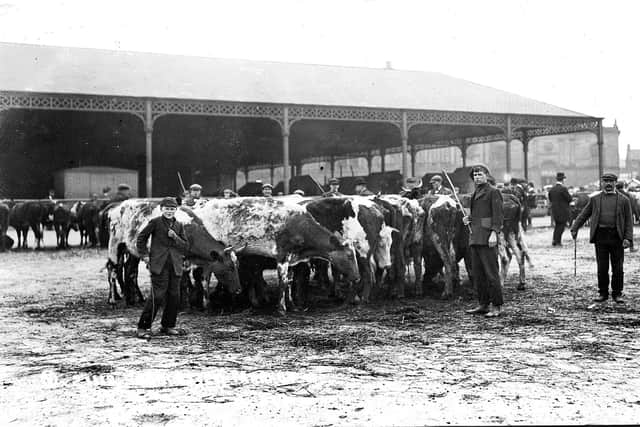
The Courtiers of the Corporation for October 25, 1781 recorded the appointment of a committee to view the ground on the east side of the parsonage yard and prepare the same for the sale of cattle.’ Consequently, this was the beginning of the town’s cattle market.
William Lindley carried out further work for the Corporation in 1784 when he made improvements to the Town Hall. By the turn of the century there were quite a number of inns and taverns in the Market Place. Amongst these were the Blackamoor’s Head, Black Lion, Black Swan, Cross Keys, Dolphin, Wellington and Woolpack.
The 19th century brought additions to the Market Place. The first of these included a covered corn market, which was erected in 1844, on the Market’s eastern side, to the designs of Corporation Steward, John Butterfield.
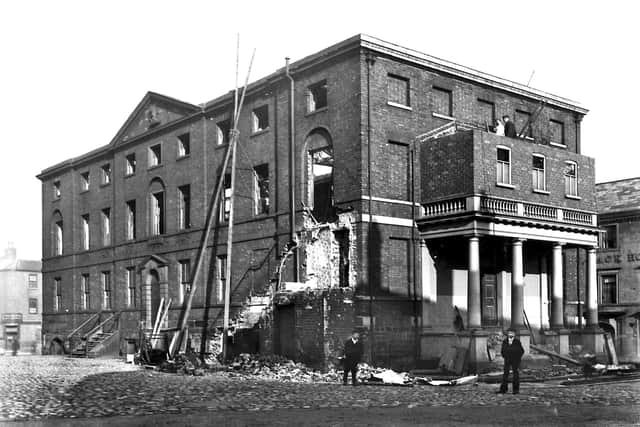
Two years later, Butterfield was instructed to prepare plans for a new Market Hall and Town Hall. To facilitate the Market Hall’s construction several properties were cleared including the Butter Cross and both of the Butchers’ Shambles.
The foundation stone for the Market Hall was laid in 1847 by Sir William Bryan Cooke of Wheatley Hall.
The existing Town Hall was taken down, but a new one was not built on the same spot. Instead, it was constructed in French Gate. During the course of the Town Hall’s demolition, the remains of the ancient St Mary Magdalen’s Church were discovered and public interest was aroused.
Further work was entrusted to Butterfield in 1862 when he was asked to prepare plans for a covered Wool Market. This was built on the Market’s south eastern section. Seven years later the cattle market was extended westwards to High Fishergate.
Between 1871 and 1873, the market traders’ pleas for additional covered space were answered when, respectively, a south wing and a Corn Exchange were added to the Market Hall. The buildings were designed by William Watkins of Lincoln and constructed by local builder John Athron.
Although primarily designed as a Corn Exchange, the structure was also intended for use as a concert hall, and for festive meetings and large public assemblies. The foundation stone was laid by the Mayor, A.J. Smith on September 22, 1870.
To facilitate the construction of the Corn Exchange the Plough and Lord Nelson public houses were demolished. The external elevation of the Corn Exchange is in the Classical style. There is a sculptured subject over the arch of the principal entrance.
Alterations taking place in the Market before the turn of the century included the removal of the Corn Market structure, the building of an additional slaughterhouse, a ‘dead meat’ store, and the laying out of more beast pens.
Also, the names of the various areas like Goose Hill and New Street were dropped in favour of a collective one – Market Place.
During the 1900, the old theatre was demolished and the site redeveloped. The road leading from Sunny Bar into the Market Place was widened, and a slightly raised and enclosed area abutting on to the Market Hall, was built.
This new area was intended for use of market areas and below were Gentlemen’s lavatories, a weighing room and three cold storage rooms.
The Cattle Market was extended in 1908, but the most significant, if not controversial, pre-Second World War alteration occurred in 1930. This was when the space in front of the Market Hall was covered. Alderman Morris, chairman of the Markets Committee was at the opening ceremony.
He said that the improvement had been essential for many years in spite of very narrow-minded opposition of the shopkeepers on the opposite side of the road. He added: ‘We who know something about markets, know that a good market square means good business for the shops in that particular district.’
In the post-War years there were plans to redevelop the market and demolish some of its fine structures, but fortunately these were never carried out. However, around 1960, the Cattle Market was transferred to Dockin Hill.
About 1973, the Market Place was declared a conservation area and in recent times much refurbishment has taken place in the overall market area.