
BYD: The Chinese firm which now sells more electric cars in the UK than Tesla
China’s BYD leads the way in electric vehicle sales in the UK but Frederic Manby got behind the wheel of its latest model, the hybrid BYD Sealion 5 DM-i, and found it ultra refined… well, almost.
In July 2023 I was introduced to BYD cars from China at low budget meeting near Bolton.
The car was the electric Atto 3, as quirky as its name but heralding the arrival in Britain of what today is the best-selling electric vehicle brand.
With sales of 2.3 million EVs it outsold Tesla last year. Four of its cars were in the shortlist for Car of the Year. It sold 51,000 cars here last year, placing it sixth overall.

BYD started as a phone battery maker in the 1990s.
By 2008 it had produced the first mainstream PHEV. Its expansive portfolio now includes electric buses and 2,800 are operating in cities from London to Edinburgh.
This year it will start building cars in Hungary and its rapid chargers, capable of adding 250 miles in five minutes, come to UK locations.
Want exciting? Its 306mph Yangwang U9 Xtreme with 3,000 horse power is said to be the fastest road-going car.
It holds the EV record time of a split second under seven minutes round Germany’s 12.94 mile Nurburgring.
A 1,160hp Porsche Le Mans prototype holds the outright record of five minutes and nineteen seconds.
Excuse me. Back to BYD. It spells Build Your Dreams. Media launches have gone from that Pennine country inn to vast bun fights for hundreds of old and new media at lavishly curated conference halls.
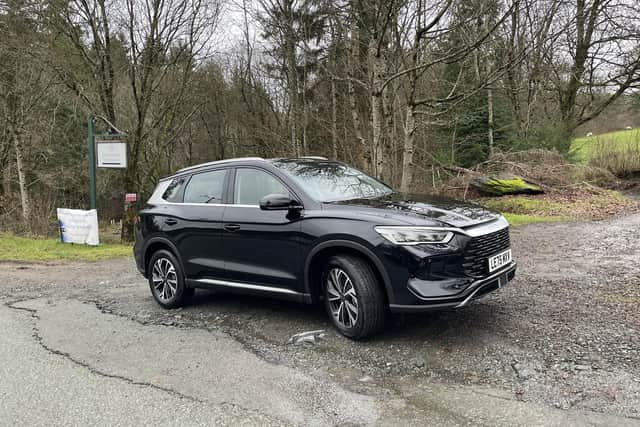
Last month we were in Shropshire to drive its ninth UK model, a smaller family focussed SUV, the front-wheel-drive Sealion 5 DM-i.
These Dual Motor Intelligent models are self-charging plug-in hybrids where, in the Sealion 5, a bespoke 96hp 1.5 litre petrol engine charges the batteries which drive the front wheels. Total output is 209bhp.
Direct petrol drive to the wheels is only during maximum acceleration. The result is an optimum tank-full range of 630 miles with a potential emission-less 53 electric miles from the Design version with a larger battery.
The rest of the time it uses the petrol-boosted batteries.
Need I say it is ultra refined? Nearly; at times there was road vibration through the fat Hankook tyres.
Mostly it feels like a fully electric car. We slipped quietly into Wales to Lake Vwrnwy. The 108-mile, three-hour route was almost all on de-restricted roads with lots of “fast” sections.
The starkly black SUV still averaged 73 miles a gallon, even with foot-down sessions to experience its claimed 7.7 seconds for 0-62mph.
It felt slower, even lazy, possibly because there is no turbo boost rush for snappy overtaking.
BYD makes its own batteries. The matrix of cobalt-free battery cells is in the floor.
Prices are less than you’ll often pay for an equivalent petrol car, thanks to the cheaper Chinese labour and in-house components and low tariffs.
That means £29,995 for the Comfort version which has almost all you expect and £32,995 for the Design. Price-matching Chinese PHEV rivals are the Chery Tiggo 7 and Geely Starray.
BYD says nine out of ten of its UK customers use PCP and the monthly fees start at £299 for the Comfort and £319 for the Design.
So the Design looks an affordable uplift. It has a larger battery for longer EV range, powered tailgate, heated seats, phone charging pad, 360 view camera, lights-on welcome and front parking sensors, a penny pinching omission on the Comfort.
Neither has a heated steering wheel!
Both have vegan leather seats, plenty of conventional switches in addition to touch pads on the central screen. The background is pale grey which doesn’t give enough contrast.
Ditto, on the smaller screen behind the steering wheel where the digital speed is small and the speed limit roundel much too small to read quickly if you are wearing long distance glasses.
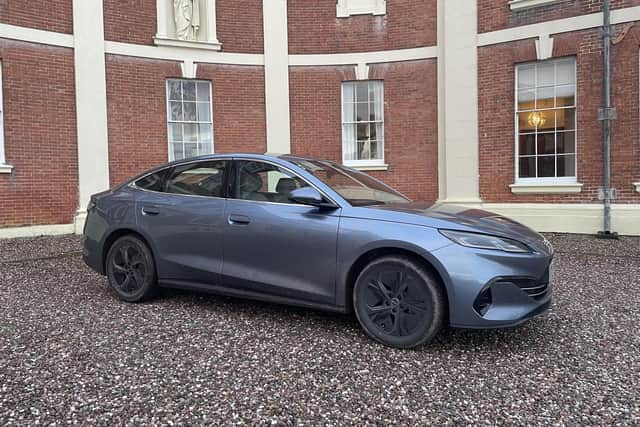
I drove down to Shropshire in one of its other newcomers, the SEAL 6 DM-i saloon with the plug-in hybrid petrol/electric power.This model has a potential range “up to” 935 miles.
Prices start at £33,990 for the saloon and another £1,000 for the more practical Touring estate, both in Boost specification. Add £3,000 for the Comfort version.
This has the same upgrades as the Sealion 5 Design, plus a glass roof and audio upgrade. It has a bigger long range battery and more power. The familiar PCP rental makes them affordable for the typical family.
These are medium-sized, front wheel drive cars, at 190 inches, long enough to look sleek. (The chunky Sealion 5 is just three inches shorter.)
They are mostly easy to drive, with a push button starter, gear shifting on a column stalk, quick enough and quiet were it not for unwanted tyre roar from sturdy Michelins on coarse surfaces.
The screen displays are in the same wan BYD-grey grisaille, with touch points which are too small to use without distraction in traffic and fewer conventional switches but like the Sealion 5, there are back-ups on the steering wheel and very obliging Hi BYD which can manage most spoken commands.
On paper, it is slower than the Sealion 5. On the road it felt quicker and lovely.
BYD Sealion 5 DM-i.From £29,995. Engine: 1.5 petrol-battery. 209bhp and 221 lb ft. One speed automatic. 0-62mph: 7.7 seconds. Rated at 105 mpg (74mpg in testing). Tank13.7 gallons (52 litres). CO 2 emissions: 62g/km. Braked towing limit: 750kg. More: BYD.com