
CUPRA Terramar: 'I drove the CUPRA e-Hybrid which comes with a one-off treat'
The Terramar is CUPRA’s roomy SUV. Frederic Manby got behind the wheel of the V2 1.5 e-Hybrid version and found that there was plenty to be pleased about, inside and out.
CUPRA, a car name derived from Cup Racing, is the performance child of Spain’s national brand, SEAT. It became autonomous in 2018.
Last year it outsold SEAT, which was marking its 75th anniversary. Both are part of Volkswagen.
Next week Cupra marks its eighth birthday by revealing the Raval, a small electric hatchback named after an arty but edgy area in Barcelona.
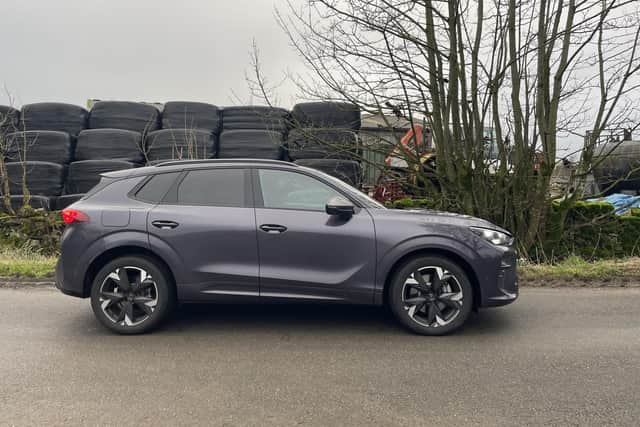

Heavy TV advertising has kept Cupra in our sights. Dramatic body styling, smart interiors and de-badged tailgates and moody colours add to the allure of these sporty cars.
Terramar is a highly wrought but roomy SUV for the family, an alternative to so many faux SUVs, including the more conservatively designed VW Tiguan and Skoda Kodiaq from the Volkswagen Group which share parts, and a deluge of cheapies from China.
While the Terramar is named after a beach and banked race circuit south of Barcelona, it is made at an Audi factory in Hungary.
The chassis is front-wheel drive but the most powerful and priciest versions offer all-wheel-drive. Trim levels are V1, V2, VZ1 and VZ3 with Tribe Edition in the middle.
A starting price is £37,995 for the V1 with a 148bhp 1.5 mild hybrid petrol engine on sensible 18 inch wheels and with all you need is the one I’d choose.
Except the V2 trim from £40,590 will not seem out of reach when, like most, you are buying on a PCP deal. It’s all on the web site.
To save you a few clicks, the AWD VZ2 a 268bhp 1.5 PHEV motor costs £50,555 or £51,000 with a 261bhp 2-litre turbo (lighter but without the PHEV’s company six per cent business tax carrot).
You can save nearly £3,000 by having them with front-wheel-drive. However, 4WD would be useful if you drive with Spanish passion or live in a snowy region. All have automatic gears.
We were sent the front-drive V2 with the weaker PHEV tune, still a hefty 201bhp and enough energy at full bore to bounce the front wheels briefly in first and second gear.
The V2 is on 19 inch wheels with 255/45 tyres. They buzzed on the first drive but this sensation faded in later days.
The PHEV battery pack adds about a quarter of a ton and there has to be an affect on handling and, I noted, on braking from speed where we noticed the extra pedal pressure needed.
In most respects the Terramar is comfortable and refined but some road faults expose the firm suspension.
The battery pack location shifts the petrol tank to under the boot floor, taking up luggage space but it is still decent and has a maximum length of almost five feet when the sliding back seats (in a 2-1-2 layout) are folded flat.
It has an electric range of around 60 miles when the lithium-ion drive battery is fully charged. Empty to full takes 150 minutes on an 11kw home hub or 26 minutes from 10 to 80 percent on a 50kw hub.
My economy peaked at 300mpg for 50 miles until the battery ran out of fizz. It then morphed into a self-charging hybrid with mpg ranging from 30 in short runs to 45 on a motorway trip into a busy city centre.
I don’t know what you think of the exterior. The studio went to town with vivid triangular light pods and an expanse of vents and ducts and vanes at both ends. The flanks are surprisingly demure.
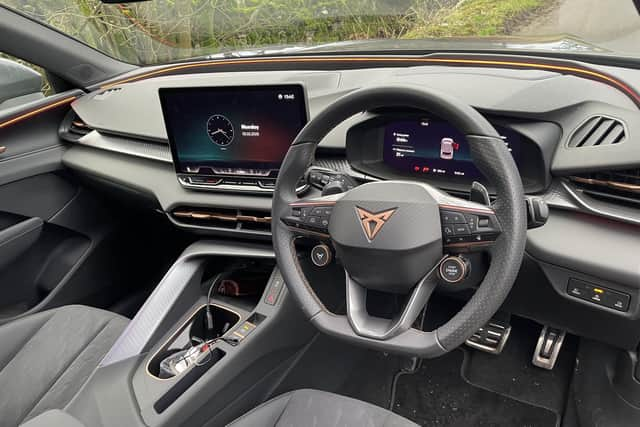
The adventure continues inside with plenty of copper coloured detailing across the fascia ventilation tabs, door releases and panels. The very sportif bucket front seats have copper stitching too.
The material is Dinamica, 73 per cent recycled and smart in fabric and vegan leather.
Rear passenger have plenty of room. The sculpted backs help knee room at the expense of map pouches but there are door pockets and useful side pockets and space in the centre arm rest: so it’s a nice place to travel.
From the driver’s seat the engine fires with a button on the steering wheel. Direction of travel is chosen by twisting a lever behind the wheel, with paddle shifters is you want to select a gear.
The graphics on the central screen are clear. I would like more physical buttons (viz, to control the cabin temperature and fan speed) but these and other functions can be set by voice control.
The V2 has a configurable dashboard (moving things like the map to the instrument binnacle). Some seaside vision is blocked by the large mirror casing pod and the rear view is squeezed.
The lateral interior light band brightens the cabin on a dull day and after dark pinpoints of light shine through the door trim.
A one-off treat which no other driver will see came when the car odometer passed 3,361.6 miles with a screen message and circuit graphic saying it matched the record 397 laps achieved by the winning Audi at the Le Mans 24 Hour race in 2010.
The Chinese have the race in mind. By the turn of the decade Chery’s EXEED may be the first Chinese brand to contest Le Mans. I wouldn’t bet against them.
CUPRA Terramar V2 1.5 e-Hybrid: From £48,190 with £995 dark void paint; Engine 1.5 petrol/battery PHEV; 201bhp and 184 lb ft; Transmission 6 speed automatic; 0-62mph 8.3 seconds; Economy 565 to 706 mpg (35 to 300mpg in testing); 11 gallons (45 litres) tank; CO 2 emissions 10g/km; Braked towing limit up to 2,000 kg; Length 178 inches; More information available at cupra.co.uk